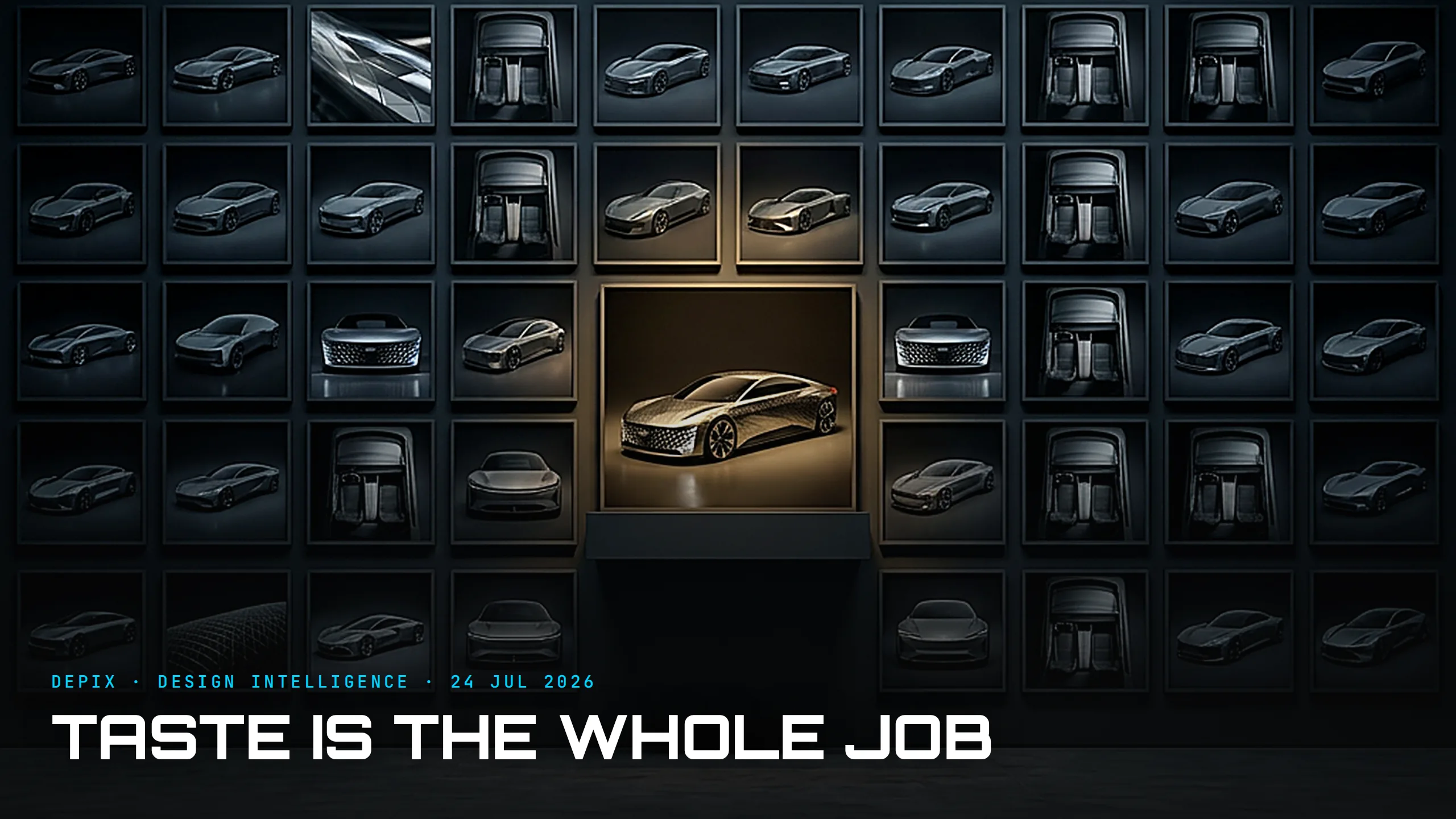
The Clay Model Refuses to Die
Every few years the automotive clay model is pronounced dead. CAD was going to kill it. Then real-time rendering. Now VR headsets. Each time, the logic is the same: why hand-sculpt a two-tonne block of industrial plasticine when you can spin a flawless model on a screen in seconds? And each time, the clay quietly survives. In 2026 the biggest studios still run full-size clay alongside their digital pipelines - Ford and Pininfarina among them - not out of nostalgia, but because the screen still cannot judge the one thing that matters most.
That thing is a highlight. A clay model finished to a mirror gloss sits in the real studio, under real light, and shows a designer exactly how a reflection travels along a flank as they walk past it - how a shadow breaks across a wheel arch, how the car actually occupies space. As one veteran modeler puts it, a monitor gives you a 2D image presented in 3D space; at some point the form has to be seen and touched as a real object. A surface that looks resolved on a screen can look awkward the moment it exists, because the eye processes real reflections and aspect ratios in a way no display reproduces. Clay is where proportion gets literally smoothed into place.
None of this means digital lost. It means the industry did something more interesting than replace one tool with another: it re-sequenced them. VR and digital viz collapsed the exploration loop - Honda's teams evaluate each other's models in VR across continents, Hyundai runs VR design reviews to cut time and material, and studios now work 3D from day one. But even the VR evangelists concede the ceiling. One immersive-design firm estimates VR delivers about 80% of the feedback of a physical clay - and the missing 20% is exactly the final surface judgment. The honest read, even from a design magazine asking if VR endangers the craft, is that immersive tools reinforce clay rather than retire it: you still, eventually, render the digital design physical, full size, in the room.
Here is the concept-phase lesson hiding in all of this, and it travels far beyond cars. The medium you validate a surface on determines what surfaces you are able to make. Judge a form on a screen and you will, unconsciously, design for the screen - for the three-quarter hero angle, the studio HDRI, the lighting rig that flatters. Those forms photograph beautifully and then disappoint in a car park, because the car park was never in the loop. Clay puts real, uncontrolled light back into the decision. It is not a slower way to do the same evaluation; it is a different evaluation, and it catches different mistakes.
Which is why the studios that got this right did not frame it as clay-versus-digital at all. They explore in digital, where iteration is nearly free and a hundred variants cost an afternoon - and they decide in clay, where the surface has to survive real light before anyone commits. The tool is never neutral. Each one biases the outcome toward whatever it happens to render well, and pretending otherwise is how a program ends up with a car that only ever looked good on the wall it was signed off against. Modelers have been saying this for a decade, and the tools keep proving them right.
So the clay model is not dying. It is being promoted - out of the crowded, cheap, infinite work of exploration, and into the one job a screen still cannot do: telling you the truth about a surface before you build it. The lesson for anyone designing anything is quieter and more uncomfortable than "keep the clay." It is this: know what your validation tool cannot see, and never make the final call inside its blind spot.
Sources:
- ●Carscoops - Why do car companies still make clay models?
- ●The Autopian - How clay car models really work and why designers still use them
- ●GrabCAD - Why clay continues to be key in car design
- ●Vizcom - Digital car design: how studios use 3D from day one
- ●Carscoops - How Honda uses VR to design new models
- ●Hyundai - How Hyundai uses VR to transform car design
- ●ENGtechnica - VR reshapes automotive design at Avant (approx 80% of clay feedback)
- ●Surface Magazine - With VR in the studio, is automotive design in danger?
- ●Formtrends - Benefits of VR vs clay modeling in automotive
- ●Werigi - Using advanced visualization to leverage clay modeling
- ●Detroit News - Future of auto design still in clay modelers' hands