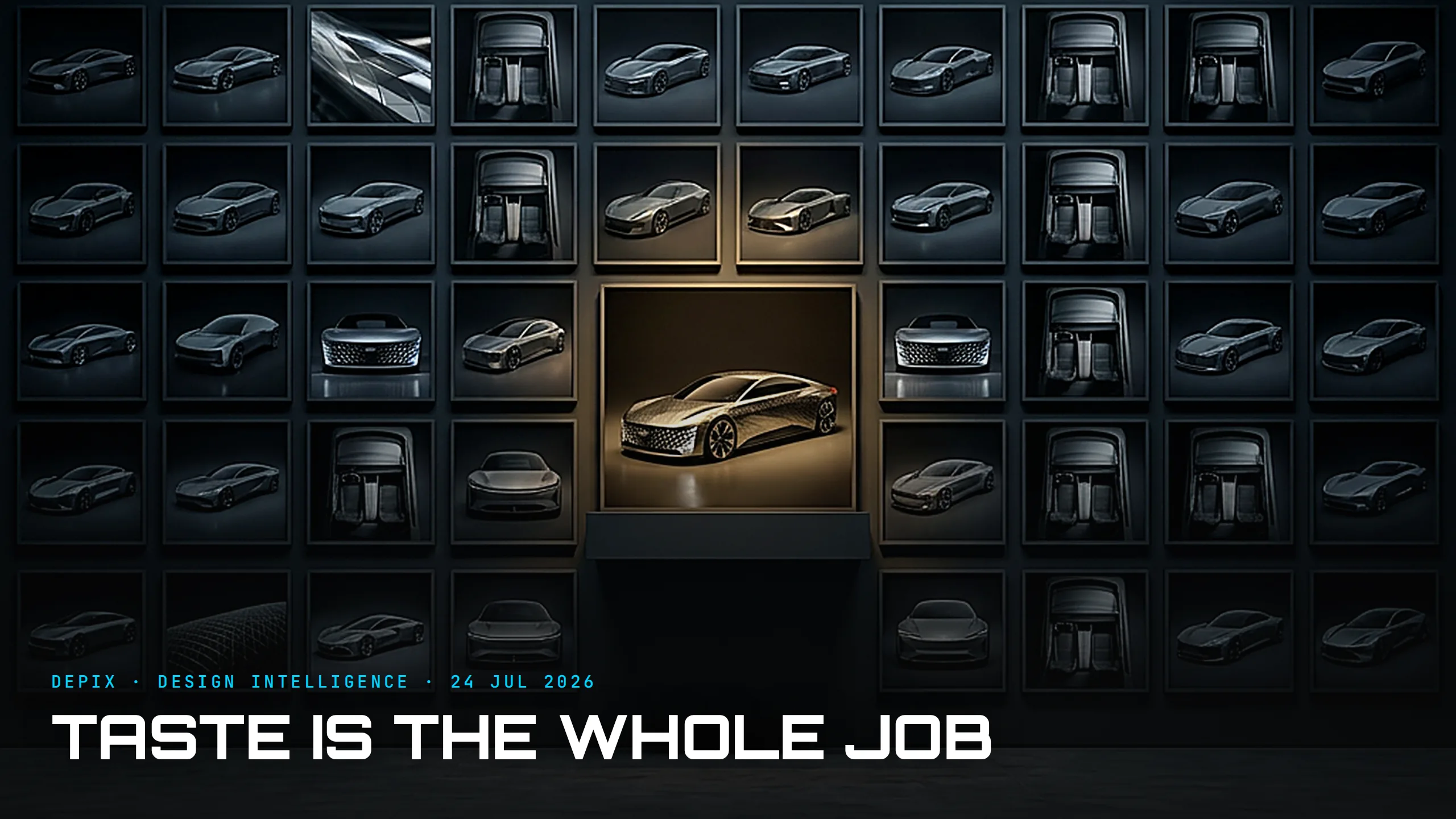
When Generation Is Free, Taste Is the Whole Job
The comfortable story about generative AI in design is that it makes the work easier, faster, more democratic. Anyone can produce a hundred polished concept variants before lunch. The story is true, and it is also the wrong thing to be excited about. Generation was never the hard part of design. Choosing was. And the moment a model can hand you a hundred competent options for free, the entire difficulty of the job moves onto the one skill it cannot give you: knowing which one is right.
The industry is arriving at this the hard way. The bottleneck, as several designers now put it bluntly, has shifted from synthesis to selection - when a tool spits out dozens of variants instantly, the challenge is no longer making, it is curation. Or, more sharply: taste is the new bottleneck. When execution stops being scarce, judgment becomes the scarce thing, and what separates good work from a wall of plausible options is the ability to discriminate between them. We are, in one memorable framing, leaving the creation economy and entering the taste economy - value comes from editing, not output.
This is not a soft, feel-good conclusion. It is a hard economic one. When anyone can make anything, the act of making is worth close to nothing, and the ability to decide what is worth making becomes the last defensible advantage. Filters outrank generators. Investors have noticed too: taste is increasingly described as the new moat, the thing that decides which products feel inevitable and which feel like everyone else's output. The role itself is being rewritten - the designer shifts from maker to curator, from the person who produces the options to the person who kills all but one.
And that killing is the real work. Infinite variation without a single authored vision does not produce great design; it produces competent slop - a hundred fine options and no conviction about which is correct, which is exactly why AI can make a mediocre designer look briefly brilliant and then leave them stranded when a real decision is required. Taste, as the sharper writers define it, is not "liking things." It is the ability to say what something should be, and then to say no to the ninety-nine near-misses that are almost, but not quite, that. As John Maeda and others keep pointing out, human judgment is becoming the differentiator precisely because the machine part got cheap.
Can the model just learn taste, and close the loop? Not yet, and not trivially. A recent designer-annotated preference dataset found that designer preference is not solved by off-the-shelf systems regardless of model scale or architecture - the models can perceive quality reasonably but cannot reliably calibrate to a designer's actual ordering of good-to-best. Which is another way of saying the taste layer is still, stubbornly, human. The academic reviews of AI in the design process land in the same place: generative tools expand the option space dramatically and leave the evaluation problem wide open.
For anyone working in the concept phase, this is the whole game, and it is good news. The concept phase was always the authored decision - what is this, what is it for, what must it feel like, what are we refusing. Free generation does not devalue that decision; it isolates it. Strip away the labour of producing options and what remains, exposed, is the conviction about which option is right and the discipline to reject the rest. A team that treats AI as a hundred-variant vending machine and ships the first plausible result has automated its own taste out of the loop. A team that treats it as an accelerator strapped to a single, defended point of view gets faster at the only part that was ever hard.
Generation is free now. That is not the end of the designer. It is the moment the designer's actual job - taste, authorship, the well-defended no - stops hiding behind the work of making, and becomes the entire visible surface of the craft.
Sources:
- ●Forbes - When AI Can Make Anything, Taste Is the Last Defensible Advantage
- ●Designative - Taste Is the New Bottleneck
- ●Complete AI Training - Creativity at the Speed of Taste
- ●UX Magazine - How AI Is Shifting Designers from Makers to Curators
- ●The VC Corner - Why Taste Is the New Moat
- ●Medium (Design Bootcamp) - The Next Scarce Skill: Curation
- ●Medium (Design Bootcamp) - Why AI Is Making Mediocre Designers Look Brilliant
- ●John Maeda - The Evolving Landscape of Design in the Age of AI
- ●arXiv - TASTE: a designer-annotated preference dataset for AI design
- ●Cambridge Core - AI in the design process: a review of generative AI perspectives
- ●MindStudio - Taste as a Durable AI Asset
- ●Averi - Why Taste Outranks Talent in the AI Era


