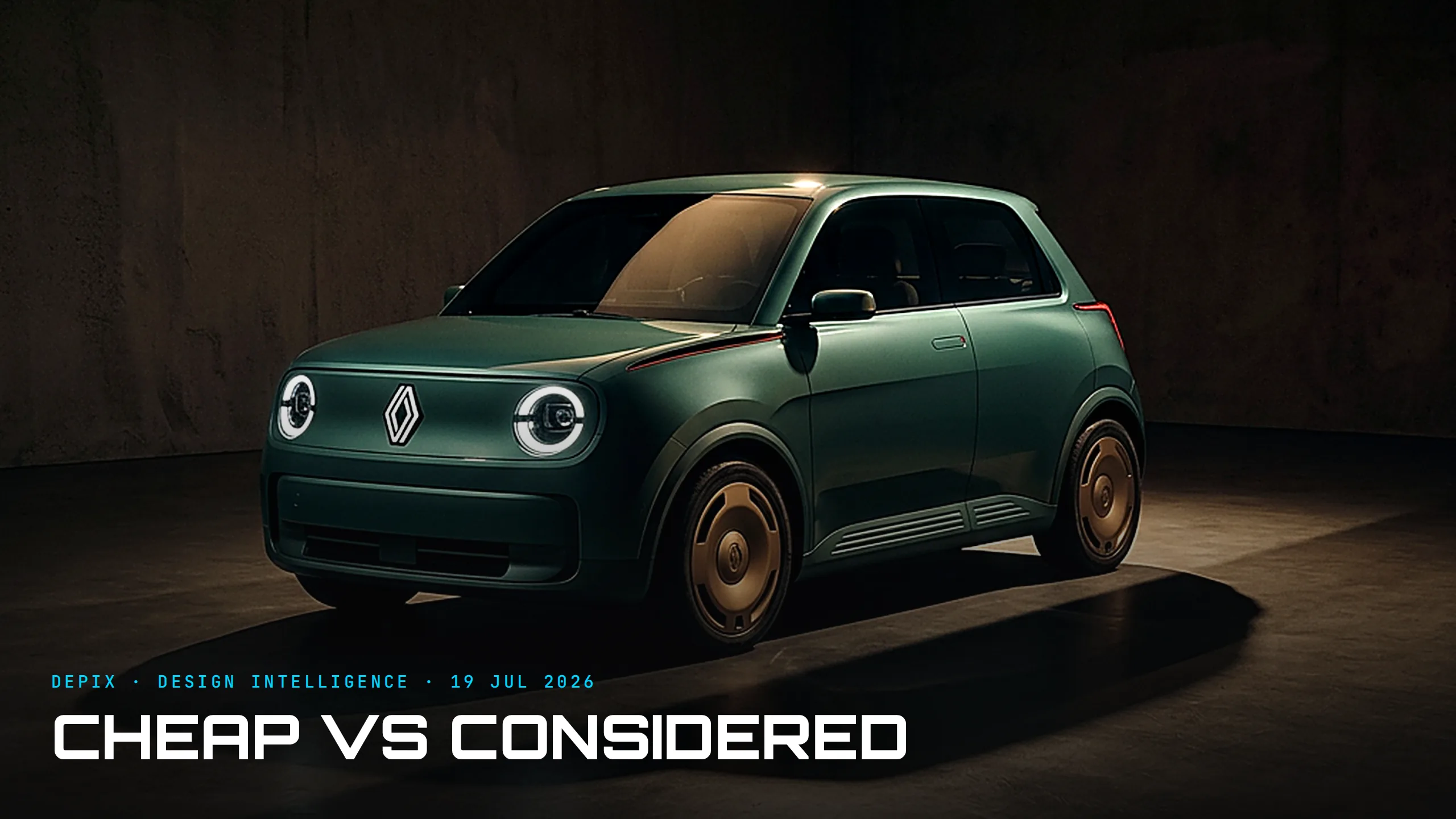
Wheels to the Corners: The Proportion Decided Before the Car Exists
Ask most people why a car looks expensive, athletic or cheap and they will point at the face — the grille, the lights, the surfacing. They are looking at the wrong thing, and worse, they are looking at it too late. By the time any of that exists, the car has already been decided. The single most consequential design choice in a vehicle is made before a designer draws a line: where the wheels go.
Car designers have a phrase for the discipline — "getting the wheels in the right place" — and Formtrends treats it as the foundational act of the whole craft. The reason is that the side view governs everything, and the side view is set by two numbers locked at the very start: the wheelbase (the distance between the axles) and the overhangs (how much body hangs past the wheels). These are not styling outcomes; they are "hard points," and as one platform primer puts it, once the front axle position, wheelbase and door openings are fixed they constrain every subsequent decision. You cannot draw your way out of them afterwards.
The maths is unforgiving and well known inside the studio. A wheelbase is typically 60–70% of overall length; a classic starting proportion puts the wheelbase at about 4.5 wheel-diameters with a front overhang of roughly one wheel; a balanced sedan keeps total overhang to wheelbase near 0.7 to 1. Push the wheels outward and the car reads planted, premium, athletic. Leave long overhangs and short wheelbase and no amount of jewellery on the face will rescue it. It is why sports-car design begins with the wheelbase, and why even a humble city car lives or dies on the same ratio. Overhang is not only aesthetic, either — it sets approach and departure angles) and puts mass outside the wheels that hurts how a car turns.
Here is the contrarian twist for 2026: this founding decision has quietly been taken out of the designer's hands, and handed to a battery. The dedicated-EV "skateboard)" platform — a flat slab of cells between the axles, motors at the ends — removes the very things that used to dictate proportion. No engine block forcing a long hood, no transmission tunnel, no driveshaft. So the wheels get pushed to the absolute corners, overhangs shrink and the wheelbase stretches almost by default. E-Mobility Engineering, US News and Capital One all describe the same consequence: a long-wheelbase, short-overhang, planted stance that the packaging produces on its own.
That is a gift and a trap. The gift is that mediocre proportions became harder to achieve; the average EV stands better than the average combustion car did, because physics now pushes the wheels outward for you. The trap is homogenisation. When the platform hands everyone the same long-wheelbase, wheels-at-corners footprint, cars start to share a proportional family regardless of badge — and the thing that used to distinguish a brand at fifty metres, its stance, converges. The designer's hardest-won variable becomes a constant.
This is precisely the concept-phase lesson we keep returning to at Depix. The decisions that determine whether an object succeeds are made upstream, by packaging and platform, before the part of the process everyone photographs and argues about. If proportion is set by the skateboard, then the designer's leverage moves earlier — into the room where the wheelbase, track and overhangs are chosen — because that is where the car is actually styled, whether a stylist is present or not. Fighting for a proportion at the hard-point stage is worth more than any amount of surfacing brilliance applied later, and conceding it means inheriting a shape you will spend the whole programme trying, and failing, to disguise.
The wheels were placed before the car existed. Everything you admire on the surface is a negotiation with a decision that was already made. The mature move is to be in the room when it is made — because you can restyle a face in a facelift, but you cannot move an axle.
Sources:
- ●Formtrends — Getting the wheels in the right place
- ●Hagerty — Car design fundamentals: wheelbase, overhangs and the side view
- ●Hagerty — Car design fundamentals: volumes and proportions
- ●Grokipedia — Wheelbase (hard points and proportion)
- ●Vizcom — Sports car design: the foundation of performance design
- ●AutoStyling — Proportion of a city car
- ●Wikipedia — Overhang (vehicles))
- ●Interesting Engineering — How EVs are redefining car design (skateboard)
- ●E-Mobility Engineering — EV skateboard platforms
- ●US News — What is the EV skateboard chassis
- ●Capital One — What is a skateboard platform?
- ●Wikipedia — Skateboard (automotive platform))

Design Debt: Why 'We'll Fix It Later' Is Borrowing at a Brutal Rate

The Texture of Touch: The One Thing a Screen Can't Fake