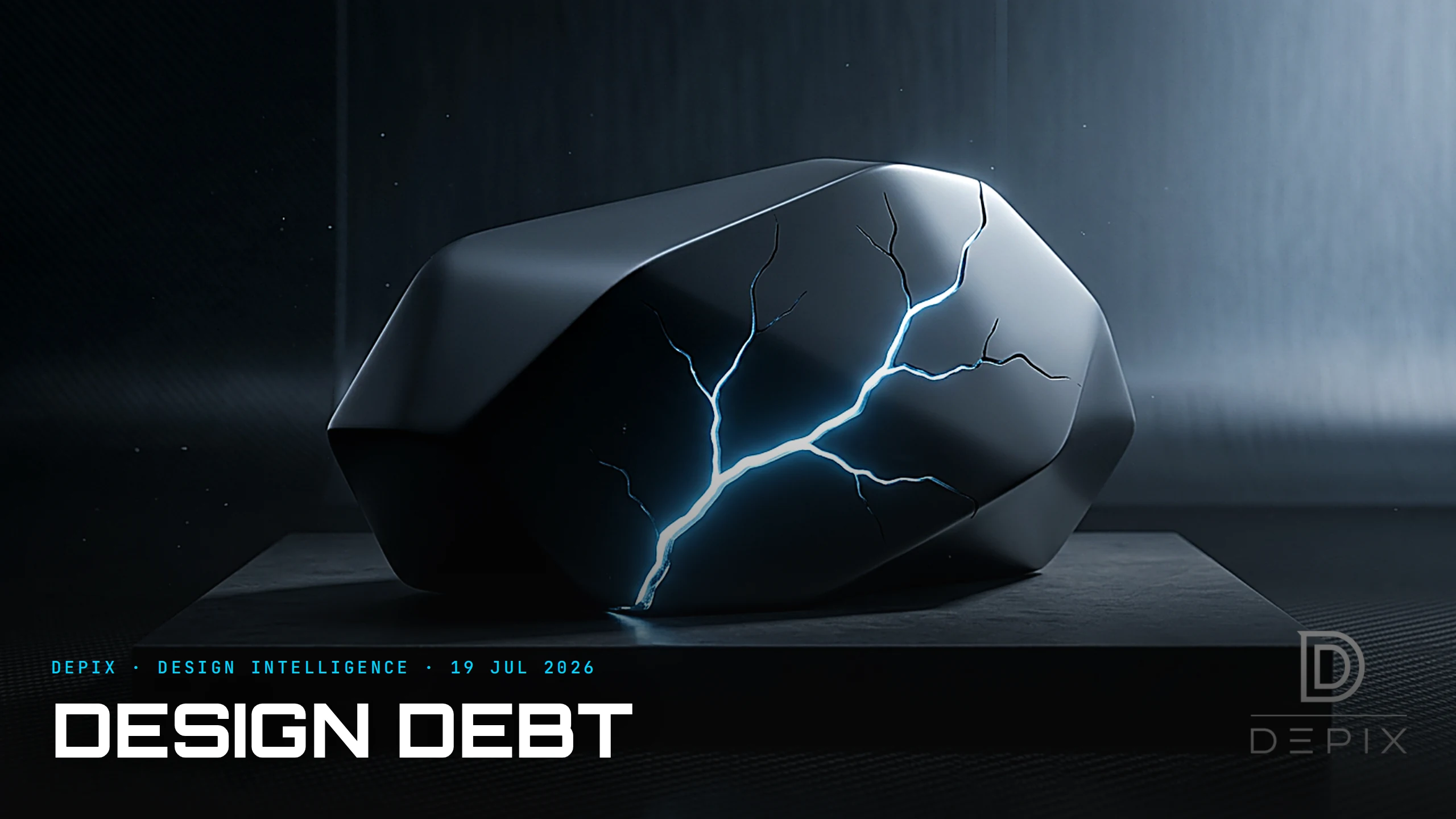
Design Debt: Why 'We'll Fix It Later' Is Borrowing at a Brutal Rate
The defining ethos of modern product culture is "ship it and iterate." Move fast, get it in front of users, fix what's broken later. In software, where changing a line of code is nearly free, this is often exactly right. The problem is that the mindset has leaked into the design of physical things — cars, hardware, products with tooling and supply chains — where "we'll fix it later" is not a philosophy. It is a loan, taken out at a punishing interest rate, and the industry has a name for the balance: design debt.
The software world borrowed the metaphor first. Design and UX teams describe design debt as the accumulated cost of shortcuts, inconsistencies and deferred decisions — the usability cousin of technical debt. And like financial debt, the consensus is blunt: it compounds over time and eventually demands payment, usually at the worst possible moment. A confusing interaction today becomes five support tickets next week and a lost deal next quarter; the distinction from technical debt is only which surface the interest is charged against.
But the hard numbers come from an older, more brutal rule, and they explain why physical design cannot afford the "iterate later" reflex at all. The 1-10-100 rule, first framed for data quality in 1992, prices the same defect at each stage of its life: a problem that costs \$1 to fix at the design phase costs \$10 in production and \$100 after release — and often far more than 100x once it reaches the customer. Quality engineers and the related rule of ten all describe the same exponential curve: the cost of change rises by an order of magnitude every time a decision crosses a phase boundary without being resolved.
Put those two ideas together and you get the real economics of the concept phase. The concept phase is the one moment in the entire program when change is nearly free — nothing is tooled, nothing is sourced, no downstream decision has hardened around the choice yet. Every phase after it is, quite literally, an interest payment. A proportion left unresolved, a material chosen for expedience, an architecture that "we'll clean up in the next cut" — these do not wait quietly. They become the fixed points that hundreds of later decisions build on top of, and by the time the flaw is undeniable, unwinding it means unwinding everything stacked above it. That is the fracture in the cover image: a hairline you could have closed for nothing at the start, branching wider through every surface it was allowed to travel across.
Here is the contrarian point for anyone running a design program. The instinct under deadline pressure is to defer the hardest decisions — they are the uncomfortable ones, the ones without consensus — and to lock the easy, visible things first. This is exactly backwards. The hard, irreversible, load-bearing decisions (what the thing fundamentally is, its proportion, its core architecture, its primary material logic) are precisely the ones whose interest rate is highest, because everything else compounds on them. Deferring a hard decision is not buying time; it is borrowing against the whole program, and the loan is called in at the least convenient hour — tooling booked, launch date fixed, no slack left to absorb it.
The discipline, then, is counter-intuitive and unglamorous: spend the concept phase paying down the decisions that will be most expensive to change, not the ones that are easiest to make. Resolve the load-bearing questions while they are still cheap; leave the genuinely reversible, low-interest choices — a trim colour, a graphic, a soft-touch texture — for later, because those actually can be iterated without penalty. Most teams do the reverse, and then spend the rest of the program servicing debt.
This is the whole reason we anchor everything at Depix to the concept phase. It is not a preference for early work; it is an interest-rate argument. The concept phase is the only place in the pipeline where the hardest changes are still free, and design debt is simply the price of every hard decision you chose to postpone until they weren't. "We'll fix it later" is true — you will fix it later. You'll just pay a hundred times more to do it.
Sources:
- ●WeAreDPP — Design debt: the UX cost no one budgets for
- ●Medium (Cerejo) — Design debt: the hidden cost of neglecting UX
- ●Userbit — What is design debt in UX?
- ●Changying — Design debt vs technical debt: the hidden costs
- ●Medium (Gruver) — Design debt vs UX debt
- ●AKF Partners — The 1-10-100 rule in quality development
- ●AIGPE — The 1-10-100 rule: why a $1 problem becomes a $100 disaster
- ●Perforce — What's the true cost of software defects?
- ●Making Strategy Happen — The cost of quality: the 1-10-100 rule
- ●Code Intelligence — The rule of ten
- ●Helio — Measure and prioritize design debt
- ●Openfield — The basics of design debt and how to pay it down

The Reference Trap: The Most Useful Tool in the Studio Is Also the Most Dangerous

Wheels to the Corners: The Proportion Decided Before the Car Exists