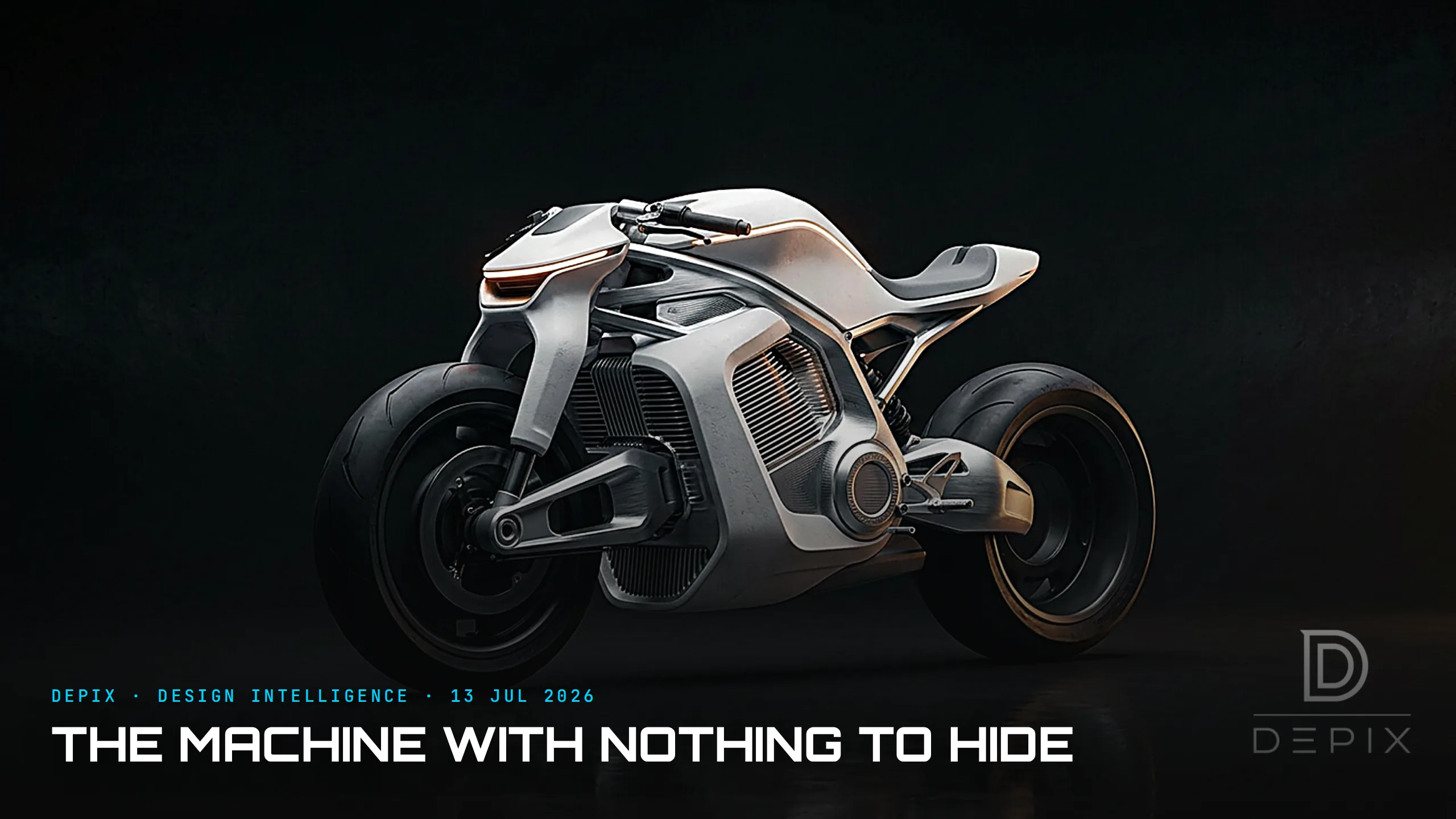
The Weight Budget Is the Design Brief
Every design programme spends its risk unevenly. The concept phase — the proportion sketch and the first weight estimate — is cheap to change and impossible to unwind later. Nowhere is that truer than in a motorhome, and nowhere will it be more visible than at Caravan Salon Düsseldorf, the world's largest caravanning fair, running 28 August to 6 September 2026 at Messe Düsseldorf. Last year it drew 269,000 visitors and 811 exhibitors across 14 halls. It is the single densest gathering of concept-phase decisions in all of mobility.
Here is the contrarian point. In a car, the cabin is a room inside a vehicle. In a motorhome, the vehicle is the room. Aero, mass, powertrain, packaging, plumbing, daylight and materials are not separate workstreams that meet at integration; they are one coupled problem, and every meaningful move is made while the whole thing is still a proportion sketch. A car can absorb a late compromise in a trim spec. A motorhome cannot, because the compromise is where you sleep.
Electrification detonates this. In a diesel coach the weight budget is generous enough to hide sloppy early decisions; add a battery big enough for real range and it vanishes. The physics are unforgiving. Green Car Reports notes buyers expect 300 to 500-plus miles between charges, yet the higher figure is "likely a physical impossibility given price and battery-pack weight." Winnebago's eRV2, built on a Ford E-Transit with a 15-kWh house pack, lands around 108 miles. Dethleffs' e.home ECO — the Ford E-Transit concept it debuted at Caravan Salon — manages a 149-mile (240 km) WLTP range and is presented, pointedly, as a concept rather than a product. Real-world electric campervans in 2026 come in at roughly half their brochure figure, 120 to 180 miles. Every one of those numbers is a payload decision wearing a range costume.
Because the weight is the brief. A battery heavy enough for a family's touring range eats the payload that same family needs to actually live in the thing — water, gear, bikes, food, bodies. On a converted panel van the arithmetic is brutal: the electric Fiat E-Ducato surrenders about 600 kg of carrying capacity against its diesel twin. And it collides with a legal edge. A standard EU category-B licence historically capped you at 3.5 tonnes; in March 2025 the EU agreed to let B-holders drive motorhomes up to 4.25 tonnes, exempting alternative-fuel vehicles from extra testing once the licence has been held two years. That extra 750 kg is not a gift to designers. It is a subsidy for battery mass, and it exists only because regulators concede the numbers do not close at 3.5 t. When the law has to move the goalposts, the trade-off is real.
So the concept phase forces one irreversible fork: design a vehicle that has a home in it, or a home that moves? Two schools are answering differently, and both will be on the floor at Düsseldorf.
One keeps the driven vehicle and fights for every kilogram inside it. Dethleffs' e.home ECO leans on a flax-fibre shell, recycled-PET insulation, maize "popcorn" furniture and sheep's-wool upholstery — a materials revolution driven not by virtue but by the weight ledger. Hymer pushed the same logic in its VisionVenture study, using BASF materials and an inflatable roof to buy back mass. The other school decouples the home from the drive. Knaus' Yaseo narrows its body to cut frontal area 14%, clawing back the tow car's range while running gas-free on Vehicle-to-Load power. Lightship's L1 goes further — a self-propelled electric trailer with its own e-axle and up to 80 kWh, engineered to add near-zero drag to the EV pulling it. And Knaus' Wankel range-extender refuses the binary entirely, carrying a rotary generator so range is decoupled from charging.
Notice what unites the serious answers: none is a styling exercise. Each is a frontal area, a mass target and a package locked before a single surface is finished. Even the incumbents concede it — the most self-sufficient camper of the 2026 season, VW's Grand California, stays firmly diesel, upgrading only its leisure batteries to lithium while leaving the drivetrain untouched. The conversion market, meanwhile, inherits Mercedes' 249-mile eSprinter and finds the range turns theoretical the moment you add a bathroom. Independent 2026 reviews agree the honest production e-motorhome is still a year or two out. The lesson is not "range anxiety." It is that a motorhome cannot paper over a late compromise, so the whole system has to be right at the sketch.
That is exactly the moment Depix exists to de-risk. When aero, weight, licence class, payload and interior volume are one decision, you cannot afford to find the trade-off at prototype. You have to see it — and iterate it — while it is still a concept. Caravan Salon 2026 will be full of finished vehicles. The interesting story is the invisible one behind each: the weight budget that was the brief all along.
Sources:
- ●Caravan Salon Düsseldorf (organiser, Messe Düsseldorf)
- ●Caravan Salon Facts & Figures — 269,000 visitors, 811 exhibitors, 14 halls
- ●Green Car Reports — Fully electric RVs face steeper range and charging challenges
- ●Winnebago eRV2 all-electric RV (official)
- ●New Atlas — Dethleffs e.home ECO sustainable electric motorhome concept
- ●Campervan.win — Electric campervans in 2026: real-world range and Fiat E-Ducato payload loss
- ●Aboutcamp BtoB — EU agrees B-licence amendment for motorhomes up to 4.25 tonnes
- ●Erwin Hymer Group — Hymer VisionVenture concept (BASF materials, inflatable roof)
- ●New Atlas — Knaus Yaseo transforming EV-towing caravan
- ●Lightship — Introducing the L1 self-propelled electric travel trailer
- ●New Atlas — Knaus Wankel-boosted electric RV range-extender concept
- ●New Atlas — Mercedes eSprinter 249-mile WLTP electric van
- ●Outwander — Electric RVs in 2026: what's real and what's not
- ●New Atlas — VW Grand California suits up for deeper off-grid exploration
Sources:

Simulate the Irreversible: How the Stone Industry Rehearses the One-Shot Cut
Design Intelligence, 13 July: The Concept Phase Was the Only Story Today