Design Intelligence, 13 July: The Concept Phase Was the Only Story Today
Four reports, ten near-twins, and one long executive question crossed the Depix desk today. Read separately they look like an ordinary news day in design. Read together they say the same sentence: the value and the risk in a vehicle program both live in the concept phase — and almost nobody is instrumenting it.
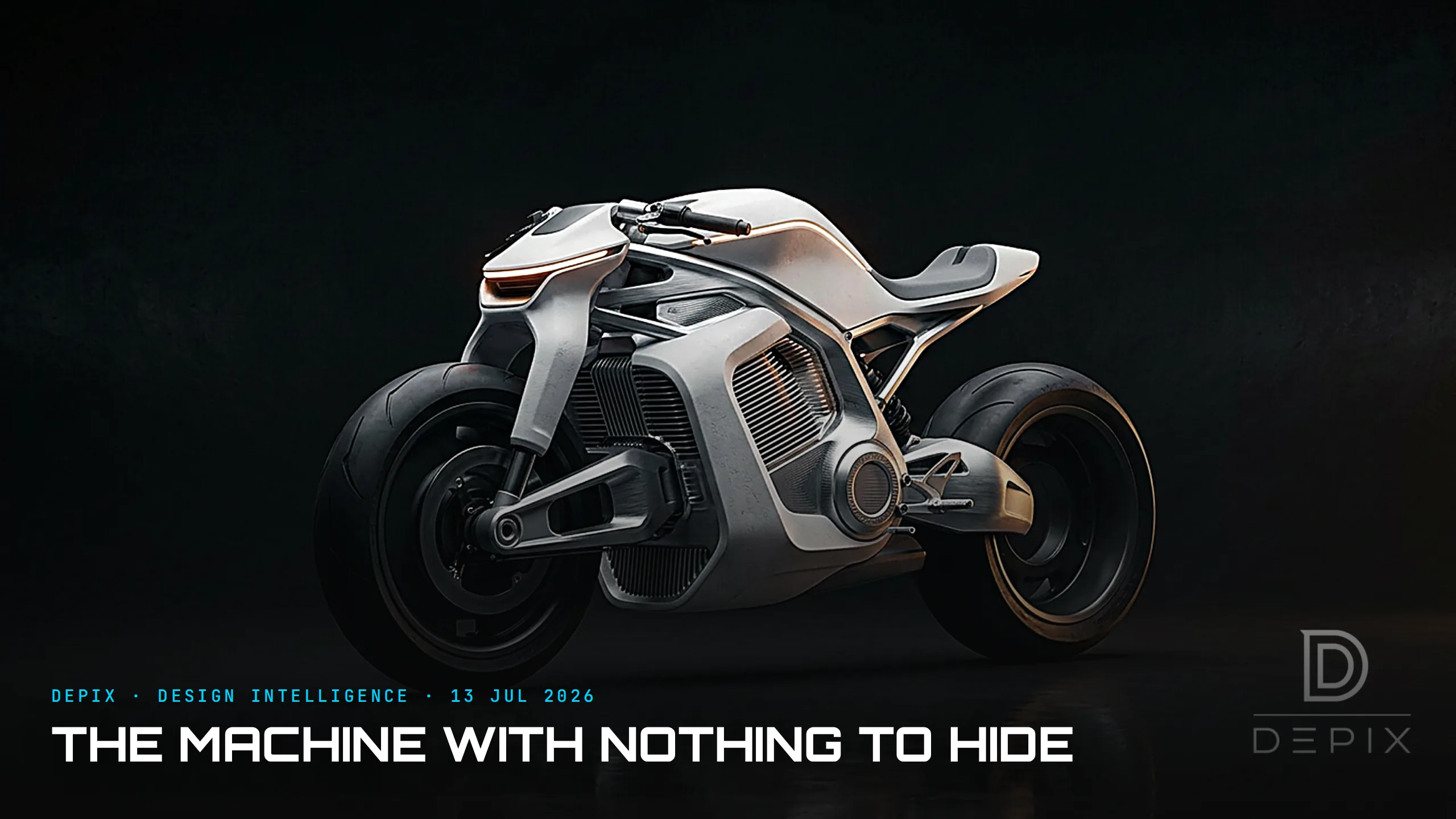
Start with the two events. At Chantilly Arts & Elegance, a concours is a jury grading finished cars — but the thing being graded, elegance, was decided years earlier, in the first proportion sketch. You cannot detail your way to grace; you can only fail to ruin a good early decision. EICMA, three months out, makes the same point with the volume turned up: the motorcycle is the only vehicle whose beauty is its exposed mechanicals, so electrification is not a range problem, it is an identity crisis — and a naked bike has no bodywork to hide an unresolved decision behind. Both events reward the same thing: conviction locked in early, before there was anywhere to hide.
Then the counter-melody. Dutch Design Week sells nothing on its front line — its provocation is that design's job upstream is to ask the question, not ship the answer. And Ferrari's "manual-by-wire" shows the other end of the same string: an emotional experience, the ritual of a gearshift, being designed back in on purpose, by decision, not by inheritance. Different disciplines, one lesson — the meaningful choices are made while the thing is still cheap to change and already impossible to un-choose.
Our own OEM work today ran that experiment ten times. Ten marques, ten forward near-twins — Jaguar, Pagani, Koenigsegg, Lucid, Polestar, Volvo, Rolls-Royce and others — each a small, specific argument about where a brand's next decision could credibly go. The exercise only works because the audience can instantly tell a real next-generation move from a re-skin of today's car. That instinct — the one that separates a genuine step forward from a facelift — is the whole business.
Which brings us to the question an executive put to us today: across every pain point, which one matters most? The honest answer is that they collapse into a single point of leverage. The designer's version is conviction erosion — a strong early idea sanded down by a hundred downstream reviews until it is safe and forgettable. The executive's version is irreversible risk under speed pressure — the most expensive decisions get made first, with the least information, and cost more to reverse every week that passes. Same moment, two seats. It is the concept phase, and today four unrelated stories all pointed straight at it.
The teams that win the next cycle will not be the ones who render faster. They will be the ones who can see the concept phase — hold more options open, longer, with evidence — instead of guessing once and defending the guess forever. That is the work. Today, it was the only story.
Sources:
- ●Depix - Chantilly Arts & Elegance 2026: the concours that grades the future
- ●Depix - EICMA 2026: the machine with nothing to hide
- ●Depix - Dutch Design Week 2026: the front of design sells nothing
- ●Depix - Ferrari, manual-by-wire: the manual is now design
- ●Chantilly Arts & Elegance Richard Mille (official)
- ●EICMA - International Motorcycle Exhibition (official)
- ●Dutch Design Week (official)
- ●Ferrari (official)
Sources: