Simulate the Irreversible: How the Stone Industry Rehearses the One-Shot Cut
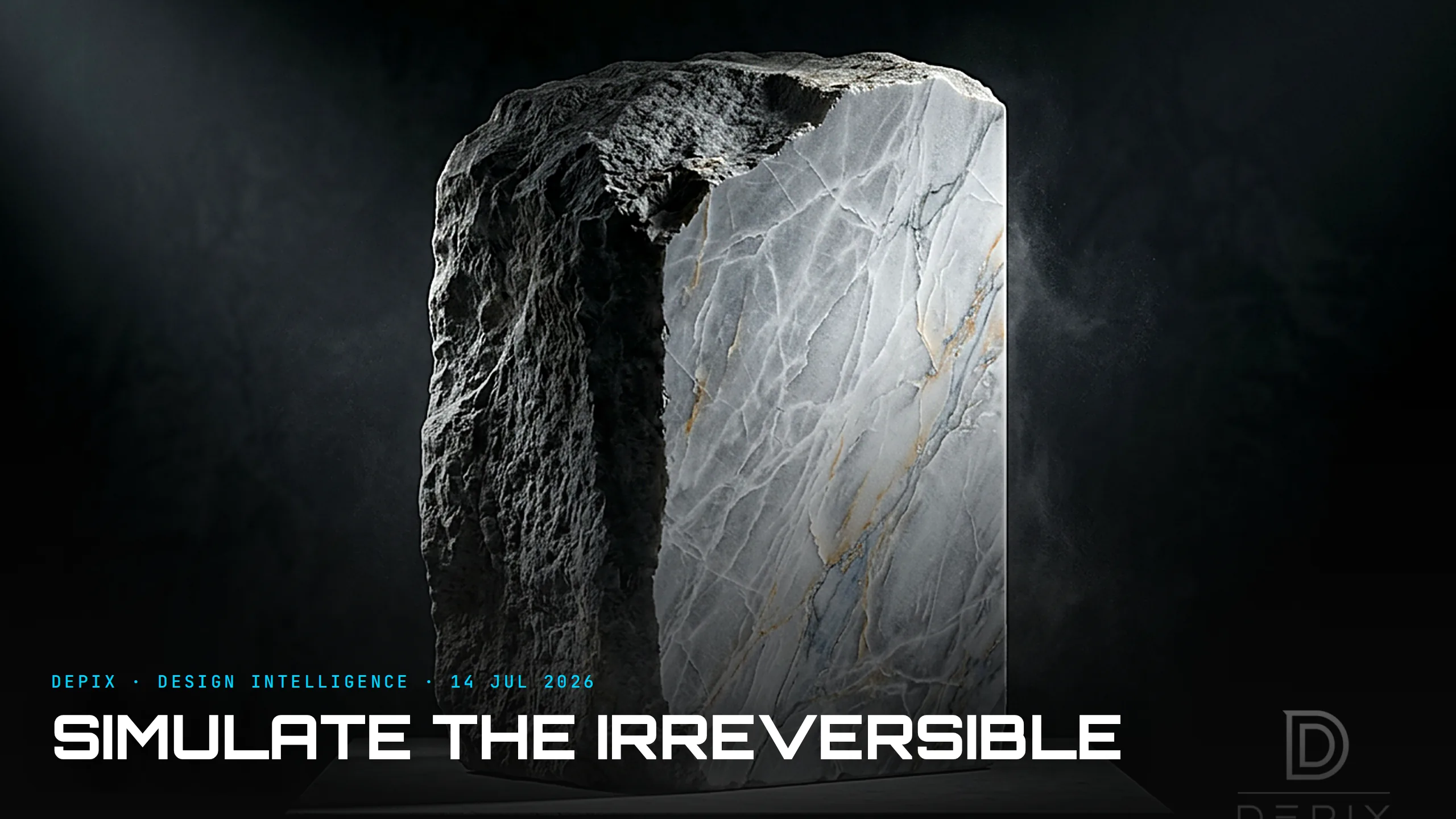
Every design medium lets you take it back. Clay reflows, CAD undoes, foam re-sands, a bad pixel is one keystroke from gone. Stone is the exception. A block of marble is subtractive and singular: every cut is final, and no two blocks are alike — the veining, the fissures, the exact drift of colour exist once and cannot be reproduced or reversed. There is no prototype, no v2, no "fix it in production," because the block is the production. That single physical fact makes stone the purest test of a thesis we hold at Depix: the concept phase is the earliest, cheapest, and most irreversible moment of any programme, and that is exactly where value and risk concentrate. When the medium can't be iterated, the concept phase is the entire project.
Which is why the world's stone capital has quietly become a software industry. When Marmomac returns to Veronafiere in Verona from 22–25 September 2026 for its 60th edition — roughly 1,400 exhibitors and 50,000-plus visitors — the marketing still sells marble as heritage. The machinery halls tell the real story. The 2026 cultural programme, The Bedrock: Leading the Future of Natural Stone, curated by Joseph Grima and Giuseppe Fallacara, opens with a section — ON STONE — explicitly about how digital fabrication and materials research are redefining the material. Stone went digital not despite its irreversibility but because of it.
Consider what makes the one-shot cut terrifying. In the Carrara basin, more than half of the marble extracted ends as quarry waste or debris — cut blind into a hidden fissure and you don't lose a pixel, you lose a forty-tonne block, a week, and a slab sequence that existed nowhere else on earth. The only way to de-risk that is to rehearse it.
So the industry rehearses. The first move is to see inside the block before the saw does. Computed tomography, borrowed from geotechnics, maps a stone's internal fractures, voids and density variations non-destructively, turning an opaque monolith into an inspectable volume. The second move is to build a faithful copy: block-scanning specialists such as Prometec reverse-engineer a quarried block into a photoreal 3D digital twin — geometry and colour — on which an inspector annotates defects and previews the finished stone under different lighting, then runs virtual cutting and nesting before a real blade moves. Months of downstream ambiguity collapse into the concept stage.
The move that matters most to designers is virtual bookmatching. Veined stone's whole drama is the mirror-image continuity of a bookmatch or a waterfall edge — precisely the thing you cannot un-cut. Software now nests templates on a calibrated slab photo and aligns veins across every seam, then exports a CNC-ready file. Horus's Match 3D simulates the nesting and vein-match of an entire project digitally before production; Park Industries' tMatch lets teams position pieces and match veining before any cutting begins; SlabSmith previews the photoreal countertop the client will actually receive. The vein flow is decided on screen. The saw merely executes a decision already made.
None of this is only aesthetic. Yield is fixed at layout, not at the saw: digital nesting routinely lifts usable slab yield from a hand-drawn 65–70% to 80–85% or higher. The cheapest offcut is the one you never generate, and every point of yield won on screen is a point of waste that never enters that 50-plus-percent stream — the circular-economy pressure the sector is now under real scrutiny to answer.
Read together, this is one idea expressed in hardware: simulation is how you make an irreversible decision reversible just long enough to get it right. Tomography, the block twin, the cutting simulation, the virtual bookmatch — each runs the concept phase over and over, at zero material cost, until the one physical action left is the correct one. Stone doesn't get more takes; it gets better rehearsals.
The lesson travels well past marble. Every design programme has a block — an expensive, low-reversibility commitment that a render makes look casually editable right up until it isn't: tooling, a chip mask, a poured foundation, a launched brand. The stone industry is simply honest about it, because the material refuses to pretend otherwise. It has learned to spend lavishly on the cheap, reversible phase — concept, simulation, rehearsal — precisely so the expensive, irreversible phase is anticlimactic. That is the whole discipline: know exactly what you're making before the saw touches the block. Everyone designs in stone. Most people just haven't met their block yet.
Sources:
- ●Marmomac 2026 — official site (60th edition, scale)
- ●Marmomac 2026 — Veronafiere (dates 22–25 Sept 2026)
- ●The Bedrock: Leading the Future of Natural Stone — ON STONE, Grima & Fallacara (Marmomac 2026)
- ●Managing Marble Quarry Waste: Circular Economy (Carrara >50% waste), Sustainability 2024
- ●Computed Tomography of rock microstructure — internal fractures & voids (IntechOpen)
- ●Prometec — stone block optimization & scanning technology
- ●3D Digital Twins Transform Natural Stone Projects, Quarry to Installation (The Marble Guide)
- ●Horus Match 3D — vein-match & nesting simulation before production
- ●Park Industries tMatch — slab imaging & vein matching before cutting
- ●SlabKast — slab layout & virtual bookmatching (CNC-ready DXF export)
- ●SlabSmith — photoreal slab imaging & bookmatch preview (SlabWise guide)
- ●Maximizing slab yield with digital nesting software (65% → 85%) — SlabWise
- ●Marmomac 2026 — Natural Stone Institute event listing
Sources: