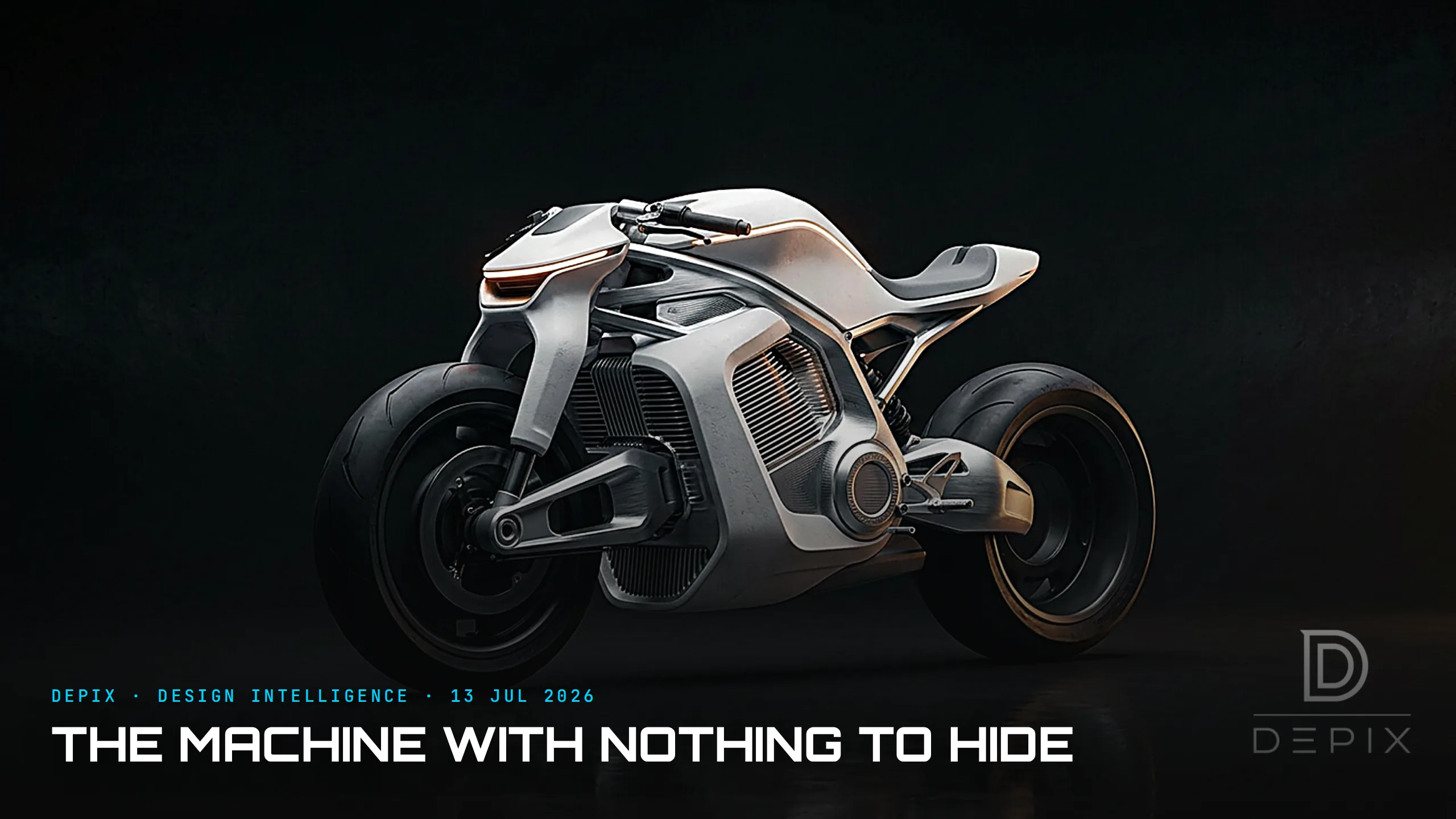
EICMA 2026: The Machine With Nothing to Hide
Every November the motorcycle world gathers at EICMA in Milan — this year 5–8 November 2026, with press days on the 3rd and 4th — to unveil the machines of the year to come. It is the largest two-wheeled show on earth, and its fastest-growing hall is the one full of electric bikes. Most of the coverage will treat that hall as an engineering story: range, charging, torque. It is really a design story, and a more existential one than any car maker has to face.
Here is what makes the motorcycle unique. Almost every other vehicle hides its mechanicals. A car wraps its engine in bodywork; the design is the skin stretched over the machine. A motorcycle does the opposite — it has nothing to hide behind. No doors, no cabin, no panels. Its beauty is its mechanicals: the finned barrels of an air-cooled engine, the sweep of an exhaust, the swell of a tank, the exposed trellis of the frame. As one design analysis of the problem puts it, a battery is fundamentally a box — an energy-storage device nobody finds beautiful — while a finned engine is "universally appreciated for its delicate intricacy." On a motorcycle the engine is not under the design. The engine is the design.
Electrification deletes all of it at once. No engine to celebrate, no exhaust to shape, no tank to sculpt, no sound to tune. The naked bike — the purest expression of the form, whose entire premise is visual honesty about its machinery — is left with a slab of cells and a silence. So the motorcycle designer arrives, earlier and more nakedly than anyone else in transport, at the question the concept phase always asks: when the thing that gave your product its identity is gone, what becomes the hero?
The industry has produced two honest answers, and both are decided before a single part is made. One is to hide the battery and chase a new silhouette — slim, seamless and quiet — that expresses the instant, nimble character of electric drive rather than mourning the engine. The other is to make the battery itself the hero. BMW's Vision DC Roadster is the clearest case: it kept the brand's boxer stance and replaced the boxer engine with a vertically finned battery block, its cooling fins and lateral intakes deliberately echoing the motor it replaced — a "highly emotional naked bike with electric drive" that put the new emotional centre exactly where the old one had been. Reviewers noticed it reached back ninety years even as it rode toward the future, and the idea was strong enough that BMW moved to protect a production "DC" line. Honda, designing an electric bike from a blank sheet, framed the same brief as being "precise in functions to express the intrinsic" — deciding what the machine fundamentally is before drawing what it looks like.
What unites the good answers is that they are decisions, taken at the concept phase, about identity. What unites the forgettable ones — the many bikes that simply swapped an engine for a battery and a motor — is the absence of one. And here the motorcycle teaches a lesson that reaches far beyond two wheels: because it hides nothing, it is the purest test of concept-phase conviction there is. A car can bury an indecisive early call under bodywork and CMF; a naked bike cannot. Every choice is visible, on the road, forever. There is no panel to value-engineer the doubt behind.
That is why EICMA's electric hall is worth watching as a design event rather than a spec sheet. It is a room full of companies answering, in public and in metal, the question every product team eventually faces: with the old hero gone, what is this thing for, and what carries its feeling now? The bikes that know — that decided early and committed — will look inevitable. The ones that didn't will look like a battery where an engine used to be.
At Depix that is the whole argument, stripped to its frame: the identity of a product is set at the concept phase, and on a machine with nothing to hide, that decision is the only thing anyone sees.
Sources:
- ●EICMA — official site (Milan, 5–8 November 2026)
- ●FormTrends — Electric Motorcycle Design: Thinking Outside the Box (the battery-box vs finned-engine problem)
- ●Return of the Cafe Racers — eBikes that look like motorcycles (the naked-bike form)
- ●RideApart — Nuen Moto N1S: an EV that looks like an old-school naked bike
- ●Electrek — BMW Vision DC Roadster electric motorcycle concept
- ●Cycle World — BMW Vision DC Roadster (finned battery block echoing the boxer)
- ●Motorcycle.com — BMW Motorrad Vision DC Roadster concept
- ●Forbes — BMW's Vision DC Roadster echoes back 90 years while riding into a possible future
- ●Electrek — BMW may produce the Vision DC Roadster (trademark filings)
- ●Robb Report — The Vision DC Roadster: BMW's most road-ready electric bike concept
- ●Honda Design — designing the ideal electric motorcycle from scratch (EICMA interview)
Design Intelligence, 13 July: The Concept Phase Was the Only Story Today

Chantilly Arts & Elegance 2026: The One Concours That Grades the Future
