The Wheels Were a Promise
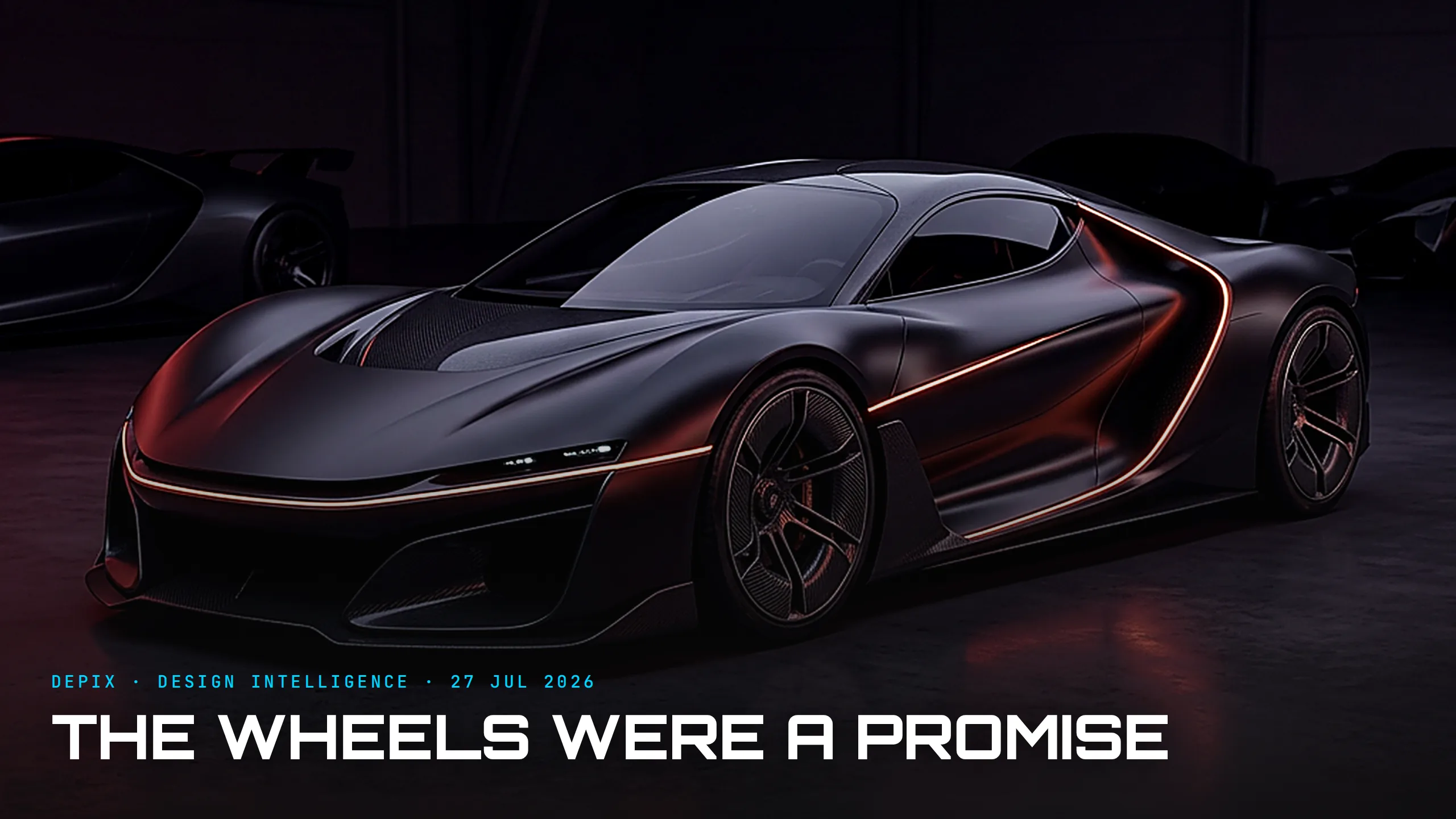
Put a concept car next to the production version it spawned and play a game: find the single biggest visual difference. Almost every time, the answer is the wheels. The show car rode on vast, gap-filling rims that made it look planted and expensive; the production car that reached your driveway sits on something noticeably smaller, with a fat cushion of tyre where the drama used to be. Designers draw absurdly huge wheels on everything, and production almost always takes them away. That shrinkage is not a detail. It is the most honest thing about the whole process.
Why the fantasy in the first place? Because big wheels give a car an aggressive stance and stage presence, and a concept exists to wow the executives signing the cheque — pulling the wheels out to fill the arches is the cheapest way to make a sketch look like money. A concept car's job is persuasion, not production; oversized wheels are its loudest rhetorical device.
Then physics arrives. Bigger wheels demand lower-profile tyres, which means less sidewall to absorb bumps, so ride comfort suffers and the suspension crashes over expansion joints. Big wheels also need big arches, which eat into the cabin and cargo space the packaging engineers have been fighting for, and they cost more, weigh more and complicate everything downstream. Even the handful of production cars that wear genuinely enormous wheels pay for it in ride and price. So the production team's job becomes finding the best balance — and the balance almost always means smaller than the show car promised.
This is where the wheel becomes a design-intelligence parable. The concept's wheel size is a promise — one made at the concept phase, in a render, by people who will never have to make it ride, cost, or package. When the promise breaks, the car looks like it is wearing shoes a size too small, because every proportion around the arch was drawn to frame a wheel that is no longer there. The gap between concept and production is visible precisely at the wheel, because the wheel is where the fantasy collides hardest with reality.
The naive move is to design a car that only works on the dream wheels — a body whose haunches and ride height only resolve when the arches are full of 24-inch rims. Shrink the wheel and the whole thing sags: under-tyred, top-heavy, cheap. It is the automotive equivalent of a building that only photographs well in the architect's sunset render and disappoints in ordinary daylight. The intelligent move is to decide, at concept, which gestures are load-bearing and which are theatrical — to know that the wheel will shrink, and to draw a car that is still beautiful at the production size. That means designing the arch, the ride height and the body-side to look right across a range of wheels, not at a single heroic diameter.
It is the same discipline everywhere else in the car. As wheels have crept up across the industry — 19s and 20s now common where 16s once lived — the temptation is to keep drawing bigger and let production sort it out. But the EV era, which needs every gram and every millimetre of aero, is already pushing back: a giant wheel is heavy, draggy and range-sapping, and the smartest EV designs are learning to look planted on a smaller, aero-efficient wheel rather than a show-off one. Stance — the quality the big wheel was faking — turns out to be achievable with proportion, not just diameter.
None of this means concepts should stop dreaming. It means the dream has to be engineered to survive contact with the production wheel, and that survival is decided at concept, not discovered at launch. The wheel is the cheapest promise to draw and one of the most expensive to keep. Most of a car's other promises can be quietly renegotiated behind closed doors; this one is bolted to each corner in plain sight, where every owner will notice if it was broken. A designer who knows that draws a car that keeps the promise anyway — one whose beauty was never resting on a diameter it was always going to lose.
At Depix, this is exactly the kind of gap we exist to close before it opens: not the render's wheel, but whether the car still works on the one it will actually wear.
Sources:
- ●Why car designers always draw absurdly huge wheels — The Autopian
- ●Why big wheels on cars just keep growing — The Globe and Mail
- ●Concept car — Wikipedia
- ●Do concept cars have oversized wheels? Why? — Quora
- ●What difference does wheel size make? — Cars.com
- ●Wheels are more complex than ever, here's why — Motor1
- ●Biggest wheels on a production car? — PistonHeads
- ●Concept vehicles vs production — AnandTech forums
- ●Design differentiation and the EV sameness problem — The Truth About Cars
- ●Vellum Venom: a glossary of automotive design terms (stance) — Hagerty