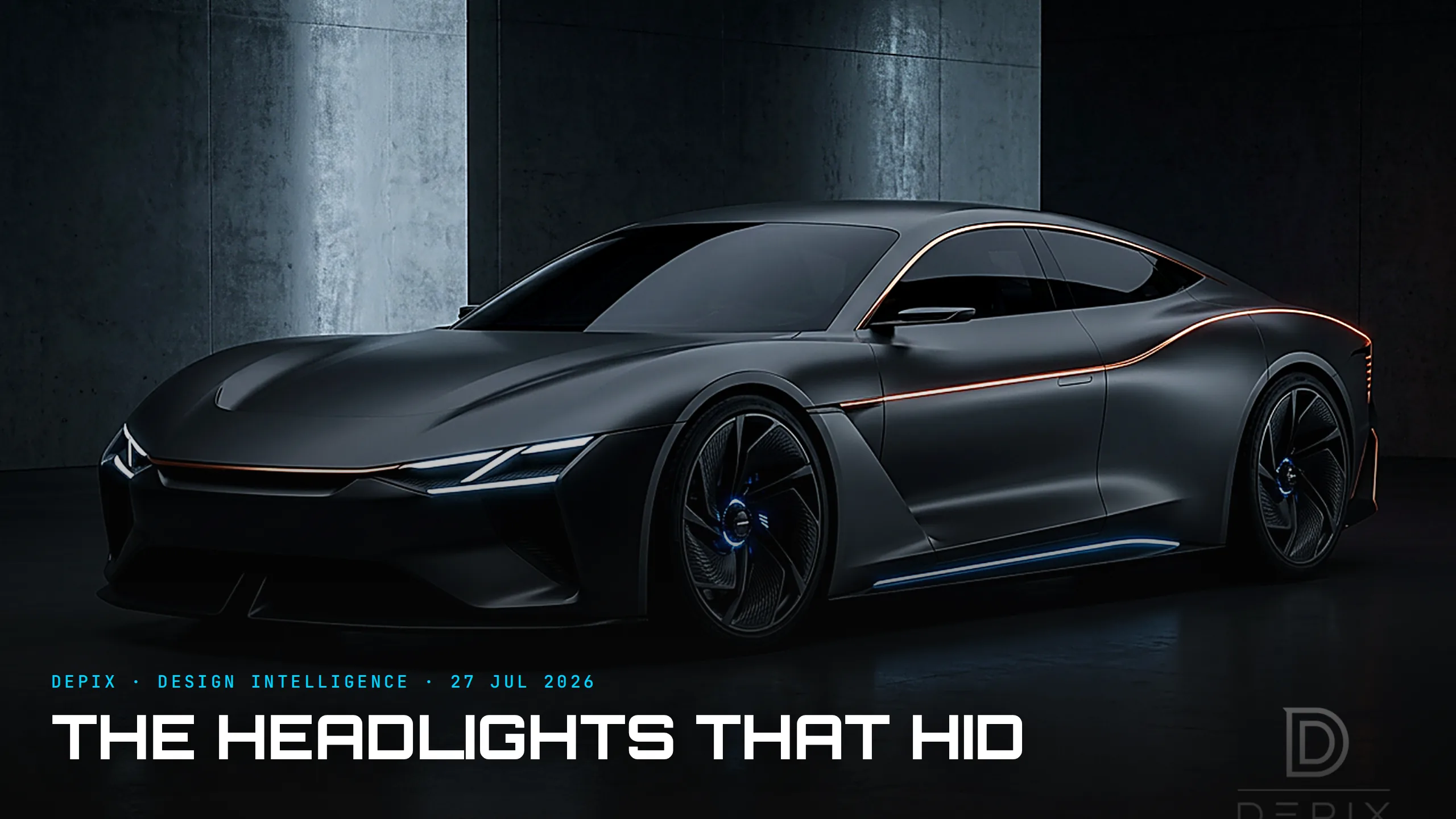
The Headlights That Hid
For roughly three decades, some of the most beautiful cars ever drawn shared a party trick: at rest they had no headlights at all. The pop-up headlight — hidden flush in the bodywork, flipping up only when needed — gave the Corvette, the Porsche 928, the RX-7 and countless others a clean, low, predatory nose that fixed lamps of the era simply could not. Then, almost all at once, they vanished. It is tempting to file them under "gimmick." That is exactly the wrong reading. The pop-up was one of the most honest pieces of problem-solving in car design — and its death is a lesson about the shelf life of every design solution.
Start with the problem it solved. Through the sealed-beam era, headlights were large, and regulations mandated a minimum height above the road so they would actually light the way. Designers, meanwhile, wanted the opposite: a low, wedge-shaped nose for aerodynamics and drama. These two demands are in direct conflict — you cannot have a knife-edge nose and a tall stack of headlamps. The pop-up resolved the contradiction elegantly: hide the legally-required, aerodynamically-inconvenient lamps below the surface, and raise them only when the light is actually needed. It was not decoration. It was a concept-phase reconciliation of two constraints that refused to agree.
So why did it die? Not because it stopped being clever, but because the constraints underneath it moved. First, pedestrian-protection regulations arrived — Europe introduced rules around 2003 that new car types had to meet from 2005 — and a hard object that pops up from the bonnet is close to a worst case for a pedestrian's head in an impact. A shape that changes position was suddenly a liability, not a feature. Second, the aero argument quietly collapsed: wind-tunnel testing showed that when deployed the raised pods acted as air brakes and could increase drag by 5 to 12 percent — the pop-up was only aerodynamic with the lights off. Third, and decisively, fixed lighting technology caught up: compact projectors and then LEDs became bright and small enough to sit legally in a low nose, dissolving the original problem entirely. Add the weight, cost and extra failure points of the motors and linkages, and the accounting stage killed what the design studio loved.
Here is the part worth keeping. The pop-up did not become bad. It became obsolete — a right answer to a problem that no longer existed. That distinction is the whole lesson. Every design solution has a shelf life, and it is set not by the solution's quality but by the constraint landscape around it. When the constraints that made a solution necessary change — a regulation appears, a technology shrinks, a material improves — even a brilliant answer expires. Designers who fall in love with the solution get stranded; designers who stay loyal to the problem adapt.
This is a concept-phase discipline, because the constraint landscape is exactly what you map at the concept phase, before anything is committed. The pop-up teams of the 1970s were solving their era's constraints perfectly. What they could not do was foresee that pedestrian regs and LED miniaturisation would, a generation later, make the whole manoeuvre pointless. The best you can do is solve the problem in a way that can evolve — and hold your cleverest mechanisms loosely, knowing the ground beneath them will move.
The pattern is everywhere once you see it. It is why so many "banned" or abandoned car features feel like unfinished business — they were often good answers whose constraints simply changed. And it is happening again: EVs and driver-assist cars must hide radar, lidar and cameras behind clean, sensor-friendly noses, and designers are reaching for flush, concealed and reconfigurable lighting to do it — the same "hide the ugly-but-required hardware in a beautiful nose" problem the pop-up solved, handed to a new generation with new tools. The problem is immortal. The solution never is.
At Depix, this is exactly why we pressure-test a concept against the constraints that will exist tomorrow, not only the ones that exist today. The pop-up headlight was not a mistake. It was a perfect answer with an expiry date — and the discipline is knowing that every answer has one.
Sources:
- ●Hidden headlamp — Wikipedia
- ●Pop-up headlights: a guide (Corvette, 928, RX-7) — Car Light Vision
- ●Why were pop-up headlights banned? — Park(ing) Day
- ●Why are pop-up headlights illegal? — Park(ing) Day
- ●Pop-up headlights and pedestrian safety — Military.com
- ●The federal mandate that ended pop-up headlights — Headcount Coffee
- ●Why don't cars have pop-up headlights anymore? — Suparee
- ●Why were pop-up headlights banned? — Engineer Fix
- ●12 car features that were banned — AOL
- ●Why are pop-up headlights banned? — Engineer Fix