The Weave Was Always a Costume
For thirty years, carbon fibre has been the universal shorthand for "fast." The instant a car wore that black cross-hatched weave, you read it as expensive, serious, engineered. The material became so tied to performance that the look detached from the substance entirely: a huge share of the carbon fibre you see is fake — vinyl wraps and fibreglass shells printed to imitate the weave, adding weight, saving nothing, doing nothing but signalling. There are even patents for producing a trim element with "a genuine carbon appearance." The appearance is the product.
Which is why the quietly most radical material story of 2026 is BMW M deciding it does not need carbon fibre at all. The M Concept Neue Klasse replaces it with Bcomp's ampliTex, a woven natural flax-fibre composite, across the roof, front splitter, bonnet outlet, side skirts, mirror caps and rear diffuser, and structurally on the seat backs. This is not a token green gesture: BMW has confirmed natural fibre for series production, and explained why the electric M3 will not have carbon fibre at all.
The reason it matters is that flax quietly beats carbon on nearly every metric a performance car actually cares about. The flax composite offers a high stiffness-to-weight ratio, safer crash behaviour (it does not shatter into sharp splinters), better vibration damping and full radio transparency — while cutting cradle-to-gate CO2 by up to 85 per cent. On the engineering scorecard, the "premium" material was beaten by a plant.
So if flax wins, why did carbon dominate for three decades? Because carbon fibre was never one decision. It was two, bundled into one material: an ENGINEERING choice (light and stiff) and a SEMIOTIC one (it looks expensive and fast). Designers got both for free — the material that performed also signified performance, so nobody had to think about the meaning separately. It came baked in. And the proof that the look mattered at least as much as the substance is the counterfeit industry itself: nobody fakes a material purely for its engineering — you fake it for what it says about the person who chose it, which means the signal was always doing half the work.
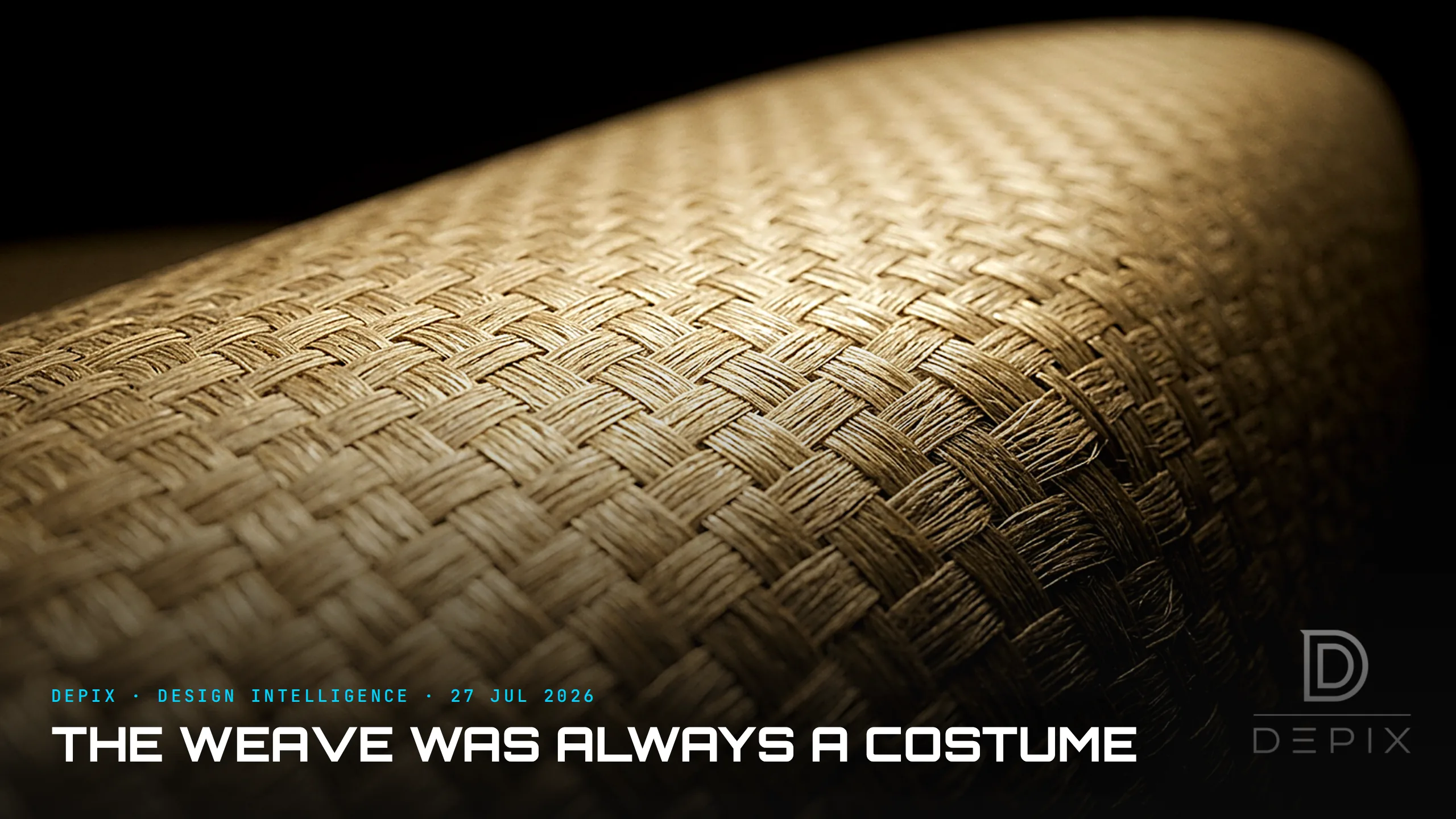
Flax breaks the bundle. It performs, but it does not look like carbon. Woven flax is warmer, more matte, more organic — closer to linen than to a stealth fighter. And that is exactly the interesting problem, because it forces the meaning to become a deliberate decision instead of an inheritance. Watch what BMW actually did: it did not bolt on a generic panel. It designed its own weave, with a unique pattern and a semi-matte finish, and integrated M branding into the roof graphic. BMW is authoring a new visual language for "advanced" — because it knows the look of performance was never intrinsic to carbon. It was a convention we agreed to read, and conventions can be rewritten.
This is the concept-phase lesson hiding inside a materials press release. Every material choice is secretly two choices: what it DOES and what it MEANS. For a generation, carbon let teams ignore the second one. Now that the highest-performing option no longer carries the inherited meaning, someone has to decide, at the concept stage, what the new material should signify — and design that meaning as deliberately as the part itself. Get it wrong and a genuinely superior material reads as "cheap" or "eco-compromise." Get it right and you mint the next status texture, the way carbon once was.
That decision cannot be made late. The weave, the finish, the branding, the way light catches the fibre are locked in with the tooling and the surfacing, at the same early moment the structural choice is made. And it is a decision a hero render actively hides: a studio shot of a flax panel looks premium under controlled light, but whether the material reads as "advanced" or "apologetic" to a real buyer, in a real showroom, against thirty years of carbon-fibre conditioning, lives in a judgement no single glamour image can make for you.
Carbon fibre spent three decades convincing us the weave meant speed. Flax is the reminder that it never did. The weave was always a costume — and the real design act is deciding, on purpose, what the next one says.
Sources:
- ●https://www.supreemcarbon.com/article/carbon-fiber-interior-trim-guide.html
- ●https://patents.google.com/patent/US10766175
- ●https://www.thesupercarblog.com/bmw-m-concept-neue-klasse-has-no-carbon-fibre
- ●https://www.compositesworld.com/news/bcomp-biocomposites-featured-in-bmw-m-concept-neue-klasse-vehicle
- ●https://www.jeccomposites.com/news/by-jec/bcomps-biocomposites-incorporated-into-bmw-m-concept-neue-klasse/
- ●https://www.bmw-m.com/en/topics/magazine-article-pool/natural-fiber-composites-series-production.html
- ●https://www.bmwblog.com/2026/06/13/bmw-explains-why-electric-m3-does-not-have-carbon-fiber/
- ●https://innovationintextiles.com/flax-composite-roof-for-the-neue-klasse/
- ●https://www.press.bmwgroup.com/global/article/detail/T0450786EN/ready-for-series-production:-bmw-group-achieves-major-breakthrough-with-utilization-of-natural-fiber-composites?language=en
- ●https://www.auto123.com/en/news/bmw-m-natural-fibre-composite-flax-2026/72908/