Never Needed a Version Two
The world is addicted to the version number. Every phone, every car, every app arrives already promising its own replacement — a Mk II, a facelift, a "new and improved" that quietly admits the last one was not quite right. We have come to treat iteration as a synonym for progress. The Chemex coffeemaker is the object that argues back.
Designed in 1941 by Peter Schlumbohm, a German-born chemist with a doctorate and a lifetime of some three thousand patents, the Chemex has not changed in eighty-five years. There is no Chemex Mk II, no 2026 edition. The carafe on a specialist's shelf today is, to the millimetre, the one Schlumbohm submitted to the Museum of Modern Art's "Useful Objects" show — where it entered the permanent collection and has stayed ever since. It was not a fluke of taste: in 1958, designers at the Illinois Institute of Technology named it one of the best-designed products of modern times, and Ian Fleming gave James Bond a Chemex as his one domestic constant. An object accumulates that kind of gravity only by being completely resolved.
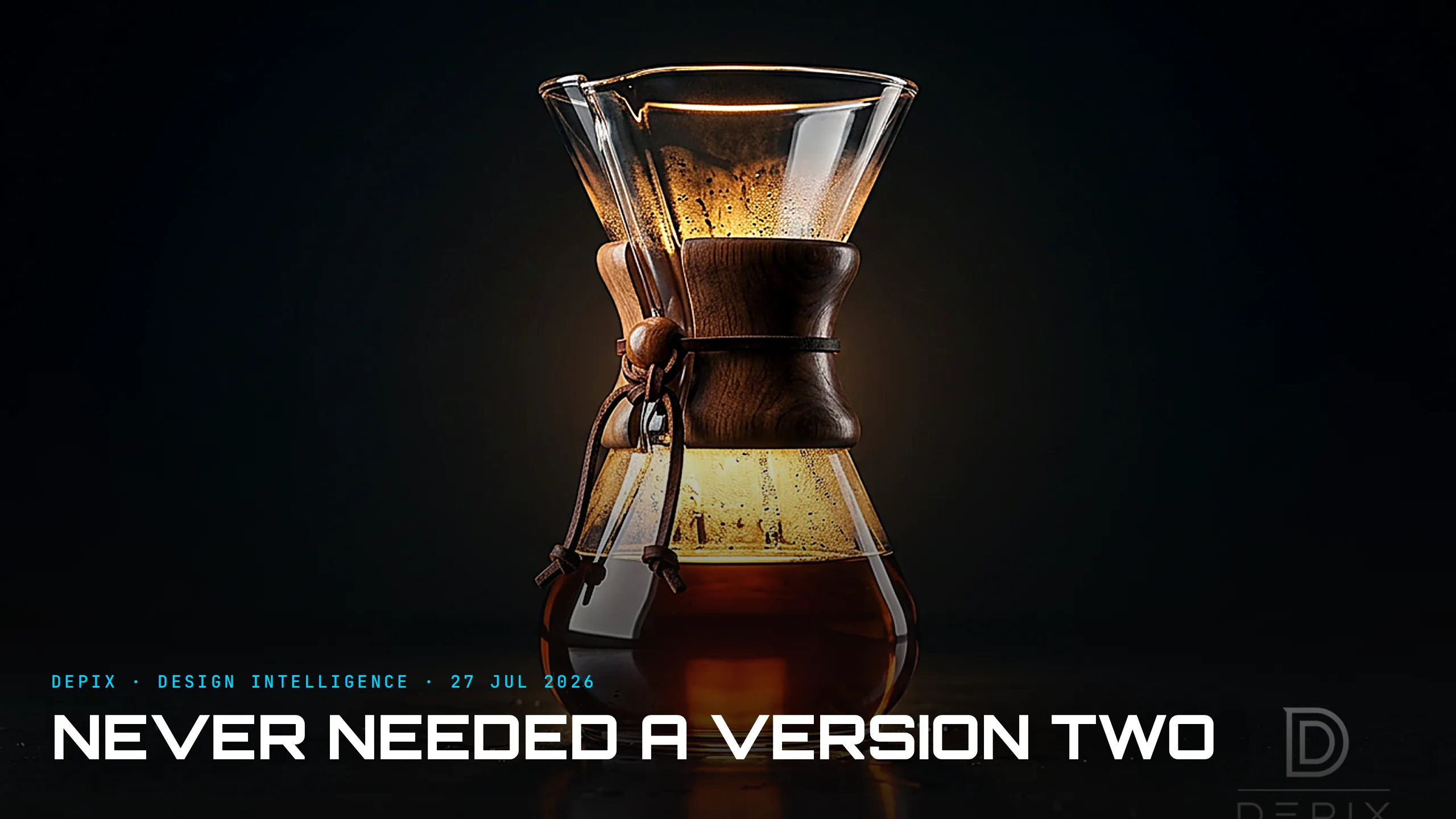
Look at what it actually is. One piece of borosilicate glass in an hourglass form, a wooden collar at the waist, and a leather tie. That is the entire object. No metal to taint the taste, no moving parts to wear out, no electronics to obsolete, no logo on the glass. The wooden collar is not decoration; it is the heat-proof handle. Every element is load-bearing. Schlumbohm, who came to it as a chemist rather than a stylist, borrowed the form directly from the Erlenmeyer flask and the laboratory funnel — shapes already perfected for pouring liquid through a filter without spilling or contaminating it.
His design creed was almost aggressively plain: "a table must be a table; a chair must be a chair; a bed must be a bed." Make the thing be purely, completely what it is, and nothing else. It sounds like a truism until you notice how few products obey it.
Here is the uncomfortable question the Chemex poses to every design team: what if the reason your product needs a version 2 is that version 1 was never actually finished?
We tell ourselves the annual redesign is how we serve the customer. Often it is the opposite — churn that papers over a concept shipped before it was resolved, a search for the answer conducted in public, one release at a time. The Chemex did that work up front. Schlumbohm was not iterating a coffee maker; he was solving a problem — brew coffee with no metallic taste and no sediment, using inert glass, a thick filter and gravity — and once it was solved, it was solved. A finished concept does not ask for a sequel.
This is what the concept phase is actually for. Not to produce a starting point you will spend a decade patching, but to get the idea genuinely right — resolved enough that the object could, in principle, never change again. Most designs never reach that state, which is why they iterate forever. The rare ones that do earn something no amount of downstream polish can buy: permanence. The Chemex has outlived thousands of "smarter", pod-fed, app-connected coffee machines, every one of which promised to improve on it, precisely because it was finished before they started — and the company still makes the identical brewer today.
There is a discipline hiding in that, and it is harder than it looks: knowing when a design is done. The instinct of every team is to keep adding — a feature, a variant, a refresh — because activity feels like value and a blank changelog feels like failure. Restraint is the harder call. The most advanced move available to a design team is sometimes to recognise that the answer is complete and refuse to touch it.
Schlumbohm held more patents than almost any American inventor of his era, most of them long forgotten. The one that endures is the one he had the confidence to leave alone. Eighty-five years on, the Chemex is not a vintage curiosity; it is a quiet rebuke — proof that the goal was never a better version. The goal was to be right the first time, and then to stop.
Sources:
- ●https://en.wikipedia.org/wiki/Chemex_Coffeemaker
- ●https://www.drinktrade.com/blogs/education/chemex-history
- ●https://en.wikipedia.org/wiki/Peter_Schlumbohm
- ●https://www.moma.org/artists/5225-peter-schlumbohm
- ●https://www.moma.org/collection/works/1847
- ●https://chemexcoffeemaker.com/pages/85-years
- ●https://chemex-canada.ca/blogs/news/history-of-chemex
- ●https://www.collectorsweekly.com/articles/mr-chemex/
- ●https://www.chemexcoffeemaker.com/gallery/album/history
- ●https://www.gustatory.co/blogs/insights/history-of-the-chemex-coffeemaker
- ●https://www.thejamesbonddossier.com/lifestyle/food/chemex-coffee-maker.htm