The Man Who Deleted Buttons
For twenty years, Jony Ive's job was to make buttons disappear. The click wheel became a sheet of glass. The home button vanished. Ports, switches and keys were deleted one by one, until the object was a single uninterrupted surface you operated by touching a picture of a control. That aesthetic did not stay in your pocket. Nearly every car interior of the last decade — the touchscreen where the climate knobs used to be, the flush dashboard, the haptic slab on the wheel — is downstream of the iPhone. The industry borrowed Apple's language of subtraction and called it progress.
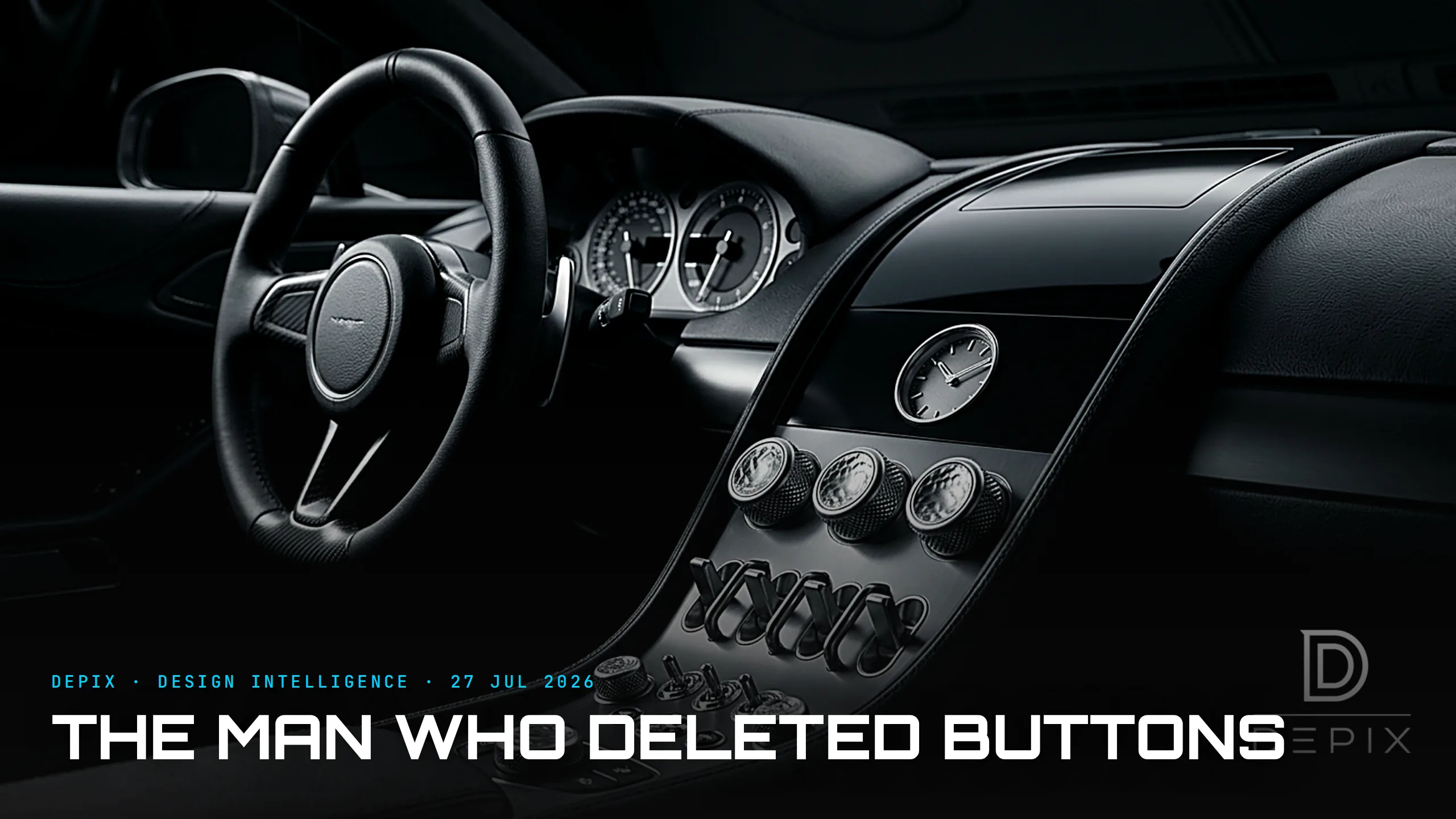
So the most instructive design story of 2026 is what happened when Ive designed a car. Ferrari's first electric car, the Luce (formerly Elettrica), has its interior shaped by Ive and Marc Newson's studio LoveFrom — and they did the opposite of everything the touchscreen decade taught. Dezeen's headline says it plainly: Ive and Newson shun touchscreens. The cabin is full of mechanical buttons, dials, toggles and switches across the dash and side panels; there is a mechanical clock; even the digital cluster is two OLED panels with physical needles sandwiched between them. The man who spent a career deleting physical controls put them back, by hand, into the most futuristic object he has ever touched — a 640,000-dollar one.
This looks like a contradiction. It is not. It is the same designer applying the same value — clarity — in a completely different context, and arriving at the opposite form. On a phone in your hand, your whole attention is on the glass; the screen IS the honest interface, because looking at it is the entire task. In a car at speed, your attention belongs on the road, and any control that demands a look to operate is stealing the one thing keeping you alive. Ive's own verdict on the Luce is blunt: a touchscreen requires you to look away from the road, which makes it "the wrong technology to be the primary interface" in a car. The man who popularised the touchscreen is now saying it does not belong on a dashboard.
The rest of the industry is reaching the same conclusion the expensive way. WardsAuto's 2026 best interiors were defined by a return of physical controls; Audi is reversing its biggest interior decision of the decade, bringing knobs and buttons back after years of screen-first cabins; and the safety case has hardened, with physical controls returning to cut the eyes-off-road time that all-touch cabins forced. A decade of "delete the buttons" is being quietly un-shipped.
The concept-phase lesson is not "buttons good, screens bad." It is that an interface is not a style you pick from a universal catalogue of what looks advanced. It belongs entirely to the CONTEXT of use: where is the user's attention, what can they operate by feel, what is the cost of a glance? The touchscreen dashboard was a category error — a solution imported wholesale from a device whose conditions of use are the exact inverse of a car's. It looked modern, it demoed beautifully on a show stand, and it failed the one test a still image can never show: a driver reaching for the volume in the rain without looking away from the road.
That failure mode is the whole point. A touchscreen cabin and a tactile one look almost identical in a hero render — both clean, both premium, both photogenic. The difference only appears in a state a glamour image cannot depict: a hand, in motion, at speed, needing a control it can find blind. That decision is made at the concept stage, years before a button is tooled, and it is nearly impossible to reverse once the whole dashboard architecture is committed — which is exactly why it has to be judged against the real conditions of use, not the render, before the surfaces are frozen.
Ive did not reverse his philosophy. He proved that simplicity has no fixed shape; it takes whatever form the context demands. The button-less phone and the button-filled Ferrari are the same idea, answered honestly in two different worlds. The mistake was ever believing the answer could be copied from one to the other.
Sources:
- ●https://electrek.co/2026/02/09/ferrari-reveals-name-first-electric-car-luce-shows-off-jony-ive-designed-interior/
- ●https://www.dezeen.com/2026/05/25/electric-ferrari-luce-jony-ive-marc-newson-lovefrom/
- ●https://www.dezeen.com/2026/02/13/jony-ive-marc-newson-lovefrom-ferrari-luce-interior/
- ●https://9to5mac.com/2026/05/25/ferrari-luce-ev-debuts-with-jony-ive-designed-cockpit-and-familiar-design-cues/
- ●https://www.drivespark.com/four-wheelers/2026/ferrari-first-electric-car-interior-retro-gauges-apple-design-081909.html
- ●https://www.engadget.com/transportation/evs/inside-ferraris-luce-ev-the-jony-ive-interior-is-here-130000211.html
- ●https://www.macobserver.com/news/jony-ive-designed-ferraris-first-ev-interior-and-it-feels-very-apple/
- ●https://www.macrumors.com/2026/05/25/ferrari-luce-jony-ive-photos/
- ●https://www.autocar.co.uk/car-news/new-cars/touchscreens-wrong-technology-main-car-controls-says-iphone-designer
- ●https://www.carscoops.com/2026/02/ferrari-luce-ev-retro-interior-jony-ive/
- ●https://www.wardsauto.com/news/2026-wards-10-best-interiors-ux-winners-oems-look-to-redefine-the-in-cab/818842/
- ●https://www.carscoops.com/2026/07/audi-interior-buttons-return/
- ●https://www.kbb.com/car-news/buttons-are-coming-back-to-cars-but-they-will-take-time
- ●https://www.bmwblog.com/2026/04/02/bmw-design-boss-ferrari-luce-jony-ive-physical-buttons/