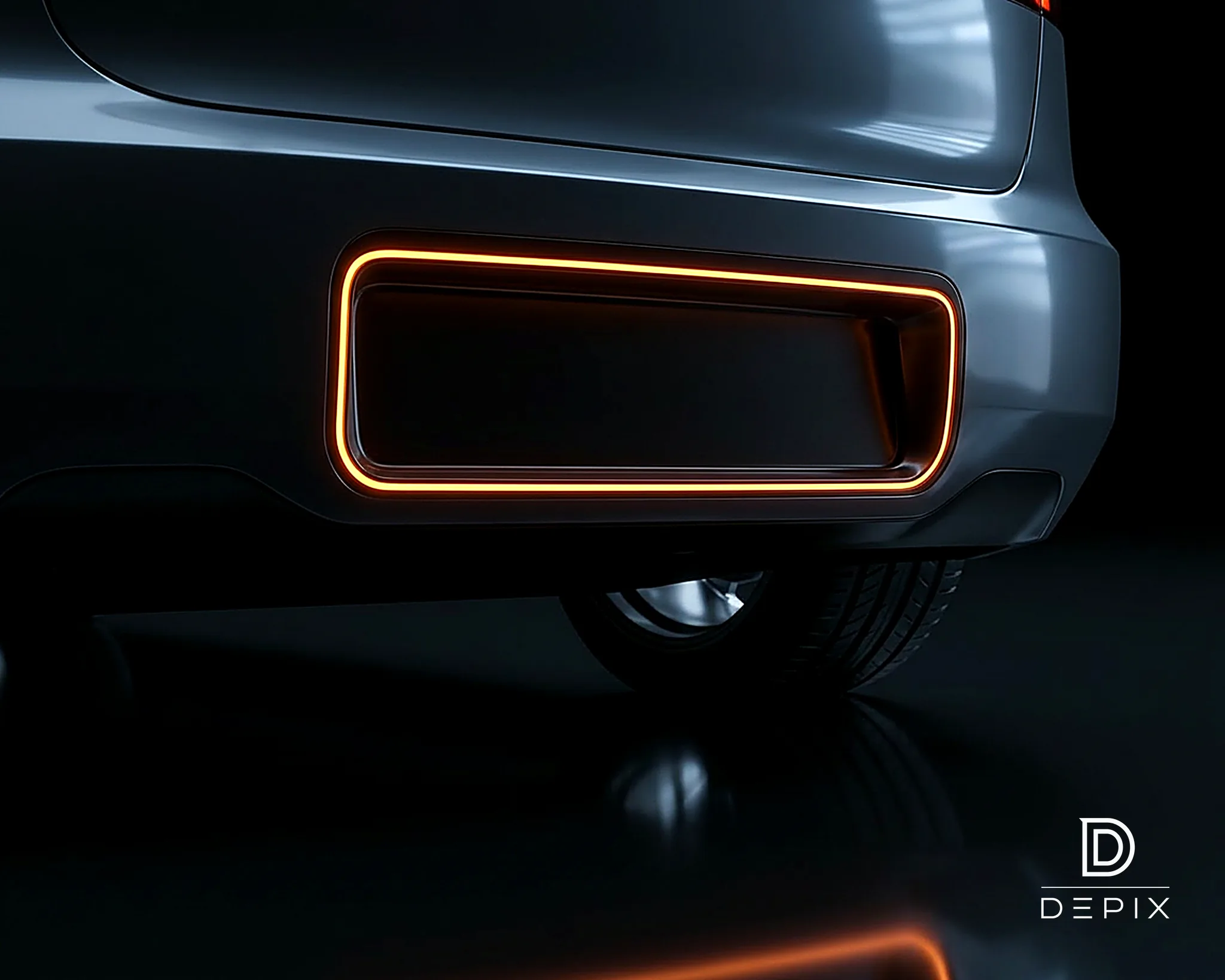
The one rectangle on the car the studio is forced to host and never allowed to own
There is a surface on every car that the exterior designer would delete tomorrow, the government will not let them touch, an aftermarket industry is trying to turn into a screen, and a police camera needs to read at sixty miles an hour in the rain — and it is the same government-issued rectangle bolted to the front and the back. The number plate is the single most-regulated, least-designed object on the modern car. The studio spends two years sculpting a face and a tail, then has to leave a flat-bottomed hole in both for a part it did not draw, cannot restyle, and is legally forbidden from improving. In 2026 four different forces are pulling that rectangle in four incompatible directions at once.
The part the designer would erase
Ask any exterior designer what they would remove from the front of the car if they could, and the front plate is near the top of the list. It interrupts the one surface the brand fights hardest over — the face — with a flat, off-centre, regulation rectangle in a colour and proportion nobody in the studio chose.
The clearest proof is the car that simply refused to mount one. Tesla leaves the front plate off wherever it can, and the reasons given are pure studio language: a front plate is "a protruding feature" that disrupts "a smooth and streamlined body," kept off for "design and aesthetic considerations, aerodynamic efficiency, and legal compliance" — in that order (TESMAG / Tesla Accessories, "Why Don't Teslas Have Front License Plates"). The aero case is mostly a fig leaf — the drag a front plate adds is, by the same enthusiasts' own admission, "an immeasurably small amount," "absolutely minimal" (Tesla Motors Club forum thread on front-plate aerodynamics). The real objection is visual. The plate ruins the face, and the studio knows it.
So the designer's instinct is to make the rectangle disappear: recess it deep, push it low into the bumper, tuck it under the lip, render the car for the brochure with no plate at all. Every press image you have ever seen of a new car wears no number plate, or wears a clean dealer-logo dummy. The flattering image of the front end is, almost by definition, the one state the car is legally never allowed to be in on the road.
The part the law will not let them touch
Here is what the studio is actually leaving room for, and why it is so awkward. The plate is not one size. It is at least two, and they do not agree.
In the United States the standard plate is 305 mm by 152 mm (12 × 6 inches) — squarish, tall. In Europe the standard is 520 mm by 110 mm — long, low, less than half the height (Engineer Fix, "What Size Are License Plates?"; regional breakdown at Car Interior / Alibaba, "Car Number Plate Size Guide by Region"). A global model sold on both continents cannot have one plate recess that fits both. The studio either tools two different rear fascias, or — far more commonly — designs one compromise recess wide enough for the European bar and tall enough for the American square, which means a hole that is oversized for one market and never quite right for either. The "long, shallow recess" you see on European-market cars is not a style choice; it is the 520 × 110 mandate made physical (Car Interior / Alibaba, regional guide).
And the mounting is regulated too. German plates clip into a top-and-bottom channel; French plates slide in; the four-corner bolt pattern is sized 6–8 mm to match European manufacturing bolts; the frame must clear the parking sensors and the reversing camera the studio also has to package in the same crowded patch of bumper (sourcing analysis of EU plate-frame mounting in Alibaba supplier guidance, 2025). The designer does not get to decide where the plate sits, how big it is, what colour it is, how reflective it is, or whether it is lit. The state decided all of that, in two mutually incompatible ways, before the first sketch.
The part an aftermarket is trying to turn into a screen
Where regulation creates a fixed, ugly, universal surface, someone always tries to sell you out of it. The number plate's escape hatch is the digital plate — an e-ink display, sold by Reviver, that shows your registration and can flip to messages, telematics and a stolen-vehicle alert.
The legality is a patchwork that is actively contradicting itself. Digital plates are approved for purchase in only a handful of states — Arizona and California chief among them — though once fitted, the car can be driven anywhere in North America (Reviver, "Digital License Plates: Where We Are, What's Coming Next"). And the direction of travel is not all forward. Michigan, which approved Reviver plates in 2022, is killing them: as of 9 August 2026 every existing digital plate in the state must be replaced with a standard metal one, after the state terminated its Reviver contract for "non-compliance" (WKFR, "Michigan Will Discontinue Digital License Plate Option," 30 December 2025). A surface that was a static legal requirement is, in some states, becoming a powered, connected, app-driven screen — and in at least one, being forcibly switched back to stamped aluminium. The same rectangle is simultaneously the dumbest and the smartest object on the car, depending only on which state line you cross.
The part a camera has to read
And underneath all of it sits the function the rectangle actually exists for: being read. Not by a human — by an automatic plate-reader at a toll gantry, a parking barrier, a police cruiser. That reader needs a flat, high-contrast, unobstructed, retroreflective rectangle at a known size and a known angle. Every design instinct — recess it, tilt it, tint it, frame it, shrink it — is in direct tension with machine legibility.
Legislators are tightening the screws on exactly that tension. California is cracking down harder in 2026 on covered, tinted and obscured plates, escalating from fines toward criminal exposure for plates a camera cannot read (The Ticket Clinic, "Facing Fines and Crimes For Covered Plates: California Cracks Down Harder In 2026"). Florida's SB 488, signed and taking effect 1 October 2026, had to be written specifically to clarify the line — it re-permits ordinary plate frames "so long as the identifying information isn't hidden," while banning any "reflective material or coverings that obscure the plate" or any "illuminated device" that defeats readability (ClickOrlando / News 6, "New Florida license plate rule takes effect this year," 23 April 2026). The law is now litigating the gap between a frame the studio (or the owner) finds tasteful and a frame a camera finds opaque. The plate must be legible first and acceptable second — the exact inverse of how the studio ranks every other surface on the car.
Four rooms, one rectangle, and a render that shows none of it
Count the rooms this part is decided in. The exterior designer wants it gone, or recessed so deep it disappears — and renders the car with no plate at all. The regulator mandates its size, colour, reflectivity, illumination and position, in at least two incompatible standards the global car must straddle. The aftermarket wants to convert it into a connected screen, legal here, banned there, switched off in Michigan by August. And enforcement needs it flat, bright and machine-readable, with covered-plate penalties escalating in 2026.
No single one of those people can sign the rear fascia. The designer's deep clean recess can be the one a toll camera misreads. The compliant, bright, correctly-angled plate is the one that wrecks the tail the studio spent two years on. The market's beautiful flush digital plate is illegal across a state line and dead in Michigan by August. And the legible rectangle the camera needs is the precise thing the brochure image is composed to hide. The decision lives in the intersection of four rooms — and the only artefact most of them ever see is the press render, shot at the one angle, in the one state, with no plate, where the rectangle simply does not exist.
That is the gap. Not a lack of taste, and not a lack of compliance. A lack of a single place where the clean face the designer wants, the mandated rectangle the law requires, the screen the market is selling, and the machine-legible target the camera needs can be put, in the same light, in front of the people who actually sign the car — before the fascia is tooled, the recess geometry locked, and the homologation booked.
Where DEPIX comes in
This is Design Intelligence's natural home: the decision that four parties half-own and nobody can adjudicate from a plate-less glamour shot. DEPIX stages the rear and front of the car as a real decision, not a brochure fiction — the clean recessed face the designer wants and the legally-plated, correctly-lit, correctly-sized, machine-legible reality shown in the same frame, photoreal, so a CEO and a design chief can see the trade as a picture instead of discovering it after tooling, when the European bar plate floods a recess cut for the American square, or the toll camera can't find the registration in the shadow the studio loved. The bold call — how deep to recess it, how to host two incompatible standards on one fascia, whether to bet on a digital plate the next state bans — is exactly the kind of conviction decision that should be pressure-tested against photoreal evidence before it becomes a stamping die. The render is the evidence. The decision is the product.
The studio is forced to host one rectangle it never drew and is never allowed to own. The law fixes it, the market wants to screen it, the camera has to read it, and the press image pretends it isn't there. The only thing missing is a room where all four of those truths are visible at once, on the actual car, before the part is real.
Sources
- ●TESMAG / Tesla Accessories — "Why Don't Teslas Have Front License Plates" — Tesla omits the front plate as "a protruding feature" disrupting "a smooth and streamlined body," kept off for "design and aesthetic considerations, aerodynamic efficiency, and legal compliance."
- ●Tesla Motors Club — "Front license plate affect on aerodynamics" — owner/engineering discussion concluding the front plate adds "an immeasurably small amount" of drag, "absolutely minimal" — i.e. the objection is visual, not aerodynamic.
- ●Engineer Fix — "What Size Are License Plates? Standard Dimensions Explained" — US standard plate 305 × 152 mm (12 × 6 in); European standard 520 × 110 mm.
- ●Car Interior / Alibaba — "Car Number Plate Size Guide by Region" — regional dimension breakdown; European cars designed with a "long, shallow recess" for the 520 × 110 format vs wider, shorter US recesses.
- ●Alibaba supplier guidance — European plate-frame mounting, 2025 — German top/bottom-channel vs French slide-in mounting; 6–8 mm four-corner bolt pattern; frames must clear parking sensors and reversing cameras.
- ●Reviver — "Digital License Plates: Where We Are, What's Coming Next" — digital plates approved for purchase chiefly in Arizona and California; legal to drive anywhere in North America once fitted; pending legislation in several states.
- ●WKFR — "Michigan Will Discontinue Digital License Plate Option," 30 December 2025 — Michigan (approved Reviver in 2022) ends digital plates; all must revert to standard metal by 9 August 2026 after the state terminated the contract for "non-compliance."
- ●The Ticket Clinic — "Facing Fines and Crimes For Covered Plates: California Cracks Down Harder In 2026" — California escalating penalties on covered/obscured/tinted plates in 2026.
- ●ClickOrlando / News 6 — "New Florida license plate rule takes effect this year," 23 April 2026 — Florida SB 488, effective 1 October 2026, re-permits plate frames "so long as the identifying information isn't hidden" while banning reflective coverings and illuminated devices that obscure the plate.

The ugliest thing on the car is the one trying to keep you alive

The Jewel in the Wheel Was Always a Lie. Now It's on a Regulator's Clock.
Related posts

The bridge of air where the gearstick used to be — the console the studio floats for the look, that the elbow and the loose phone never agreed to

The clean pad that cooks the phone it charges — the cabin feature sold as the cableless future, that a fifty-cent wire still beats on every metric that matters

The rails on the roof that carry nothing — the one styling cue that promises a life the car will never live, and quietly taxes the range to do it