
The ugliest thing on the car is the one trying to keep you alive
There is a new object on the modern car that lives at the single highest, most-seen point of the whole silhouette — the centre of the roof, just above the windshield — and the people who put it there and the people who have to draw around it are at open war over whether it should exist at all. It is the autonomy sensor: the LiDAR pod, the "roof bump," the dome the press nicknamed the London-taxi bubble. It is the most safety-loaded component a designer has been handed in a generation, and it is sitting in the one place a designer would never, ever choose to put a lump. In 2026 that fight stopped being theoretical. One of the most design-led brands in the world just ripped the thing off its flagship — and got sued for it.
The bump nobody wanted, on the roof everybody sees
For a hundred years the roofline was sacred. It is the line a designer uses to make a car look fast, planted, expensive — the falling arc from windshield to tail that does more for "stance" than almost any other gesture. You do not put a wart on it. And then autonomy needed a high, unobstructed, 360-degree vantage point, and physics chose the worst possible spot: the top of the car.
Volvo's EX90 wore the result honestly — a roof-mounted LiDAR module integrated at the leading edge of the roof, which the company tried to soften with "a low-profile aerodynamic cover... to reduce drag," pitched in the launch language as an "invisible shield of safety" (Automotive News, 4 November 2022). "Invisible" was the tell. The marketing department was already apologising for a thing the engineering department insisted on. The press was less diplomatic and called it the taxi-cab bubble.
That is the whole problem in one word. The component the safety case calls non-negotiable, the brand language calls invisible, and the customer calls a bump. Three rooms, one lump, no agreement.
Then the most cautious brand in the business deleted it
On 19 November 2025, Volvo confirmed it would stop offering LiDAR on the 2026 EX90 and ES90 entirely — removing the very sensor it had spent years marketing as the heart of "the safest Volvo ever." The stated reasons were a stack of unglamorous ones: "customer demand," "limited hardware supply," and a move "to limit the company's supply chain risk exposure... a direct result of Luminar's failure to meet its contractual obligations" (Carscoops, 19 November 2025).
This is not a small reversal. Volvo had been LiDAR-supplier Luminar's largest single customer; Luminar had already filed a claim seeking significant damages in late October when Volvo first moved the sensor from standard to optional, and on 14 November 2025 the contract was terminated outright (Carscoops, 19 November 2025). A brand whose entire identity is built on safety looked at the roof bump — the cost, the supply risk, the customer cool-response, the drag — and decided the car was better off without the most advanced safety sensor it had ever fitted. The lump lost.
And there was a smaller, almost comic indignity layered on top: the EX90's roof LiDAR was powerful enough that pointing certain smartphone cameras directly at it could permanently damage the phone's image sensor — a warning that circulated widely enough that Volvo and outlets had to address it (The Drive, "Volvo EX90's Lidar Sensor Will Fry Your Phone's Camera"; Kelley Blue Book). The single most visible new object on the car was also, briefly, the one you were told not to photograph.
The other camp is doubling down — and hiding it better
While Volvo retreated, the rest of the industry is sprinting the other way — and the design conversation has quietly become the entire game. At Rivian's AI & Autonomy Day on 11 December 2025, the company committed to rooftop LiDAR for Level 4 self-driving rolling out toward the end of 2026 — but it described its sensor as "completely integrated into the roof," with no spinning element and, pointedly, none of "the bulge of a Volvo EX90," tucked at the forward roof edge just above the windshield (Electrek, 11 December 2025; Gizmodo). Rivian's autonomy chief went so far as to call LiDAR "very affordable" and a "no-brainer" (AOL / Business Insider).
Read those two stories side by side. Volvo took the bump off. Rivian is engineering the bump flat. Both decisions are being argued in the language of design — drag, bulge, integration, how it reads on the roof — as much as in the language of perception range. The defining battle over the most important new safety hardware on the car is being fought, in public, over how it looks.
And the purists say the sensor shouldn't be there at all
Then there is the third camp, which removes the design problem by removing the sensor. Tesla's camera-only philosophy treats LiDAR as a crutch and bets the whole autonomy stack on vision; XPeng has gone further, arguing that LiDAR sensor data "can't contribute to the AI system" used to train its self-driving model (carbuzz / industry coverage, December 2025). Waymo sits at the opposite pole, deliberately loading its cars with LiDAR, radar, cameras and pre-mapped streets — the belt-and-suspenders approach, sensor pods unapologetically on display (Supercar Blondie, "Tesla versus Waymo robotaxi strategy").
So the spectrum, in 2026, runs: celebrate the pod (Waymo), hide the pod (Rivian), apologise for the pod (Volvo's "invisible shield"), delete the pod (Volvo's reversal), or deny it should ever exist (Tesla, XPeng). Five answers. One roof. No consensus anywhere in the industry about whether the most important new object on a car should be seen, hidden, or absent — and that disagreement is not going to resolve, because it isn't really an engineering question. It's a design conviction wearing an engineering costume.
This is a market, not a fad
It would be easy to file all of this under "early-autonomy growing pains." The money says otherwise. The global automotive LiDAR market is projected to grow from US$960.9 million in 2026 to US$6,464.4 million by 2033 — a 31.3% compound annual growth rate, driven by robotaxi and ADAS adoption (Persistence Market Research, via The Auto Channel, 12 May 2026). Hesai alone has shipped over 1.37 million cumulative LiDAR units across ADAS and robotics (The Auto Channel, 12 May 2026). The pod is not going away. It is multiplying — onto roofs, into A-pillars, behind grilles, into corner fascias. Which means the design fight isn't a launch-week problem. It is the permanent new condition of the exterior surface.
Four rooms, one roof, and the silhouette in the middle
Count the rooms this object is decided in. The autonomy / perception engineer wants the sensor as high and unobstructed as physics allows — the roof centreline, full hemispherical view, no compromise on range or field. The exterior designer wants that exact line clean, because the roof arc is the most powerful proportion gesture on the car and a bump at its apex reads as an afterthought bolted to a finished shape. The aero engineer wants whatever shape adds least drag at the highest, most exposed point of the airflow. And the brand / product strategist has to decide the impossible thing — whether this hardware is a status signal that says "this car can drive itself, that's worth paying for," or an embarrassment to be hidden, or a cost-and-supply liability to be deleted, as Volvo just decided in public.
No one of those four can sign the roof. The engineer's perfect vantage point is the designer's ruined line. The designer's flush integration is the aero team's drag penalty and may cost the sensor its range. The strategist's "celebrate it" can curdle into "taxi bubble" overnight. And the one artefact all four of them usually argue over is a flattering three-quarter render — shot, as always, from the low front angle where the roof apex is foreshortened to nothing and the bump simply cannot be seen. The single viewpoint from which the most contested object on the car disappears is the exact viewpoint the studio chooses to decide it from.
Where DEPIX comes in
This is the native habitat of Design Intelligence: a high-stakes decision that four disciplines half-own, that turns on how a thing looks from angles the glamour shot is engineered to avoid, and that — as Volvo just proved — can be made or unmade at the level of a CEO and a design chief rather than a parts engineer. DEPIX stages the sensor pod as a real decision instead of a hidden compromise: the flush-integrated option and the honest raised dome shown in the same light on the same roof, photoreal, from the top-down and rear-three-quarter angles where the apex actually reads — so the people signing the car can see what a customer standing beside it will see, before the housing is tooled and the supplier contract is signed. The bold call — celebrate it, flatten it, or live without it — is exactly the kind of conviction decision that should be pressure-tested against photoreal evidence, not discovered in a clinic after the line is locked. The render is the evidence. The decision is the product.
The most cautious brand in the business just deleted the most advanced safety sensor it ever built — and got sued over it — partly because of how a lump on the roof made the car look. That is not an engineering failure. It is the absence of a single room where the look, the physics, the drag and the brand meaning of the bump could be seen together, before it was real.
Sources
- ●Automotive News — "Volvo reorients lidar to create 'invisible shield of safety' on EX90," 4 November 2022 — roof-mounted LiDAR module, low-profile aerodynamic cover to reduce drag, "invisible shield of safety" positioning.
- ●Carscoops — "Volvos Are Losing Their LiDAR Roof Bump For Good And Luminar Isn't Happy," 19 November 2025 — Volvo removes LiDAR from 2026 EX90/ES90; customer demand, limited supply, Luminar contract terminated 14 November 2025; Luminar damages claim.
- ●The Drive — "Volvo EX90's Lidar Sensor Will Fry Your Phone's Camera" and Kelley Blue Book — roof LiDAR powerful enough to damage smartphone camera sensors.
- ●Electrek — "Rivian AI & Autonomy Day," 11 December 2025 and Gizmodo — Rivian rooftop LiDAR for Level 4, fully integrated, "no bulge of a Volvo EX90," rolling out end of 2026.
- ●AOL / Business Insider — "Rivian's autonomy chief says lidar is 'very affordable' and a 'no-brainer'" — Rivian autonomy leadership framing LiDAR as affordable and obvious.
- ●Carbuzz — "Rivian Announces LiDAR Next Year," December 2025 — XPeng argues LiDAR data "can't contribute to the AI system"; camera-vs-LiDAR debate.
- ●Supercar Blondie — "Tesla versus Waymo robotaxi strategy" — Tesla camera-only vs Waymo's LiDAR-radar-camera belt-and-suspenders approach.
- ●The Auto Channel / Persistence Market Research — "Automotive LiDAR Market to Grow at 31.3% CAGR," 12 May 2026 — automotive LiDAR market US$960.9M (2026) to US$6,464.4M (2033), 31.3% CAGR; Hesai 1.37M+ cumulative units.

The bend in the window that belongs to no one is the one a brand will fight hardest to keep
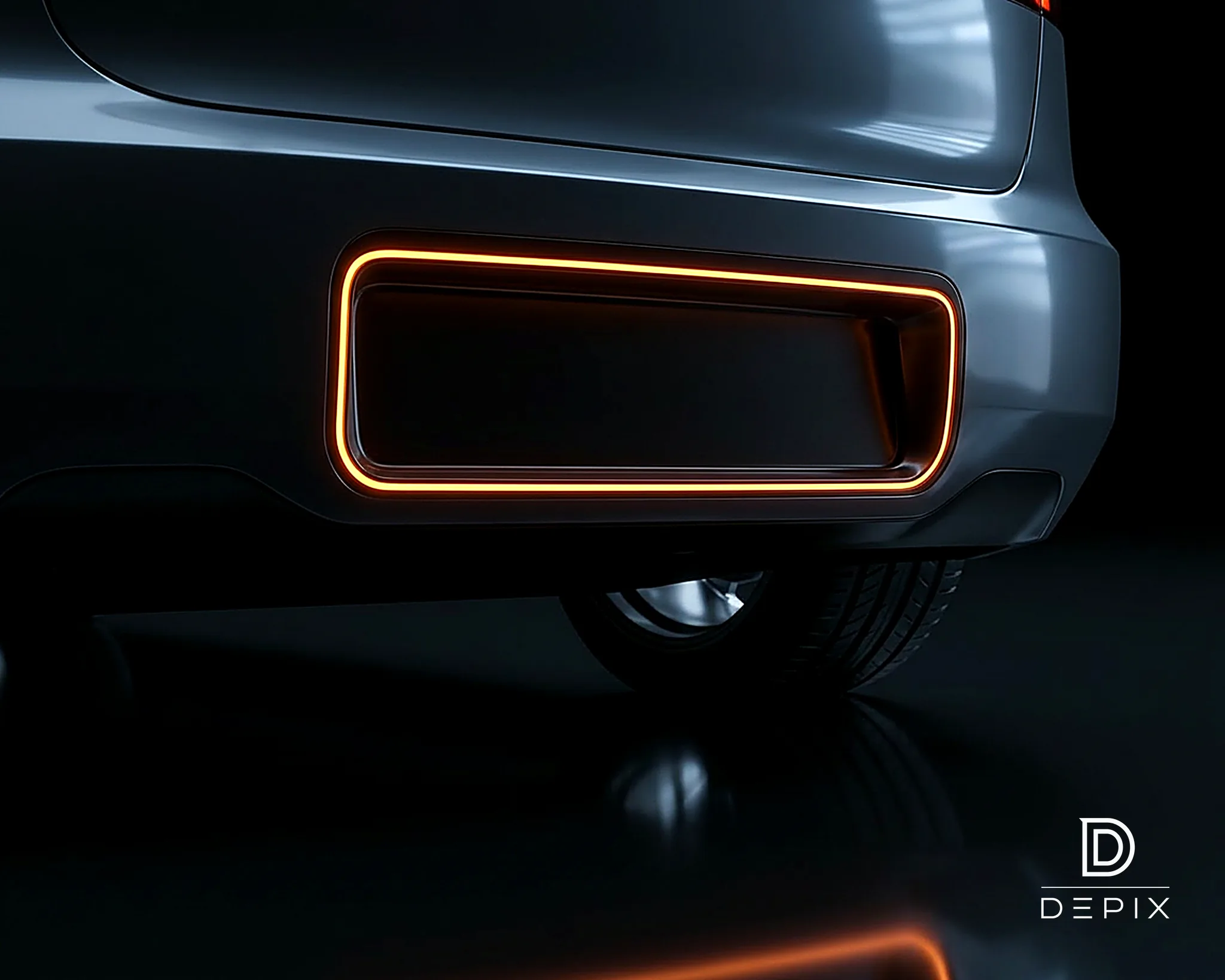
The one rectangle on the car the studio is forced to host and never allowed to own
Related posts

The bridge of air where the gearstick used to be — the console the studio floats for the look, that the elbow and the loose phone never agreed to

The clean pad that cooks the phone it charges — the cabin feature sold as the cableless future, that a fifty-cent wire still beats on every metric that matters

The rails on the roof that carry nothing — the one styling cue that promises a life the car will never live, and quietly taxes the range to do it