The Lever That Vanished
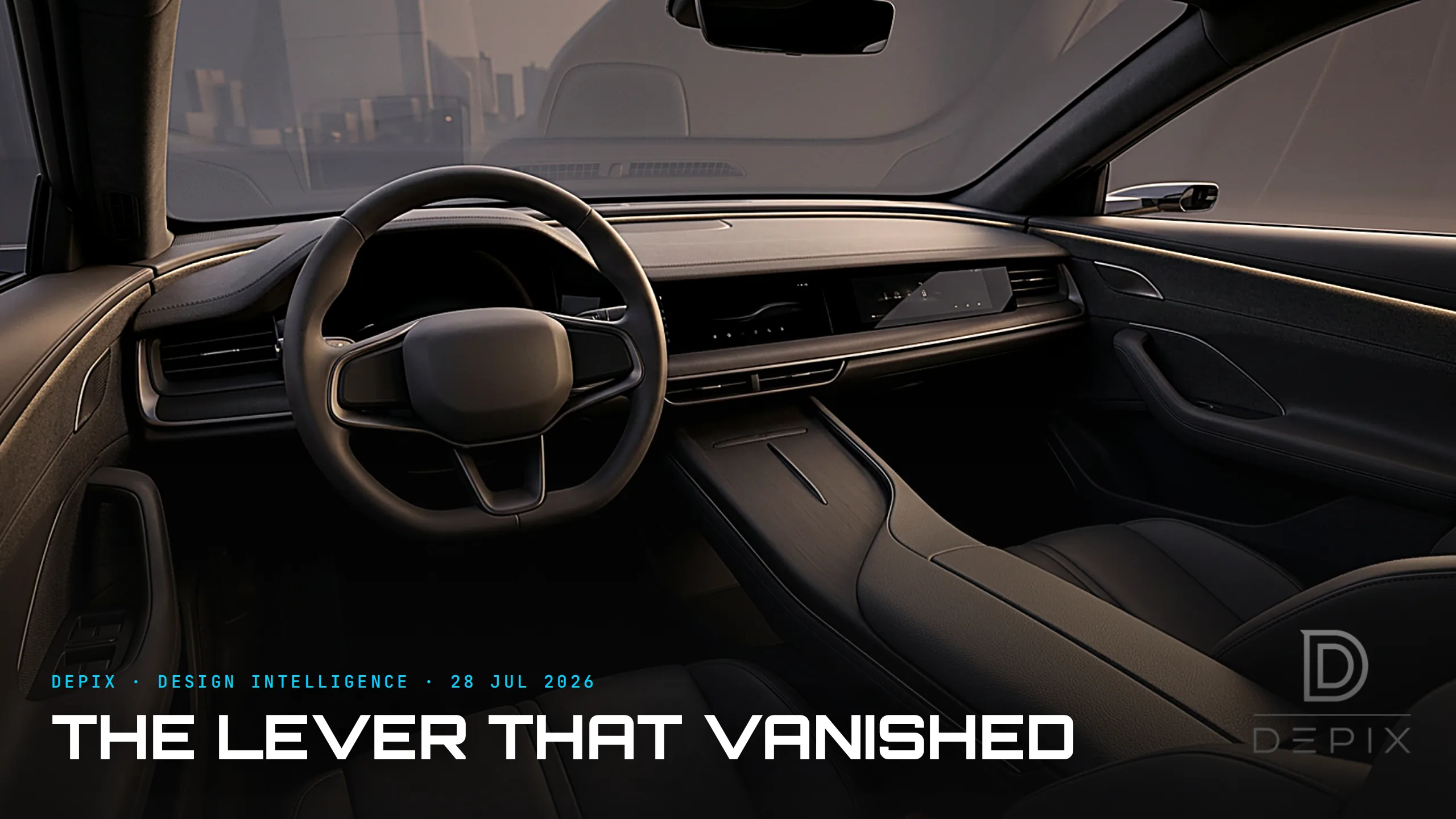
For a century, the gear selector was the tactile heart of the car. It was a big, deliberate lever rising out of the centre console, and you learned to operate it entirely by feel - a downward pull into Drive, a firm shove up into Park - eyes on the road, your hand knowing exactly what the car was doing because the lever's position told you. Then, quietly, it began to vanish. Today the shifter might be a stalk on the column, a rotary dial that rises out of the console, a row of push-buttons, an overhead switch, or nothing at all - on newer Teslas you swipe a touchscreen, or let the car guess which direction you want.
The engine behind the disappearance is shift-by-wire. Once the mechanical linkage between lever and transmission was replaced by an electronic signal in the 1990s, the shifter no longer had to be a big lever in a specific place. It could be anything, anywhere. And designers had every reason to move it: the centre console is prime real estate, and deleting the shifter frees it for storage, screens, or simply a cleaner, more spacious cabin. On paper it is a pure win - a packaging and surface upgrade with no downside.
Except the shifter was never only a control. It was a safety-critical interface with a century of accumulated muscle memory, and its physical position was itself the feedback: you could tell, without looking, what state the car was in. Redesign it for the clean console and you risk deleting that feedback - which is exactly what happened in the most infamous case in modern interface design. Fiat Chrysler adopted a "monostable" electronic shifter: a lever that always springs back to the same centre position after you nudge it, so its resting place tells you nothing about the gear you are actually in. Drivers, trusting decades of learned behaviour, stepped out believing they were in Park when they were not. FCA recalled 1.1 million vehicles; regulators tied the design to 266 crashes and 68 injuries. And in June 2016 the actor Anton Yelchin was crushed by his own Jeep Grand Cherokee - a vehicle in that very recall - when it rolled down his driveway. The lawsuits ran for years.
That is the whole design-intelligence lesson in one dark example. The monostable shifter was, by the metric of the showroom, better: sleeker, more modern, more "advanced" than a chunky mechanical lever. It optimised for how the car looked and felt on a test drive. What it quietly discarded was the one thing a gear selector exists to guarantee - that a human being can know, instantly and without looking, whether the car is about to move. The interface was redesigned for the eye and the first impression, and against the muscle memory and the worst-case moment.
The deeper point is that "cleaner and more modern" is not a neutral upgrade when it touches a safety-critical, deeply-learned control. Every new shifter format makes the same trade in miniature: a stalk frees the console but pushes the gear state off to the side; buttons are compact but abstract; a touchscreen swipe is elegant but has no feel at all, and no fixed home a hand can find in a panic. Some are resolved beautifully - a rotary with distinct detents and a clear readout, a stalk with unambiguous positions. Others, like the monostable lever, are resolved for the render and against the driver. Tellingly, the industry has begun walking some of it back: Tesla, having stripped its stalks entirely, quietly returned traditional turn-signal stalks to an updated Model Y - an admission that not every physical control was dead weight.
This is a concept-phase decision, and an unforgiving one. How you select drive direction is chosen when the whole console and HMI architecture is laid out - the packaging, the wiring, the screen strategy, the physical controls - years before anyone steps out onto a sloped driveway. By the time the failure mode shows up in the real world, the interface is frozen in tooling and shipped by the million. You cannot patch muscle memory after the fact. So the choice has to be made at the very start, with the discipline to ask not "does this look cleaner" but "can a stranger, in the dark, in a hurry, still tell what this car is about to do."
The lever vanished because it was in the way of a cleaner cabin, and mostly that was fine. But the cases where it went wrong all share one root: a safety-critical control redesigned to serve the surface instead of the human - decided early, admired in the studio, and paid for later, on a driveway. The best interfaces earn their minimalism. The worst borrow it against the one moment that matters.
Sources:
- ●https://en.wikipedia.org/wiki/Gear_stick
- ●https://en.wikipedia.org/wiki/Shift_by_wire
- ●https://www.jalopnik.com/these-are-some-of-the-weirdest-shifters-and-gear-select-1851210171/
- ●https://www.autoblog.com/features/tesla-new-gear-shifter-guesses-direction-you-want
- ●https://www.jalopnik.com/heres-the-problem-with-jeeps-recalled-gear-shifter-1782364420/
- ●https://www.consumerreports.org/consumerist/regulators-close-investigation-into-confusing-gear-shifter-linked-to-68-injuries-266-crashes/
- ●https://www.thelemonfirm.com/2019/12/10/fcas-dangerous-gear-shifter-defect/
- ●https://www.wapnernewman.com/recalled-jeep-shifter/
- ●https://abcnews.com/amp/Entertainment/anton-yelchin-killed-jeep-included-rollaway-recall/story?id=39991253
- ●https://moparinsiders.com/fcas-monostable-shifter-lawsuit-is-scheduled-to-go-to-trial/
- ●https://www.aol.com/stalk-tuah-updated-tesla-model-154400225.html