The Grille Didn't Die. It Became a Screen.
The received wisdom about electric cars is that they are killing the grille. No engine to cool, no need for a big open mouth, so the front of the car goes smooth and blank. And on the engineering, that is true: an EV doesn't need a grille the way a combustion car does - there is no radiator demanding a large unrestricted intake, and sealing the front cuts aerodynamic drag, which buys range. The grille, as a functional object, is genuinely obsolete.
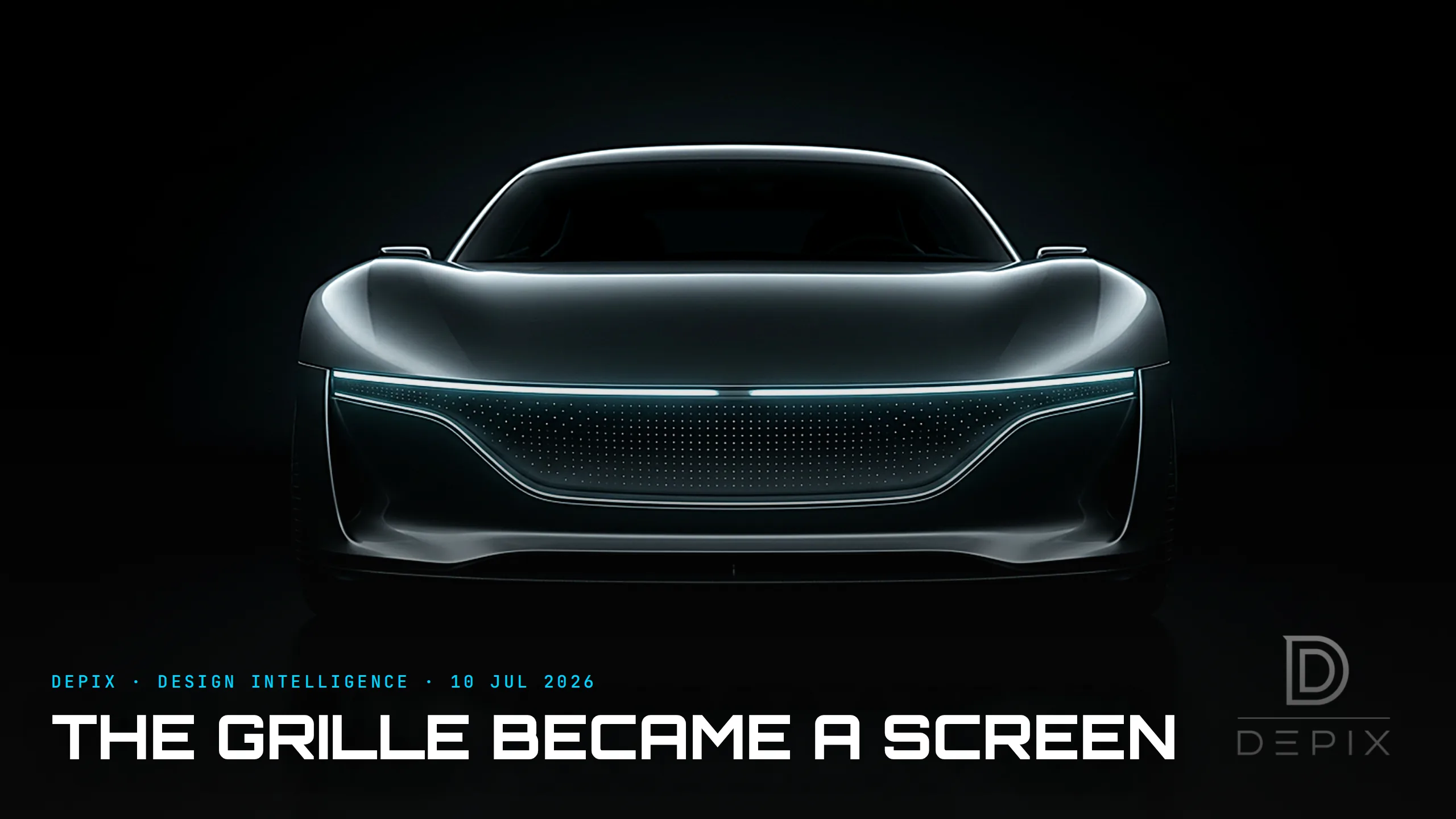
And yet the opposite of death is happening. Look at what the brands are actually doing and the grille is not disappearing - it is being reborn as something more powerful: pure identity, with the function stripped out.
Mercedes is the clearest case. Its electric C-Class carries an illuminated grille built from 1,050 individual light elements. The all-electric GLC goes further still, with 942 backlit, animated LED dots forming a pixelated grille graphic - a grille that lights up and moves. Mercedes describes it as light replacing steel, and the shape deliberately quotes heritage icons like the upright W108 and 600 Pullman. This is not a company hiding the grille. It is a company doubling down on it, turning it into the single most theatrical element on the car.
BMW is running the same experiment from the other end. It dialled back the giant kidney on the second-generation iX3, but it now sells an illuminated kidney that traces the grille's outline in light, lit whether the car is moving or parked. Opposite aesthetics, identical instinct: keep the shape, drop the holes, make it glow.
Here is the part that matters for anyone who designs anything at all. The moment a signature element stops being functional, it becomes purely a decision about identity - and that decision gets harder, not easier. When the grille had to breathe, its size and its openings were half-dictated by the radiator behind it; physics did some of the design for you. Take the physics away and every millimetre is now a choice: what shape says "us," how much light, animated or still, a solid shield or a lit graphic. A blank canvas is the most demanding brief there is, precisely because nothing external is deciding it for you.
That is why so many of the smooth, sealed EV faces that look "clean" in a render actually fail on the road. Without the grille's built-in structure, a featureless nose reads as anonymous - a phone on wheels, interchangeable with six other brands. The teams getting it right are the ones treating the front not as a surface to simplify but as brand real estate to author: a defined light signature, a considered proportion, a face you would recognise in a wing mirror at two hundred metres. The grille's job was never really cooling. Cooling was the excuse. Its real job was always to be the face - and that job just got promoted.
Which puts the whole question exactly where it belongs: at the concept stage. You cannot bolt a convincing new face onto a car late in the process. The illuminated panel, the light signature, the sealed shield - each one has to be designed into the proportions and the surfacing from the first sketch, or it looks like an afterthought stuck onto a generic body. And the two winning strategies prove the point precisely because they are opposites: Mercedes maximal, a wall of animated light; BMW minimal, a glowing outline. Neither is more "correct." Both work because both are decisions, made early and committed to, about what the brand is.
So the grille is not dying. The excuse for it is. What remains is the pure design problem that was underneath all along - deciding what a face should say once nothing forces its shape - and it turns out that was always the interesting part. Getting that decided before a single surface is locked, so the identity survives the switch from steel to light, is exactly the work we care about at Depix.
Sources:
- ●Carscoops - Mercedes' electric C-Class (illuminated grille)
- ●Carscoops - All-electric Mercedes GLC's huge illuminated grille
- ●Motor1 - Mercedes teases an even bigger light-up grille
- ●CarBuzz - Mercedes GLC LED grille, new design language
- ●MotorAxle - Mercedes' 942-LED illuminated electric GLC grille
- ●NetCarShow - Mercedes-Benz GLC EV (2026)
- ●BMW USA - iX with available Illuminated Kidney Grille
- ●Carscoops - Mercedes design looks more convincing electrified
- ●DriveQuip - Why electric cars don't have grilles
- ●Danillo Almeida - Front grilles are the toughest enemies of EV design
- ●Motor & Wheels - Why don't electric cars have grilles
- ●ReCharged Commute - Why EVs don't have grilles