F1's 2026 Cars Don't Have One Shape - And That's the Future of Design
When the grid arrives at Spa-Francorchamps on 17–19 July for the Belgian Grand Prix, most of the talk will be about lap times, the Ardennes weather, and whether the new cars are "too slow." Almost none of it will be about the thing that actually matters to anyone who designs objects for a living: the 2026 car is the first mainstream vehicle in history whose shape is a variable, not a fixed thing.
Start with what everyone agrees on. The 2026 regulations make the cars smaller, narrower and lighter — the wheelbase drops from 3,600mm to 3,400mm, width from 2,000mm to 1,900mm, and the minimum weight falls by roughly 30kg. The power unit moves to a near-50/50 split of combustion and electric energy, running on 100% advanced sustainable fuel. All true, all widely reported, and all beside the point.
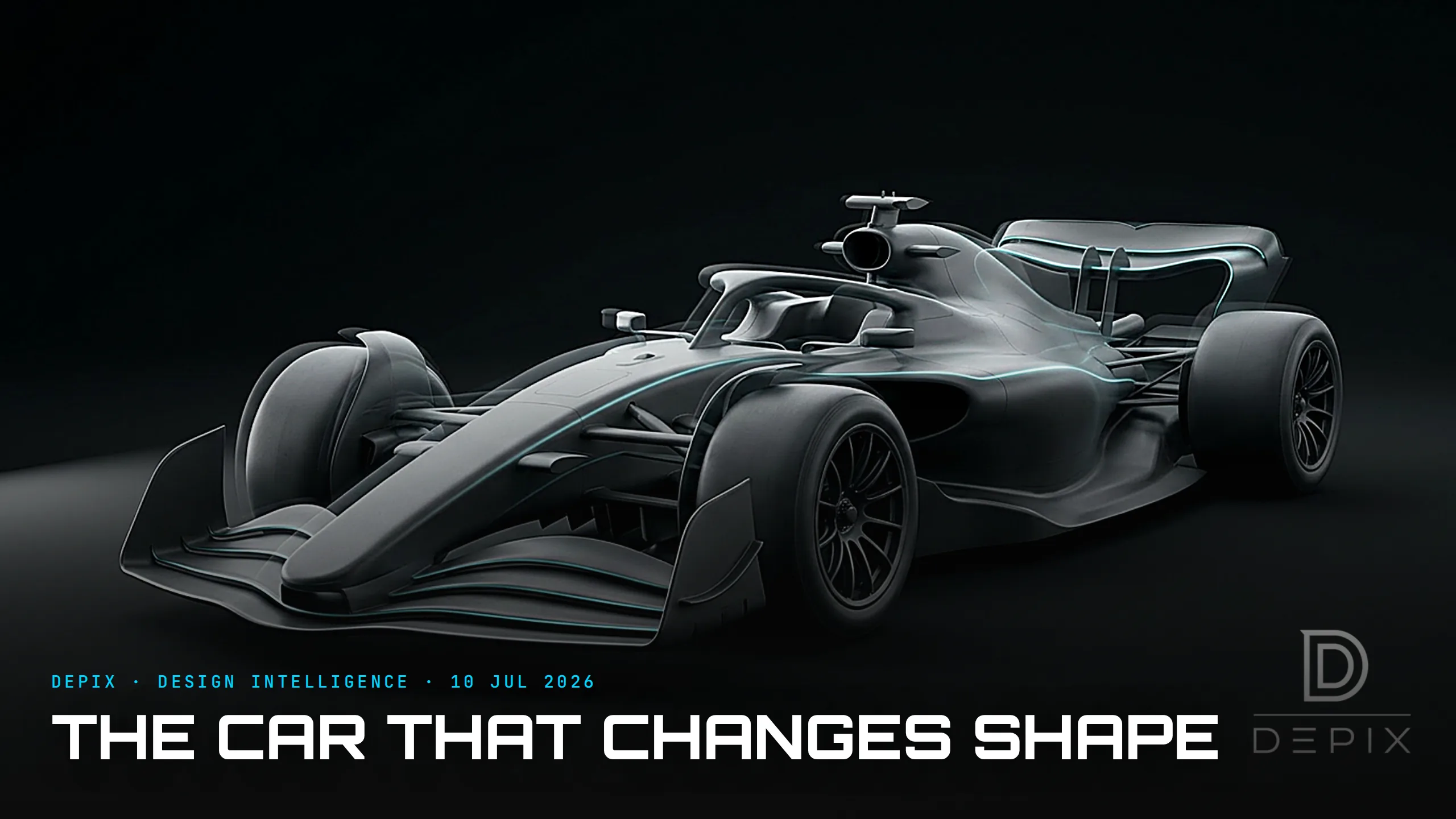
The real change is active aerodynamics. For the first time, the front and rear wings move together as one coordinated system. In what the FIA now calls "Corner Mode" (the setup first nicknamed Z-mode), the flaps angle up for maximum grip through a bend; in "Straight Mode" (the old X-mode) they flatten out to shed drag and chase top speed. The driver switches between them on any straight longer than about three seconds.
Read that as a designer, not a fan. For a hundred years, designing a car has meant resolving a single silhouette — one set of surfaces, one stance, one answer. Active aero breaks that. The 2026 car does not have a shape; it has a low-drag shape, a high-downforce shape, and a defined path between them. The object stops being a noun. It becomes a verb.
That is not a racing curiosity — it is where the whole industry is heading, just faster and more visibly. Road cars have been inching toward this for years; supercars are quietly turning into road-going aircraft. The Zenvo TSR-S has a "Centripetal" wing that tilts in corners to convert downforce into cornering force; the Pagani Huayra and Lamborghini's ALA system split their aero left-to-right mid-bend; McLaren blends active flaps straight into the bodywork so the surfaces you admire are also the surfaces that move. Active grille shutters, deployable spoilers and adaptive ride heights are already on ordinary cars. The direction of travel is unmistakable: more and more of a vehicle's form will be a range, not a fixed point.
Here is why it matters beyond racing, and why it lands squarely on the concept phase. When form becomes a state, the most important decisions move earlier and turn more abstract. You are no longer choosing only what the thing looks like; you are choosing what its states are, which one is the resting identity, and how it behaves in the transition between them. Get that concept-stage brief wrong — decide too late that the object needs to reconfigure — and you end up bolting a mechanism onto a shape that was never meant to move, which is exactly how you get the ugly active wing that reads as an afterthought. Get it right and the movement feels inevitable, even beautiful, because the whole form was conceived around it.
This is the uncomfortable part for a design culture that still treats the "hero shot" — one frozen three-quarter view — as the deliverable. A car that changes shape cannot be judged by a single render. Its identity has to survive being in motion, in multiple configurations, and still read as one coherent thing. That is a far harder brief, and it is decided almost entirely up front: in the proportions, the surfacing logic and the mechanical packaging, long before anyone picks a colour.
The 2026 cars will divide opinion at Spa. Some will find them awkward; the early renders have already drawn mixed reactions. But the awkwardness is the growing pain of a genuinely new idea — that a designed object does not have to hold still. The teams that thrive under these rules will be the ones that stopped designing a shape and started designing a system of shapes, a decision made not on the drawing board but at the very first concept sketch. That shift, from fixed form to designed behaviour, is the one worth watching. At Depix, it is the shift we build for.
Sources:
- ●Formula 1 - Belgian Grand Prix 2026
- ●RacingNews365 - Belgian GP 2026 date & schedule
- ●Formula 1 - Everything you need to know about the 2026 rules
- ●Motor Authority - FIA unveils 2026 F1 car design
- ●FIA - F1's New Era (2026)
- ●McLaren - Explaining F1's new 2026 regulations
- ●Formula 1 - 2026 aerodynamic regulations explained
- ●Motorsport.com - New 2026 F1 renders and terminology
- ●F1 Chronicle - 2026 F1 aerodynamics explained
- ●The Drive - Active aero and road-going aircraft
- ●CarBuzz - Zenvo TSR-S active aerodynamics
- ●CarBuzz - 8 active wings and spoilers
- ●Williams Racing - What's new in F1 for 2026
- ●Formula 1 - FIA unveils 2026 regulations (agile cars, active aero)