The Fastest Car at Goodwood Makes No Sound. That's a Design Problem.
The theme of the 2026 Festival of Speed is "The Rivals — Epic Racing Duels," a nostalgia trip through motorsport's great head-to-head battles. But the most interesting rivalry at Goodwood this year isn't on the poster. It's the quiet war between two definitions of speed — and the noisy one is losing.
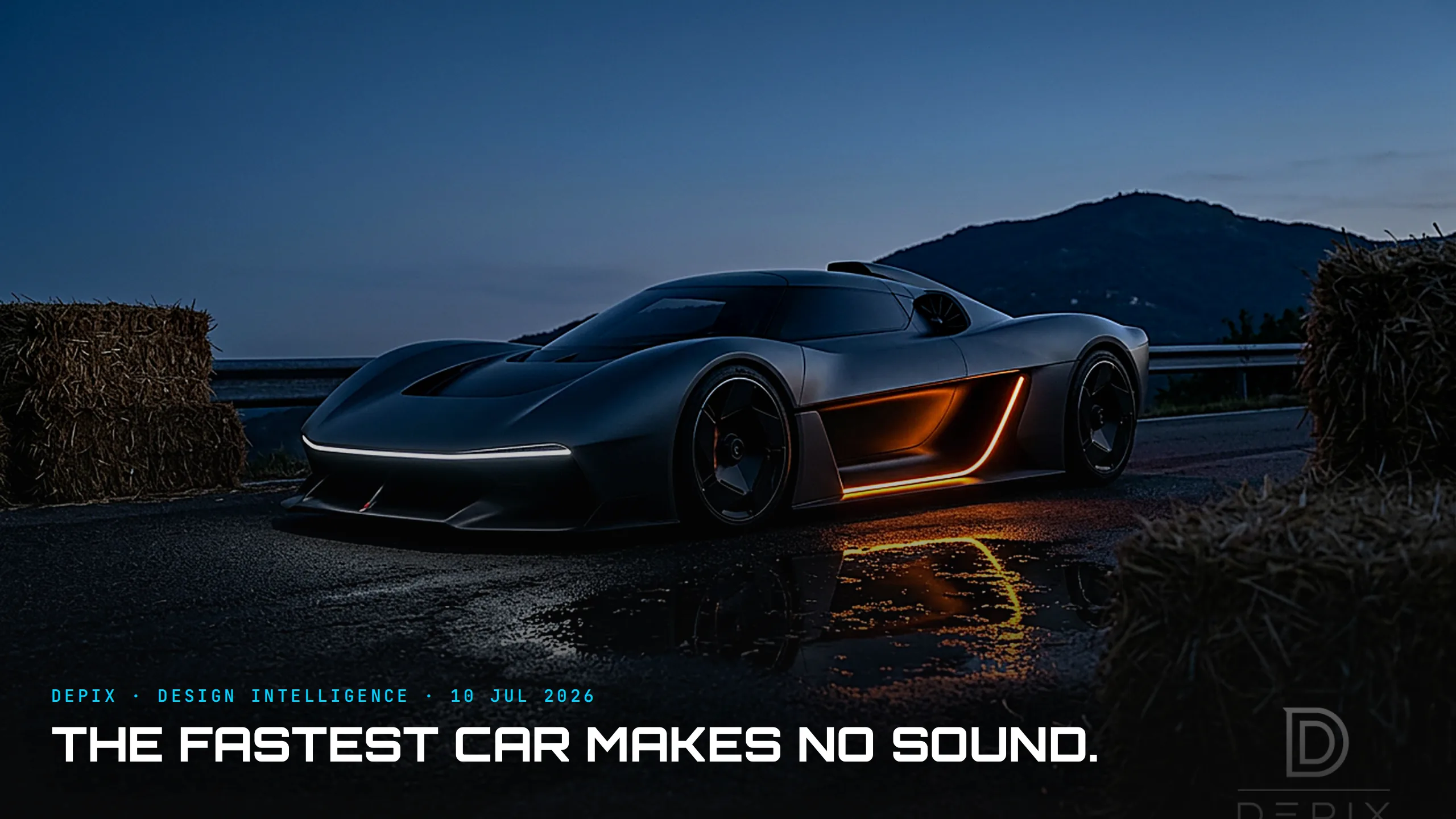
Walk the hill and the reveals make it plain. The headline debut is the Yangwang U9 Xtreme, a BYD-backed electric hypercar certified at 308mph — the fastest production car ever built, and completely silent at a standstill. The electric debut list runs long, and the new-car list overall leans hard toward the battery. Even the combustion halo cars — the production Apollo EVO, Maserati's Project GT4 — now share the paddock with machines that will out-accelerate them without a sound.
And the clock has already settled the argument. The outright hillclimb record belongs to the McMurtry Spéirling, a sub-1,000kg electric fan car that climbed the hill in 39.08 seconds in 2022, beating the Volkswagen ID.R's 39.9 from 2019. The fastest thing ever to climb Goodwood's hill has been electric, and near-silent, for the better part of a decade.
Here is the design problem hiding inside that stat. For a century, a performance car got most of its emotional payload for free. The intake snarl, the exhaust crack, the gearchange, the mechanical drama — the soundtrack did the work of making you feel fast, often before the car had actually done anything. Electric performance deletes that channel. The Spéirling is violently quick and emotionally blank at rest; the U9 is a spec sheet until it moves. The sensation of speed has been decoupled from the making of it.
Which means the feeling now has to be designed in, on purpose, rather than arriving as a by-product of combustion. And — this is the part most teams underestimate — that decision belongs at the concept stage, not in a late "character tuning" sprint. You cannot bolt drama onto a finished EV. If a car is meant to feel fast, its proportion, its stance, the way the light signature loads the front, the weight and travel of the controls, even the sound it chooses to make, all have to be resolved together, up front, as a single intention. Get it right early and the whole object reads as quick standing still. Get it wrong and you have built a 300mph appliance.
You can see both answers on the hill. The Spéirling's is honesty: it looks like a ground-effect missile because it is one, its fan-car silhouette a direct expression of the 2,000kg of downforce doing the real work. The pantomime supercars around it take the opposite route, borrowing the visual grammar of speed — vents, wings, slashes — much of it now purely decorative. Both can be valid. What separates them is whether the drama was a concept-phase decision about what the car is, or a costume applied to disguise what it isn't.
The tells are everywhere once you look. Some makers reach for synthetic engine noise piped through the speakers — a crutch that quietly admits the shape isn't carrying the emotion on its own. Others invest the drama where it becomes permanent: a light signature that reads as tension rather than ornament, a body-side that looks loaded even at rest, seats and controls weighted to feel serious the moment you touch them. The first approach is reversible and skin-deep; the second is baked into the architecture, and it is far harder to fake. Only one of them still convinces once the novelty of instant torque has worn off — which is precisely why it has to be committed to early, before the surfaces are frozen.
This is the shift Goodwood quietly documents every July. The Festival still sells theatre and nostalgia, and the crowds still cheer loudest for the loud stuff. But the A-to-Z of what actually matters is increasingly a story about how brands manufacture emotion once physics stops handing it over for free, and the wider 2026 programme is a live audit of who has worked it out.
At Depix, this is exactly the kind of problem we think belongs at the front of the process — in the concept phase, where form, stance, materials, light and interaction can still be decided as one feeling rather than reconciled at the end. The engine used to be the emotion. Now the design has to be. The fastest car on the hill makes no sound, and that is the most demanding brief the industry has faced in a generation.
Sources:
- ●Goodwood - Explore Festival of Speed
- ●Autocar - 2026 FoS, every car you need to see
- ●Yahoo Autos - 5 big reveals, from a paint job to a 308mph EV
- ●Electrifying - every electric car and EV debut at FoS 2026
- ●Motor1 - every new car debuting at Goodwood FoS 2026
- ●autoevolution - Apollo EVO production version at Goodwood 2026
- ●Stellantis Media - Maserati previews Project GT4 at Goodwood 2026
- ●Top Gear - McMurtry Speirling breaks the Goodwood hillclimb record
- ●Forbes - the comically fast McMurtry Speirling sets the hillclimb record
- ●Magneto - Festival of Speed 2026, what to see
- ●Goodwood GRR - the best photos from the 2026 Festival of Speed
- ●Auto Express - Goodwood FoS 2026 live, A-Z of all the key cars
- ●CarBuzz - 2026 Goodwood FoS, what to expect