The Panel Gap
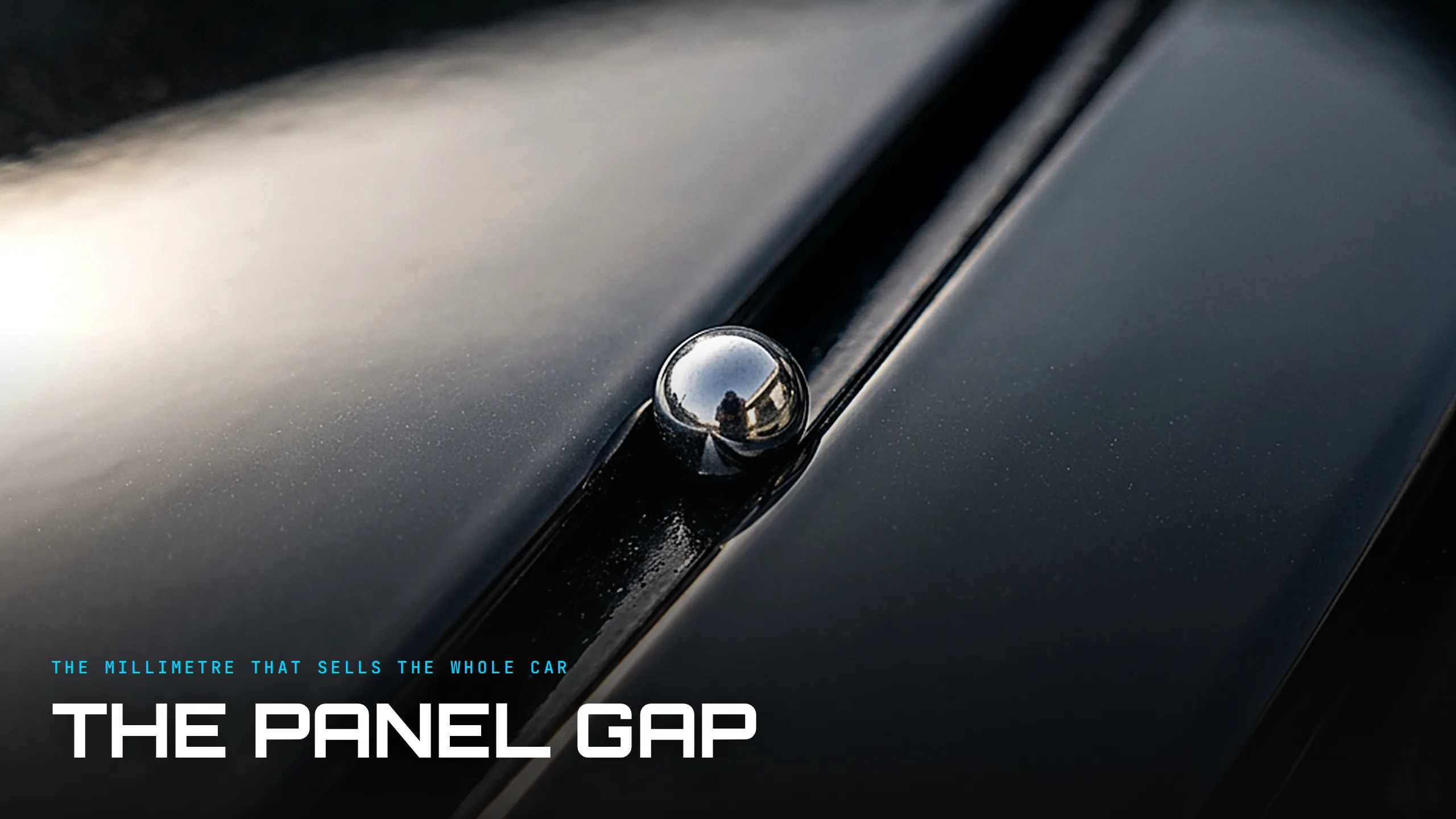
The most revealing quality test on a car is a millimetre wide. Run a finger along the seam where the door meets the wing, where the bonnet meets the headlight: if the gap is tight, even and dead-parallel, the car reads as expensive and carefully made; if it wanders, widens or steps, it reads as cheap — whatever the paint or the badge says. The panel gap is one of the few ways the industry can actually quantify "perceived quality", and buyers use it as a proxy for everything they cannot see. Lexus understood this in the 1990s with an advert of a ball bearing rolling flawlessly along the shut-lines; the gap has been a luxury signal ever since.
We obsess over colour, material and finish — but the gap is the finish of the join, the negative space between two panels, and it does more to signal care than almost any surface. Generally, the smaller and more even the gap, the higher the perceived quality, which is why Porsche and the German premium brands treat consistent split-lines as non-negotiable. It is not only cosmetic, either: the right clearance is what lets a door shut cleanly, keeps water and wind out, and kills the whistles and leaks a misaligned seam creates. The gap is precisely where invisible engineering tolerance becomes visible aesthetics.
And a gap is the end of a long chain. Every stamped panel carries a tolerance; every joint stacks one tolerance onto the next; by the time forty pressed parts are welded into a body, those errors have compounded into the wandering seam you see in the metal. Tight gaps are not a polishing job at the end of the line — they are the product of the body architecture, the material choice and the way the parts are joined, all settled at the engineering and concept phase. This is why the brands famous for their gaps pour fortunes into stamping precision, assembly fixtures and robotic measurement long before a body reaches the paint shop — the seam is won or lost in the factory's geometry, not in any final polish. You cannot sand a good gap into a badly-conceived body. The millimetre is designed in, or it is not there at all.
Here is the frontier, and it inverts the entire problem. Instead of chasing a perfect gap between many parts, the industry is starting to remove the parts. Gigacasting uses 400-tonne machines to injection-cast a single piece of aluminium that replaces seventy to a hundred separately stamped and welded components in about eighty seconds. Tesla pioneered it in 2020; Toyota is bringing Tesla-style gigacasting to a 2026 electric model, with a three-section body in which the rear alone folds 86 parts into a single casting. Megacasting is now being called "production minimalism" precisely because it collapses the body shop's welding complexity — and every join you delete is a gap that can never be misaligned. The best panel gap turns out to be the one that does not exist.
It is not free, and the catch is instructive. A single giant casting is far harder and more expensive to repair after a crash than a bolted-on panel, and committing to it locks the body architecture extremely early. That is exactly the point: gigacasting is a concept-phase bet that trades late flexibility for a structural integrity — and a gap-lessness — you simply cannot add later. Whether a maker chases the perfect millimetre through tolerances or erases it with one casting, the decision that governs the seam is made in the first architecture, never at the final inspection.
The panel gap is the smallest surface on a car and one of the most eloquent. It is the point where all the invisible decisions — how the body is structured, how tightly it is toleranced, how many pieces it is made from — become a line you can see and a quality you can feel with a fingertip. For a century the goal was to make that line as tight and even as human hands could manage. The next century's goal is to make it vanish. Either way, the gap was never a finishing detail. It was a concept-phase decision wearing a one-millimetre disguise.
Sources:
- ●Car Design News — The mysterious role of perceived quality in car design
- ●The Truth About Cars — What Do the Auto Industry's Good Panel Gaps Look Like?
- ●Jalopnik — Why Car Body Panel Gap Size Is Important
- ●MyCarPark — Why Panel Gaps Matter When Buying a Used Car
- ●ASSEMBLY — Gigacasting: The Next Big Idea in Automotive Manufacturing?
- ●iLoveTesla — Toyota's Embrace of Gigacasting (Tesla pioneered it in 2020)
- ●Teslarati — Toyota to use Tesla-style gigacastings for a 2026 EV
- ●TechTimes — Toyota Gigacasting Platform: rear section folds 86 parts into one cast
- ●Automotive Manufacturing Solutions — Production minimalism: how megacasting is reshaping manufacturing
- ●KrASIA — Toyota Revolutionizes Car Assembly with 'Gigacasting'
- ●All About Industries — Megacasting components: and the repair?