Pebble Beach Judges the Past to the Rivet. The Concept Lawn Judges the Future. It's the Same Test.
Every August, one stretch of California coast hosts two contests that look like opposites.
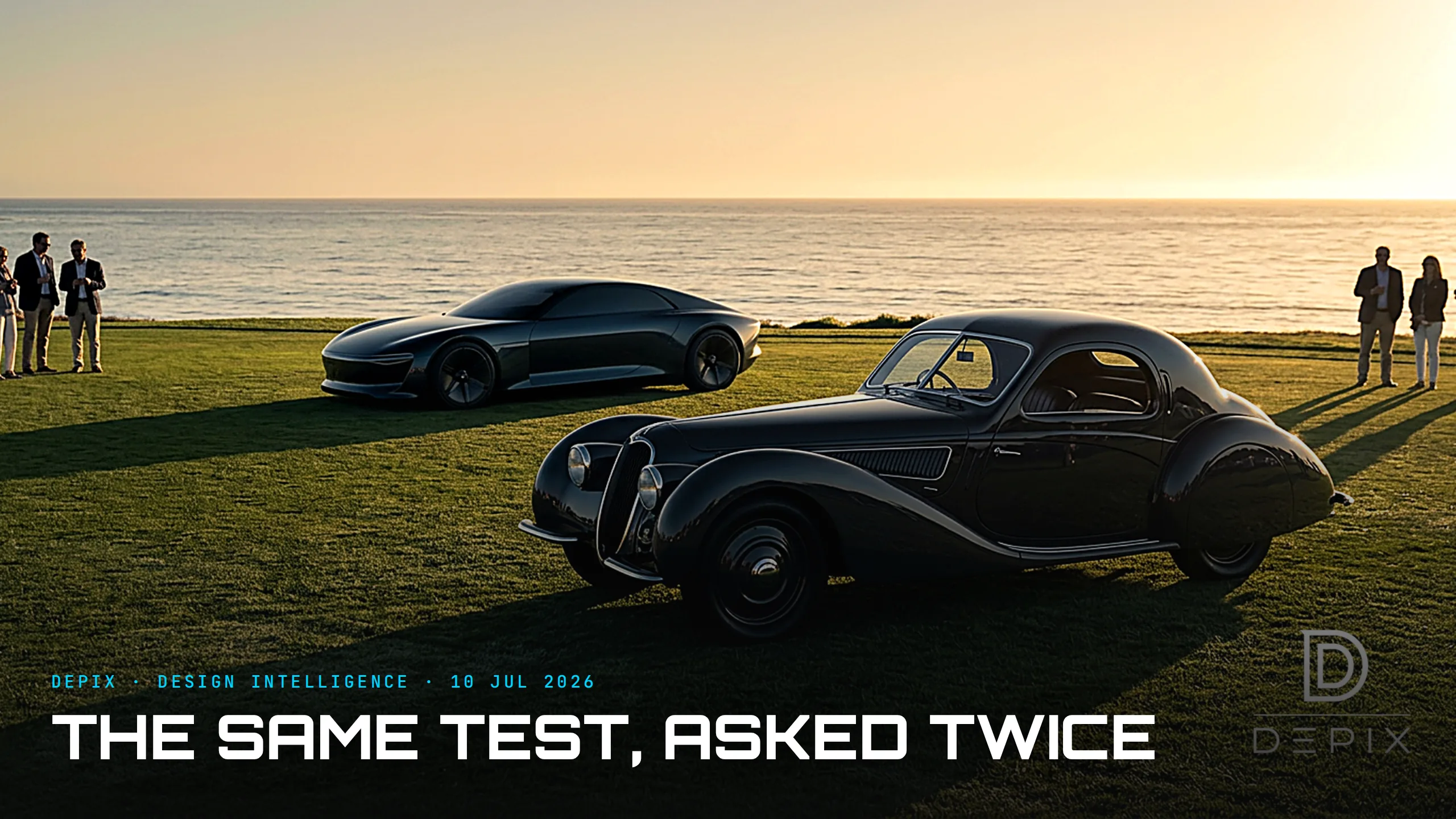
On the 18th fairway at Pebble Beach, the 75th Concours d'Elegance will judge pre-war coachwork to the rivet — the correctness of every fastener, the exact weave of a seat piped in 1936, the originality of a finish laid down before the war. A hundred yards away, on the Concept Lawn, the same weekend rewards the opposite instinct: manufacturers reveal design studies that point a decade or more into the future. Monterey Car Week 2026 runs 7–16 August, and the concept debuts have quietly become as much the story as the concours itself.
It is tempting to read these as rival philosophies — preservation versus futurism, the rear-view mirror versus the windscreen. They are not. They are the same test run in two directions, both asking one question: does this object carry an identity clear enough to survive time? At the concours, the answer is proven backwards — the cars that earn a spot on that lawn are the ones still unmistakably themselves 70, 80, 90 years on. On the concept lawn, the same answer is a bet placed forward.
The most revealing exhibits are where those two directions touch. At the 2025 gathering, Bentley's EXP 15 — a three-door electric grand tourer built to preview the marque's future language — openly quoted the 1930 Speed Six 'Blue Train.' A concept meant to sell the next decade reached back nearly a century for its proportions, and it worked. It worked precisely because the original identity was resolved so early and so completely that it still reads as Bentley across an electric powertrain, a new silhouette and ninety-six years. It was not alone: Mercedes-AMG brought the 1,341-horsepower GT XX, Chevrolet used The Quail to unveil its Corvette CX Vision Gran Turismo, and the lawn held the strongest concept field in years alongside a run of near-production debuts.
Here is the uncomfortable part for anyone shipping a product. The cars that win at Pebble Beach and the concepts that steal the lawn share a trait, and it is not beauty. It is conviction decided early. The designs that endure were never the ones chasing the trend of their moment — chrome for chrome's sake, fins because everyone had fins. They were the ones with a resolved core idea that every later decision either protected or expressed. Trend-chasing cars do not age; they date. A clear identity ages into a classic.
That resolution happens at the concept phase — long before tooling, before the clay is milled, before a single supplier is briefed. It is the moment a team decides what the object is: what is essential and load-bearing, and what is merely fashion riding along. Get it right and the design always has somewhere to return to when the trends move on. Get it wrong and no amount of downstream surfacing craft rescues it — you have built an expensive artifact of one particular year.
This is why a concours and a concept lawn belong on the same grass. The concours is a decades-long A/B test of concept-phase decisions, scored by survival. The concept lawn is that same decision made live, in public, outcome unknown. The judges in tweed and the designers in black — the ones the design press chase between lawns — are grading the same exam.
At Depix, that is the whole premise of working at the concept phase. Most of a product's identity — the part still legible in a photograph decades later — is locked in the earliest hours, when the idea is cheapest to change and most expensive to get wrong. The tools that matter are the ones that let a team explore that space fast and commit with conviction, before the cost of changing their mind balloons.
When the 2026 Concours crowns its Best of Show on 16 August, glance across at the concept lawn. You are not looking at the past and the future. You are looking at the same question asked twice — and the same answer both times: identity is decided early, or not at all.
Sources:
- ●Pebble Beach Concours d'Elegance (75th)
- ●Pebble Beach Concours 2026 event calendar
- ●Monterey Car Week 2026 - dates & schedule
- ●Automotive News - the Monterey concept lawn
- ●Bentley EXP 15 debut at Monterey Car Week 2025
- ●Mercedes-AMG at Pebble Beach 2025
- ●The Quail, A Motorsports Gathering
- ●Monterey Car Week 2025 highlights (Surface)
- ●The wildest concepts at Pebble Beach 2025 (Yanko Design)
- ●Pebble Beach & Monterey new-vehicle debuts (Clean Fleet Report)
- ●Car Design News
- ●Depix - design intelligence at the concept phase