Simplify, Then Add Lightness: Why a Car's Weight Is Decided Before the First Line Is Drawn
There is a sentence every car designer knows and most of the industry has quietly stopped obeying. Colin Chapman, the founder of Lotus, built a company on it: "Simplify, then add lightness." He put it more bluntly, too - "adding power makes you faster on the straights; subtracting weight makes you faster everywhere." It sounds like a driving tip. It is actually the most demanding design philosophy in the business, because lightness is the one property you cannot add at the end.
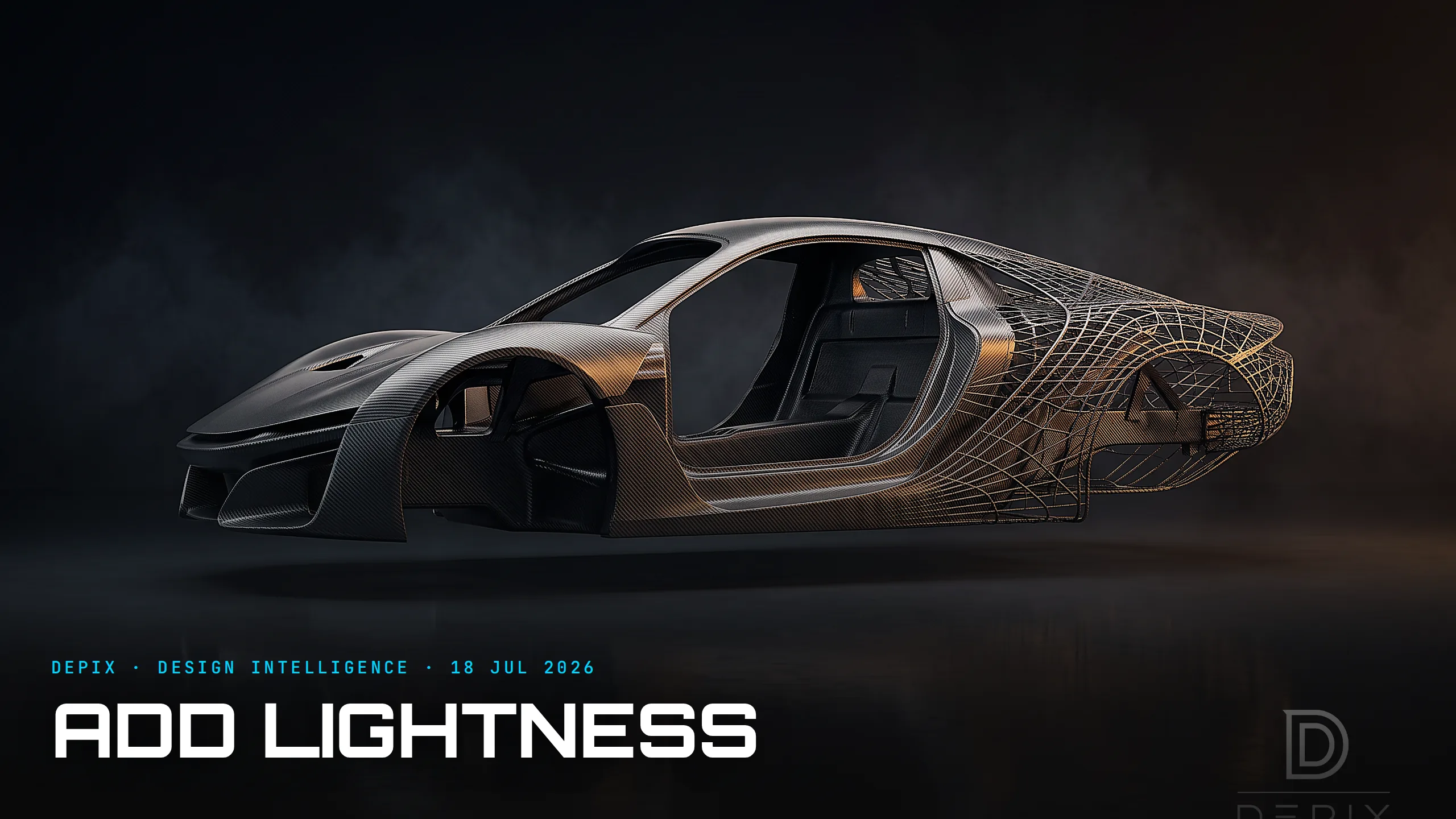
Weight is not a number you discover when the car is finished. It compounds from the very first architectural choice, through a mechanism worth calling the weight spiral. A heavier body needs a stronger structure to carry it; a stronger structure needs bigger brakes to stop it; bigger brakes need bigger wheels and tyres; all of that needs heavier suspension - which needs more structure again. Every kilo you accept early demands more kilos to support it. Run the loop the other way and the physics rewards you: a lighter car accelerates harder, stops shorter, corners faster and uses less of everything to do it. Lightness improves every dynamic at once. That is why Chapman chased it so ruthlessly, and why the Lotus 25's stressed monocoque - the body itself carrying the loads, now built in carbon rather than aluminium - was a concept-phase decision, not a diet applied later.
Which makes the present moment worth naming, because the industry is going the other way. Electric cars are, on average, around 30% heavier than the combustion cars they replace, because the battery pack alone is 20-25% of curb weight and more than cancels the weight saved by deleting the engine. Worse, mass is now piling on in layers: thicker floors to protect the battery, extra crash structure, heavier wiring, cooling, sensors and driver-assist hardware. The costs are not abstract. Every extra 100 kg raises energy use by about 0.6 kWh per 100 km, and crash research finds a 1,000-lb increase raises the probability of a fatality by 47%. Heavier cars are thirstier, harder on tyres, and more dangerous to everyone else on the road; some of the heaviest EVs on sale now clear three tonnes.
Here is the uncomfortable part for designers: on an EV, lightweighting buys less efficiency than it used to, because regenerative braking recovers much of the energy a heavy car wastes. So the easy justification - "it saves range" - is weaker, and the temptation is to stop fighting weight at all. That is exactly the trap. Weight still governs how the car turns, stops, feels and how safe it is for the person in the next lane, and none of that regenerates. Because of the spiral, the decision cannot be deferred: you cannot value-engineer lightness back in during detailing, any more than you can add it to a finished building. Compact battery and a smaller car, or a big battery and a heavy one; a load-bearing structure, or a body hung on a heavy frame - that choice is made in the first architectural sketch, and everything downstream inherits it.
That is the whole point, and it generalises far beyond cars. Complexity, like weight, compounds. Every feature you add to a product demands supporting features - settings to manage it, code to maintain it, documentation to explain it, and more features to fix the ones that now conflict. The lightest, clearest thing you can ship is almost never restraint applied at the end; it is an architecture chosen at the start to need less. "Adding lightness" is a paradox on purpose: you reach it by removing, and removal is the hardest discipline in design because it means deciding early, on incomplete information, what the thing is truly for.
Chapman's real insight was never about cars being fast. It was that the most valuable properties - lightness, clarity, coherence - are subtractive, and subtractive properties have to be designed in from the first move or they are gone. The solid-state batteries expected in road tests from 2026-27 may hand the industry a reprieve on mass. But the discipline underneath will still separate the cars that feel alive from the heavy ones that merely work. Decide how light it must be before you decide anything else - because by the time you can weigh it, it is already too late to change the answer.
Sources:
- ●The Genius of Colin Chapman: Simplify, then add lightness - Classic Driver
- ●Applying Colin Chapman's ruthless 'simplify and add lightness' - Terence Dove
- ●Colin Chapman: F1 Innovator - Monocoque & Ground-Effect - F1 Briefing
- ●Simplify, then add lightness - Lotus Garage
- ●No more adding lightness: Farewell to the Chapman-Ethos - ViaRETRO
- ●Why Are EVs So Heavy? - Motor1
- ●Why New Energy Vehicles Are Getting Heavier - TaiRui
- ●Electric Vehicles: No Room for Further Weight Increase - 36Kr
- ●Lightweighting and EV energy consumption (real-world testing) - ScienceDirect
- ●EV Weight Surge Sparks Safety and Environmental Concerns - Motor Illustrated
- ●Heaviest Electric Vehicles - Kelley Blue Book
- ●Why are EVs so heavy? - Bluewater Healthy Living

The Sound of the Door: What a Car's 'Thunk' Reveals About Designing Quality You Can Hear

Designed by One Hand: What a Concours Lawn Reveals About Why Committees Can't Make a Beautiful Car