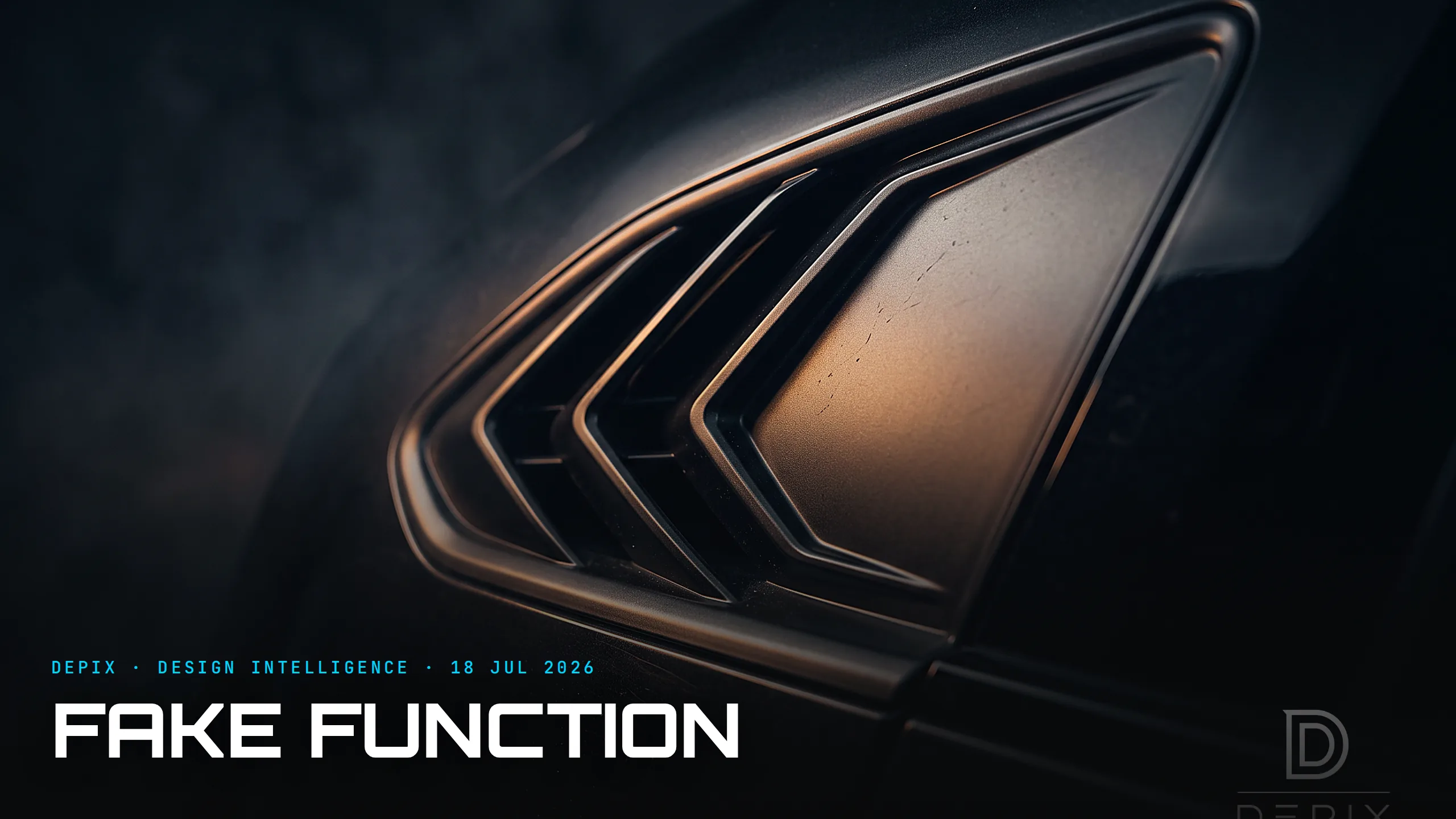
Fake Vents, Fake Pipes: What Decorative Deception Reveals About a Design's Integrity
Run your hand over a modern performance car and you'll find things pretending to be other things. The aggressive side "vent" that's a solid blank of plastic behind the slats. The four fat exhaust tips, when the real pipe is a single outlet hidden below, exiting under the bumper. The "carbon fibre" trim that's a printed film. The V8 snarl that's a recording through the speakers. None of it does what it claims - and every one of those fakes was chosen, deliberately, at the concept phase.
Start with the tailpipes, because they're the most brazen. Fake exhaust tips are now standard equipment: multiple pipes read as power, so cars keep the quad-tip look while the real exhaust - often a single pipe on a small, efficient engine - exits discreetly underneath. Manufacturers have quietly tried to trick us with fake vents and exhausts for years. EVs, which make almost no noise of their own, now pipe artificial engine sound through the speakers - Hyundai's Ioniq 5 N simulates a revving engine with shift points, Dodge gives its electric Charger a 600-watt "roar," BMW hired Hans Zimmer. And that glossy carbon-fibre trim is frequently a printed sticker; real carbon has a smooth vacuum-formed back and can't be brightly coloured.
Some of it is genuinely defensible, and it's worth saying so. Fake tips give designers freedom to style the rear while engineers place the real pipe for performance and safety; a decorative outlet stays clean while a hidden, downward pipe blackens out of sight; a plastic tip is cheaper than a chromed one aligned through the bumper. The fake borrows the visual language of function - a vent says "this is fast and needs cooling," pipes say "power," carbon says "lightweight" - without the cost or engineering of the real thing. It is, in a word, cheap richness.
But decorative fakery is a trust decision, and it compounds against you. Enthusiasts notice, and here is the trap: the moment you spot one fake, you start doubting everything. The blanked-off vent makes you wonder what else on the car is a costume. It's the exact inverse of the panel gap: a shut line is an un-fakeable honesty signal, while a fake vent is a fakeable dishonesty signal - and both get read, instantly and below conscious thought. A brand that fakes function is quietly telling you it believes you can't tell the difference, or won't care.
None of this is an argument against ornament. Design has always used non-functional elements - a colour, a chrome line, a decorative grille pattern - and there is nothing dishonest about a shape that is honestly just a shape. The line isn't decoration; it's deception. A pattern that reads as ornament is fine. A "vent" that mimics an air intake for a cooling system that doesn't exist is a lie, because it borrows the authority of a function it doesn't perform. The controversy over artificial engine sound is the same line drawn in audio: a new sonic identity, honestly presented, is design; a recording pretending to be a combustion engine that isn't there is costume. The concept-phase question is never "should this be decorated?" It's "will this element tell the truth about what it does?"
And that is decided early, in the surfacing and packaging work, when a designer chooses whether that dramatic intake will actually feed air to something or merely look like it might. Real function costs money, weight and engineering; fake function is a decal and a moulding. The choice is a quiet declaration of who the car is really for: the owner who will live with it and eventually look closely, or the shopper who only needs to be impressed in the showroom for an afternoon.
The most honest cars, and the most honest products, are the ones where every visible element earns its keep - a vent vents, a pipe carries exhaust, a material is what it claims to be, and the sound is the machine actually working. As fakery gets cheaper and more ubiquitous, that honesty is quietly becoming a real mark of quality: the tell of a design confident enough not to wear a costume. It's a decision made at the very beginning, and it comes down to a simple question of respect for the person who will, sooner or later, run a finger over the truth.
Sources:
- ●Why Do Cars Have Fake Exhaust Tips? - CarBuzz
- ●Why Do New Cars Come With Fake Exhaust Tips? (And Do Emissions Rules Play A Role) - Jalopnik
- ●9 Times Car Manufacturers Tried To Trick Us With Fake Vents And Exhausts - HotCars
- ●Fake Exhaust Tips on New Cars: Style Over Substance? - Market Report Analytics
- ●Fake Engine Noise: Creating or Enhancing Engine Sounds - Kelley Blue Book
- ●EVs are adding fake engine noises (Dodge, Hyundai) - Axios
- ●Most EVs get artificial sound wrong, but these brands nailed it - Yahoo Autos
- ●5 Cars That Use Fake Engine Sounds (Active Sound Design) - SlashGear
- ●The Feature We Love To Hate: A History Of Fake Engine Noises - CarBuzz
- ●Real vs Fake Carbon Fiber: Spotting Genuine Performance Parts - T-Launch

Daily Design-Intelligence Brief - 18 July 2026

The Owned Colour: Why a Single Hue Can Be Worth More Than a Logo