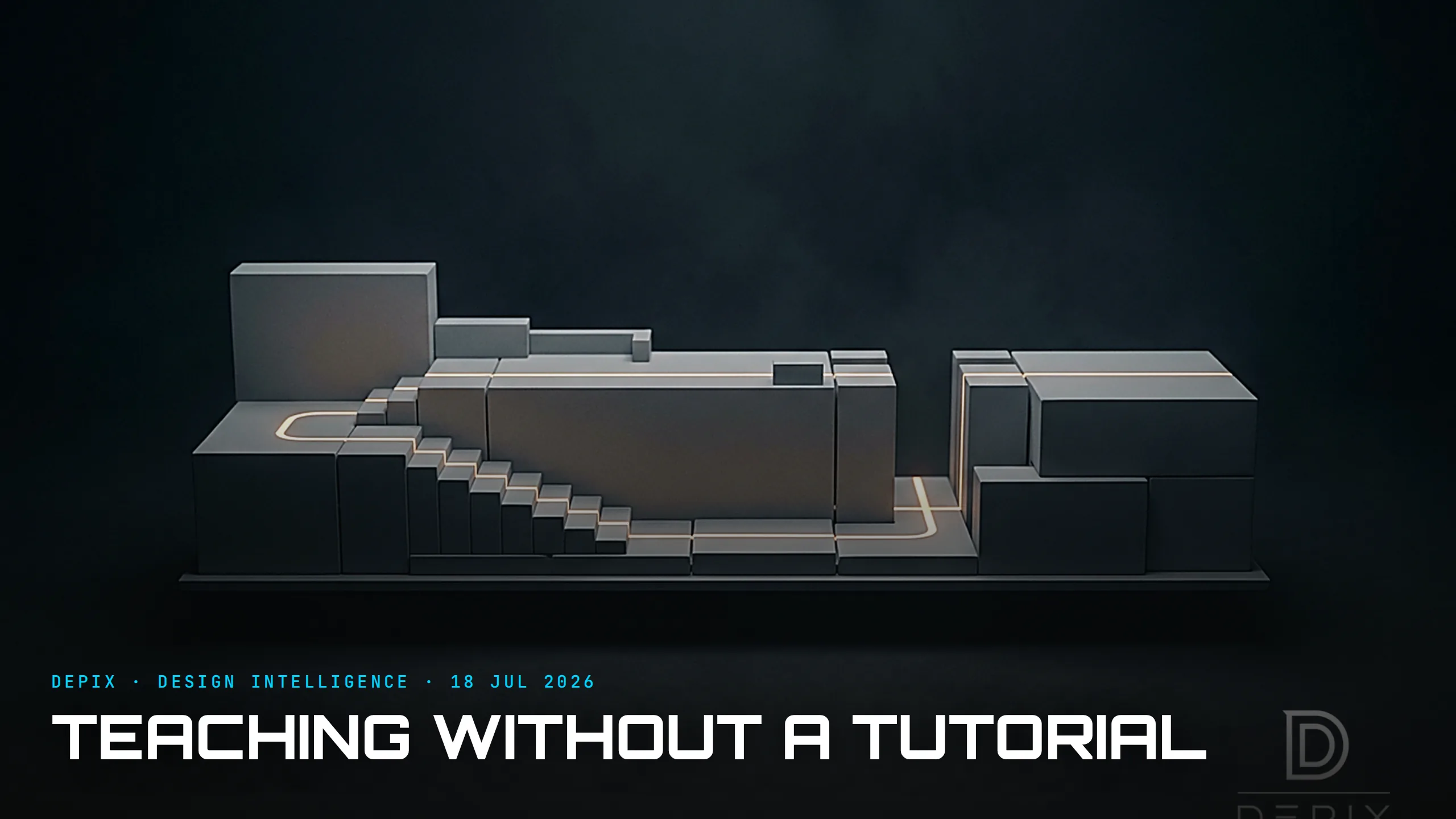
Teaching Without a Tutorial: What Super Mario's First Level Reveals About Designing How People Learn
Forty years ago, someone dropped you into a strange world and taught you everything you needed to know without saying a word. The first level of Super Mario Bros — World 1-1 — was designed by Shigeru Miyamoto as a tutorial for players who had never held a controller, at a time when on-screen instructions barely existed and you learned a game entirely through its level design. And it worked so completely that designers still study it forty years later as the gold standard for teaching without telling.
Watch what the opening screen does. It is deliberately empty of danger, so your first instinct is to press a button and see what happens — you move, you jump, nothing punishes you. Then a mushroom-shaped enemy walks toward you, and the level is arranged so the natural, safe reaction — jump — is exactly the mechanic you need to learn. A block above your head, glinting, invites a curious jump and rewards it with a coin. A pit appears only after you already know how to jump. Every lesson is delivered in a safe first move, before the stakes arrive. It is widely regarded as one of the most influential levels ever made, and its principle — "once the player realises what they need to do, it becomes their game" — is the whole philosophy.
None of this is improvised charm. It is a rigorous, repeatable discipline the industry now runs on: introduce a new mechanic in a safe environment, let the player prove they understand it, then present a slightly harder variation, and finally a challenge that combines mechanics. Teach, test, twist, combine — a curriculum hidden inside a playground; the same "learning through play" idea any good level teaches by structure, not signage. Valve built Half-Life 2's entire opening around it, teaching you to interact with the world when a guard barks "pick up that can" — no menu, no tooltip, just the world showing you what it wants rather than telling you, with no arrows anywhere.
Here is why this matters far outside games. The learnability of anything — how a first-time user comes to understand it — is either designed into its structure at the concept phase, or it is not there at all and has to be bolted on afterward as a manual, a tooltip, a five-screen onboarding flow. Every one of those add-ons is, quietly, an admission that the design failed to teach itself. The tutorial is a symptom. The best possible tutorial is no tutorial: a structure so well-sequenced that the user learns by doing, safely, before anything is at risk, and never notices they were being taught at all.
That is a concept-phase claim in the most literal sense, because in games the teaching is built at the greybox — the untextured grey blockout of a level, made on paper and in raw geometry long before any art, character or polish. The sequence of understanding is laid into the bare structure first. You cannot teach-through-structure if the structure was designed for something else and the learning was added at the end; by then the only tool left is exposition, and exposition is what you resort to when the architecture won't teach on its own. Environmental storytelling — showing, not telling — is a property of the level's bones, not its decoration, and the best environments guide the player without a word of direction.
The generalisation is almost uncomfortably direct. Every product has a World 1-1: the first screen, the first minute, the first interaction a new person ever has with it. Whether they glide through it, learning effortlessly by doing, or stall and reach for the help menu, was decided in the structure — the flow, the sequence, the order in which capability is revealed — long before any visual design was applied. A great first-run experience is not a well-written tutorial layered onto a confusing product; it is a product whose concept-phase structure makes the tutorial unnecessary. The seamless tutorial is the one you never see, and a mechanic the environment teaches you is one you never forget.
So the discipline is to treat the first experience as an architecture problem, not a documentation problem. Ask, at the blockout stage: what is the one safe thing a new user will do first, and does doing it teach the next thing? Sequence capability so each step makes the next legible. Reward curiosity early and cheaply. Withhold the pit until they can jump. Build the lesson into the space, so understanding arrives as discovery rather than instruction.
Designing the structure so it teaches itself — deciding, at the concept phase, how understanding will unfold before a single surface is drawn — is the part of design intelligence we care about most at Depix. The manual is where a design goes to admit it didn't teach. World 1-1 never needed one.
Sources:
- ●Wikipedia — World 1-1 (Super Mario Bros)
- ●No Context Culture — How Super Mario Bros World 1-1 Revolutionized Game Design (40th anniversary)
- ●Medium (Abhishek Iyer) — Analyzing Super Mario's level and tutorial design
- ●CBR — Is Super Mario Bros World 1-1 the Most Influential Level in Gaming History?
- ●Hi3D — Level Design Fundamentals: A Complete Guide (teach-test-twist-combine; greybox)
- ●Pinnguaq — Mario Maker Level Design Basics
- ●Game Developer — 'Pick Up That Can': Storytelling in Half-Life 2
- ●GameRant — Half-Life 2, 20 Years On: FPS Level & World Design
- ●The Level Design Book — Environmental Storytelling
- ●Jethro Jongeneel — Environmental Storytelling in Games
- ●Cultured Vultures — Half-Life 2 & The Seamless Tutorial
- ●Intermittent Mechanism — Let's Study Half-Life 2

Designed by One Hand: What a Concours Lawn Reveals About Why Committees Can't Make a Beautiful Car
Felt First, Decided Last: What Colour Reveals About the Backwards Order of Design