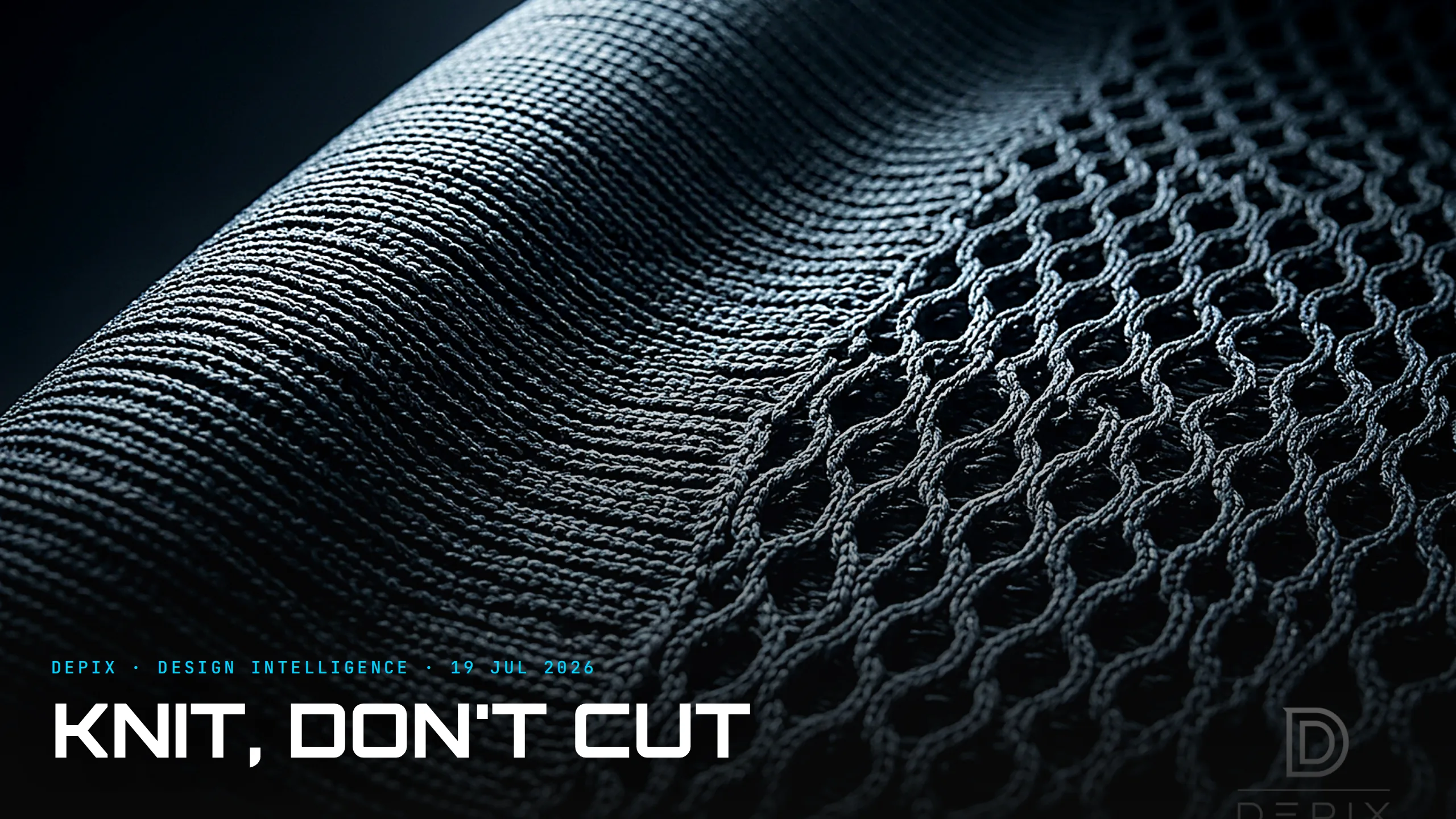
Knit, Don't Cut: How Digital Knitting Is Quietly Rewriting the Car Interior
When we talk about the future of the car interior, we point at the obvious things: bigger screens, new sustainable materials, ambient light. We are pointing at the wrong layer. The most consequential change coming to the cabin isn't what the soft surfaces are made of — it's how they are made. And the answer, quietly borrowed from your running shoes, is that we are going to stop cutting fabric and start knitting it.
Consider how a seat is upholstered today. A roll of fabric is cut into dozens of flat panels, those panels are sewn together along seams, and the leftover offcuts — a meaningful fraction of the material — are thrown away. It is the same cut-and-sew logic clothing has used for centuries: shape a flat material, then join the pieces. Every seam is a potential weak point, a place that wears, a line the designer had to route around.
3D knitting deletes that entire process. Instead of cutting panels, a digital knitting machine builds the entire seat cover as one continuous piece, knit to the exact three-dimensional shape in a single program — no cutting, no sewing, and, because the machine knows the precise length of yarn each cover needs, almost no waste. Ford's European engineers have already demonstrated exactly this: seamless seat covers produced with the same flat-knit technology behind Nike Flyknit and Adidas shoes. The zero-waste principle is the headline: the cutting step, and much of the assembly, simply vanish.
But waste reduction is the boring benefit. The real story is what happens to the design process. When you knit rather than cut, you stop specifying "a fabric and a pattern" and start writing a program — and a program can vary continuously. Different yarns can be used in the same piece — polyester, wool, even carbon fibre or recycled thread — and the knit's density, stretch and texture can change zone by zone across a single cover. The bolster that needs to grip can be tight and firm; the centre that touches your back can be open and breathable; the edge can taper to nothing. One part, infinitely tunable, with no seam between the zones.
And because it is programmable, the fabric can carry more than softness. Ford's work explicitly explores knitting in heating, controls, wireless charging and health sensors — functions woven directly into the textile rather than bolted underneath it. The seat cover stops being a passive skin and becomes an active, integrated component, decided at the yarn level.
If this sounds like a manufacturing story rather than a design one, look at where the idea actually comes from. Decades ago Issey Miyake built A-POC — "A Piece Of Cloth" — a system that programmed a knitting machine to turn a single thread into a finished garment, texture, shape and all, straight from a computer's translation of an engineering design. His connected knits were made as one continuous run. Miyake understood the profound point half a century early: once you can program the cloth, design moves upstream — from arranging pieces to authoring the rules that generate the whole thing at once.
That is why this is a concept-phase discipline, not a supplier's problem. In the old model, the industrial designer draws a shape and hands it to a trim engineer who works out how to cut and sew fabric over it. In the knitted model, the softness, the breathability, the grip, the built-in heating and even the graphic are all decided together, in code, before anything physical exists — because they are all the same file. You cannot bolt "programmable" onto a cut-and-sewn seat at the end; you either designed the knit from the start, or you didn't. The research into seamless knitted preforms makes plain that the geometry has to be conceived for knitting from the outset.
So the next time you are told the interior of the future is about the screen, look lower — at the seat you are sitting on. The quiet revolution is that it will arrive as one programmed, seamless, waste-free piece, its comfort and its intelligence knitted in rather than assembled on. The most advanced surface in the car won't be cut and stitched. It will be compiled.
Sources:
- ●3D-knitted seat with integrated upholstery — Knitting Industry
- ●Ford 3D knitting is the future of car upholstery — Digital Trends
- ●3D-knitted car seat covers, infinite personalisation — Ford Media Center
- ●Ford uses 3D knitting for seamless seat covers — Textile Technology Source
- ●3D knitting technology: an innovation in modern textile — Textile Trainer
- ●Ford's 3D-knitted covers target infinite personalisation — Knitting Industry
- ●Ford explores 3D-knitted 'smart' seat covers (heating, charging, sensors) — Textile Technology Source
- ●A Piece of Cloth for the Future (Issey Miyake A-POC) — Cooper Hewitt
- ●The A to Z of Issey Miyake — Metropolis
- ●Connected Knits and Layering at Issey Miyake — The Cutting Class
- ●3-D seamless knitted preforms for automotive seating — CSIRO
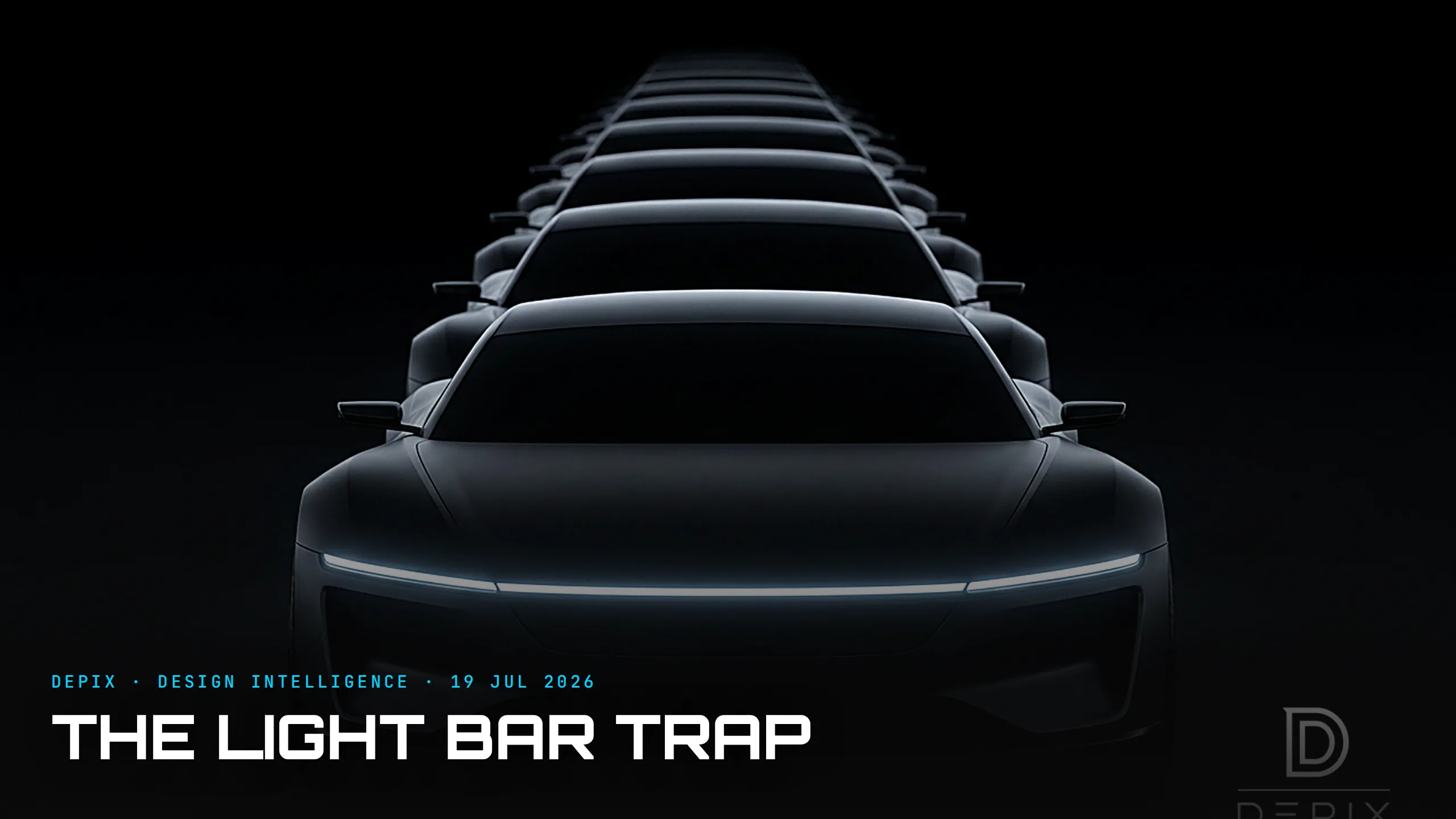
The Light Bar Trap: How the EV Era's Signature Move Made Every Car Look the Same

Premium Is Physics: The Micron-Scale Engineering of How Things Feel


