The Genesis Problem: How You Build a Design Language From Scratch
The received wisdom about design recognition is that it takes generations. A Porsche 911 is instantly a 911 because six decades of silhouettes taught us the shape; a Jeep is a Jeep because the seven-slot grille has eighty years of mud behind it. Heritage, the argument goes, is the one thing you cannot fake and cannot rush — and a brand-new luxury marque, however good its cars, is doomed to years of "nice, but what is it?"
Genesis is the counter-example, and it is worth studying because it treated recognition not as something to wait for but as something to engineer. Spun out of Hyundai in 2015 with no heritage, no silhouette and no emotional memory to draw on, it faced the hardest version of the problem: a future beyond "premium Hyundais" had to be built from a standing start. Under Luc Donckerwolke — later named World Car Person of the Year — and design head Sang Yup Lee, the brand did something quietly radical: it decided that its identity would be a signature, not a shape.
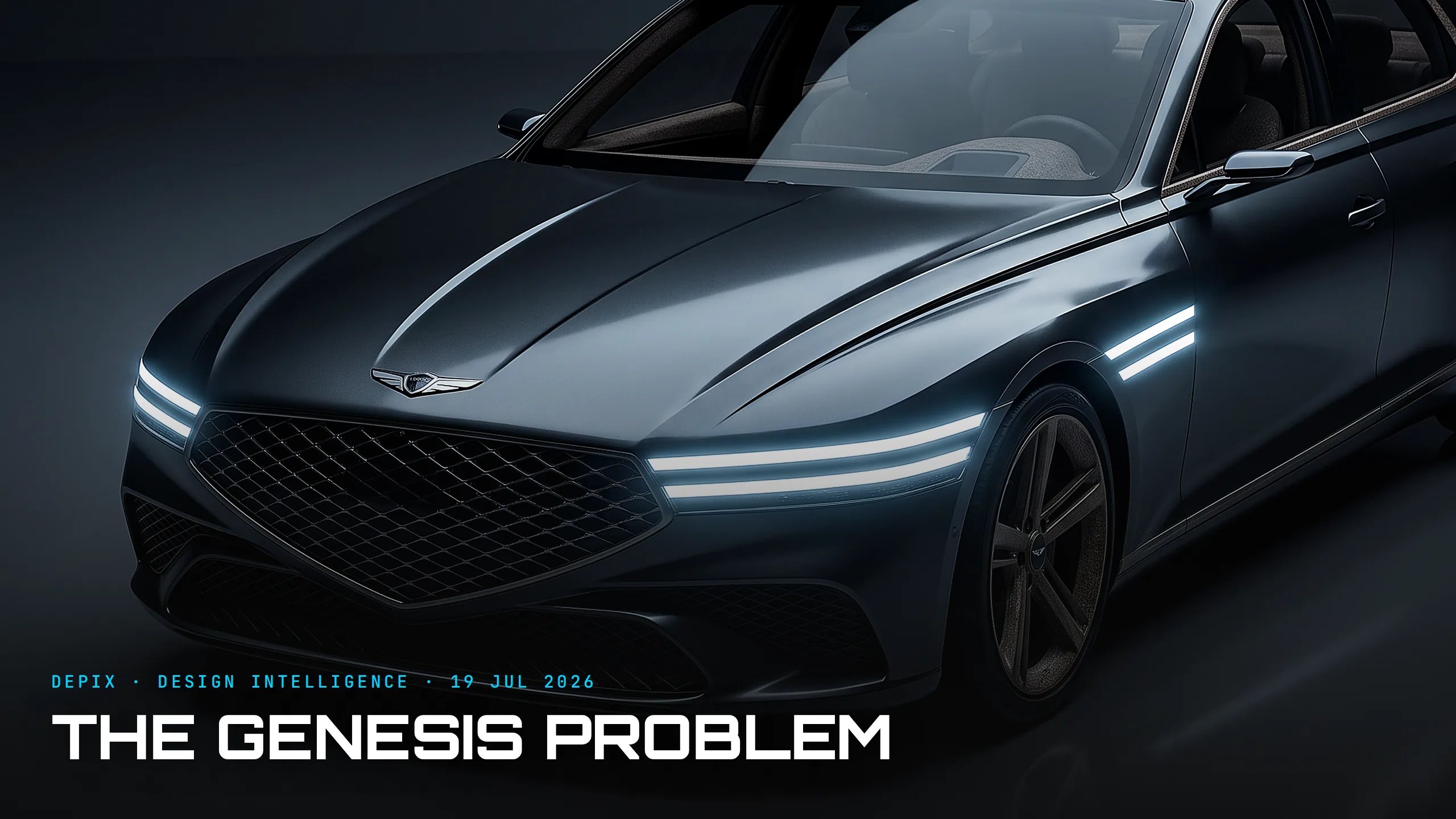
That distinction is the whole game. A shape — a silhouette, a proportion, a body — is expensive to make recognisable, because it only reads at certain angles and cannot survive being a sedan one year and an SUV the next. A signature is portable. Genesis chose two horizontal lines. "The Genesis design DNA begins from the logo itself," Donckerwolke explained — "the crest of the logo becomes the Crest Grille and the two lines of the wings become the Quad Lamps." The winged emblem was reverse-engineered into a lighting alphabet: two parallel strokes that read as Genesis in a fraction of a second, day or night, from across a car park.
Then came the part most brands get wrong — discipline. The two-line Quad Lamp was applied to everything, without exception, in exactly the same grammar: the G80 sedan, the GV80 SUV, the G90 flagship, the electric GV60. The lines wrap the front, the sides, the rear; even the advanced matrix lighting modules are packaged to preserve the two-stroke read. Genesis codified the surrounding language as "Athletic Elegance" — the deliberate tension between athleticism and elegance, carried by arcing "parabolic" body lines — but the signature is what does the recognising. As their own designers put it: "the design starts with the brand, and design is the brand."
Here is the contrarian point. Recognition was never really about heritage; heritage is just one slow way to accumulate consistency. What actually creates recognition is repetition of an unmistakable, meaningful device — and repetition is a decision you can make on day one, if you have the nerve to commit to a single idea and never break it. Genesis compressed decades of "consistency" into under a decade by choosing the device deliberately at the concept phase, deriving it honestly from the logo, and then refusing to deviate. Porsche got there by not changing the 911 for sixty years; Genesis got there by not changing the two lines for ten. Both are the same discipline — one inherited it, the other engineered it.
The risk is the mirror image of the reward, and it is a concept-phase risk. A signature applied by rote curdles into wallpaper: the moment the two lines are just a styling tic rather than a derived, meaningful mark, they stop signifying and start decorating, and a rival can copy the graphic without the grammar. The reason Genesis's works is that it is rooted — it comes from the emblem, it obeys a stated philosophy, and every application is judged against that source. The lines are not the identity; they are the visible edge of a decision about what the brand is.
This is the discipline we keep returning to at Depix. Identity is not a shape you hope becomes iconic; it is a portable core you define early — the one thing that survives every reinvention — and then protect against the endless temptation to freshen it. Genesis proved you do not have to wait a lifetime to look like yourself. You have to decide, at the start, what "yourself" is — and then be disciplined enough to mean it every single time.
Sources:
- ●Genesis Newsroom — G80, newest expression of Athletic Elegance
- ●Genesis Canada — All-New G80 (Athletic Elegance)
- ●Forbes — Luc Donckerwolke on building a new car brand
- ●Robb Report — Genesis CCO on a future beyond 'premium Hyundais'
- ●Genesis News Europe — Donckerwolke, World Car Person of the Year 2022
- ●Hyundai Motor Group — GV80: Athletic Elegance
- ●Genesis Newsroom (US) — 2020 GV80 overview
- ●Genesis Middle East — G90 design details
- ●Genesis Middle East — GV80 design details ('design is the brand')
- ●Hyundai Motor Group — Genesis intelligent front-lighting / Quad Lamps
- ●Genesis — Our Design Philosophy
- ●Auto&Design — Luc Donckerwolke talks about Genesis design

The Cabin Becomes a Room: When the Car Stops Being a Cockpit
The Button Comes Back: Why the Industry Is Un-Deleting the Touchscreen