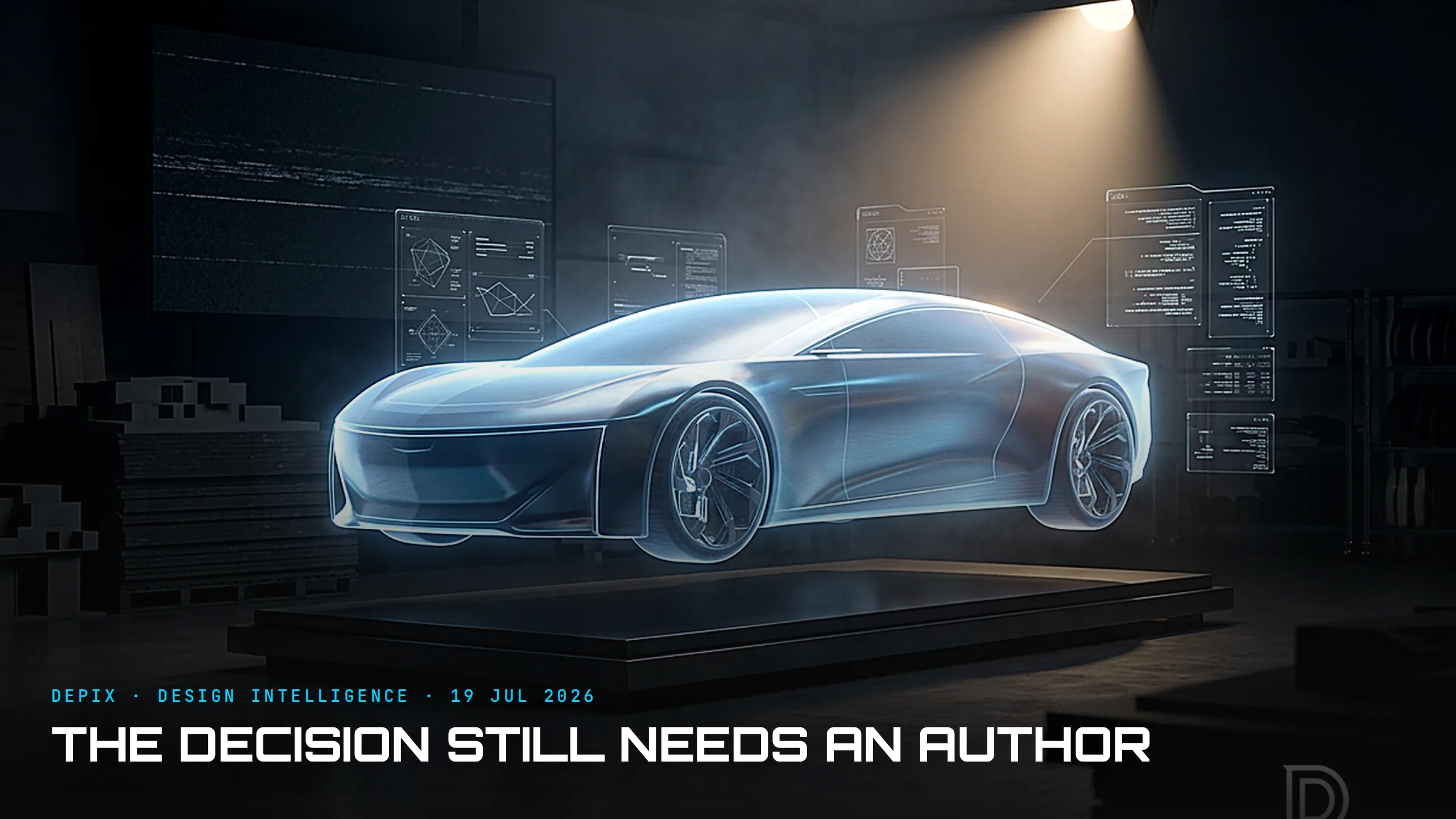
The Render Went Real-Time. The Decision Still Needs an Author.
Real-time rendering was sold as a speed upgrade — shorter design cycles, fewer errors, 94% of teams say it is vital to reducing design errors. All true. But the more interesting thing it changed isn't the speed of the render; it is the decision. When any change is visible instantly, the bottleneck stops being "how long until we can see it" and becomes "who decides, and when." That quietly rewires how design actually gets made.
Consider what a tool like NVIDIA's Omniverse enables: a whole team gathers around a full-scale model, points out flaws, and tests options with every change reflected instantly. That used to be a serial ritual — a designer makes a change, renders it overnight, the team reviews next week, repeat. Now it is simultaneous and collective, coordinated live across engineering, design and manufacturing in one model. The loop from idea to shared image that took days collapses to seconds, and the room fills with people who can all now see the thing.
This is a genuine superpower and a subtle trap. The superpower is real: teams can conceive, refine and market faster and cheaper, explore ten proportions before lunch with Lumen light reacting instantly to every change, catch the mistake while it is still a file, and even carry the same real-time model all the way to the showroom. The trap is threefold.
First, instant photorealism tempts you to optimise for what looks good in the render right now — the hero angle, the studio light, the perfect reflection — rather than what is right in the world. A modern engine makes almost anything look expensive; it can flatter a weak idea into a decision it never earned.
Second, when everyone can see it, everyone has an opinion, and the decision drifts from an author to a committee. Fast, collective feedback can democratise — or it can produce consensus mush, the safe average of everyone's comfort. The tool speeds up the loop; it does not tell you whose judgment should close it. That is why the platform wars are quietly a workflow question: Omniverse prioritises collaboration, Unreal prioritises fidelity, and Unity, Unreal and Omniverse are really competing over how teams decide, not just how they render.
Third — and this is the concept-phase point — collapsing the loop makes it dangerously easy to keep iterating instead of deciding. When each change is free and instant, "let's try one more" has no cost, so teams can circle forever, polishing variants rather than committing to a direction. Speed without a decision discipline is just faster indecision.
There is a historical irony here. The old clay model was slow and costly precisely because every change cost days of a modeller's hands — which forced teams to think hard before they cut, and to commit once they had. That friction was doing quiet work: it manufactured decisiveness. Real-time rendering removes the friction, and with it the built-in forcing function. That is a net good only if the discipline the friction used to supply is replaced on purpose — a named owner, a locked date, a clear question each review is meant to answer. Otherwise the tool that was supposed to speed the work up just multiplies the options nobody ever chooses between.
So the real design-intelligence question is no longer "how fast can we render?" — that is answered, from the studio to the architecture office to the production line. It is: now that seeing is instant and collective, who decides, when do we lock it, and what are we actually optimising for? Real-time rendering collapsed the loop between idea and image. It did not collapse the loop between image and judgment — and that gap is now the whole game. It lives at the concept phase, where the direction is set before the polishing starts, and where a shared 3D model can align a team or quietly stall it.
At Depix this is exactly why we treat visualisation as a decision tool, not a beauty tool. The point of making a concept instantly visible is not to fall in love with the render; it is to make the right call faster — to give a human's judgment the clearest possible view of the thing while it is still cheap to change, and then to actually make the call. The render became real-time years ago. The decision never will. It still needs an author, and knowing when to stop rendering and start deciding is the most valuable skill in the room.
Sources:
- ●Unreal Engine — Real-time ray tracing in automotive design (94% reduce-errors stat)
- ●University of Plymouth — NVIDIA Omniverse AR: real-time 3D collaboration
- ●SuperDNA 3D Lab — Unreal Engine vs NVIDIA Omniverse vs Bentley iTwin
- ●Unreal Engine — Automotive and car design visualization
- ●Unreal Engine — Real-time manufacturing and the future of automotive sales
- ●Chaos — Best 3D rendering software for photorealistic results in 2026
- ●Thomas Strigl (LinkedIn) — The shifting landscape of industrial simulation: Unity, Unreal, Omniverse
- ●Unreal Engine — Architecture design & 3D rendering visualization
- ●NVIDIA — Design firm achieves new heights of production with Omniverse
- ●3D Artist (Michael Tanzillo) — What is NVIDIA's Omniverse?

Volkswagen Decided How Its Cars Should Feel Before It Decided What They Look Like

When Silence Became Free: The EV Just Redefined What a Luxury Interior Is


