Form Follows Intent™
Download PDF"Form follows function" shaped modern design. It pulled form away from pure decoration and anchored it to purpose — an idea associated with Louis Sullivan and later echoed by the industrial clarity of the Bauhaus.
But the world has changed.
Today, generating form is fast. The bottleneck isn't producing shapes anymore — it's deciding what the product should be, and expressing that decision clearly enough that a team (and increasingly, a system) can create the right outcome.
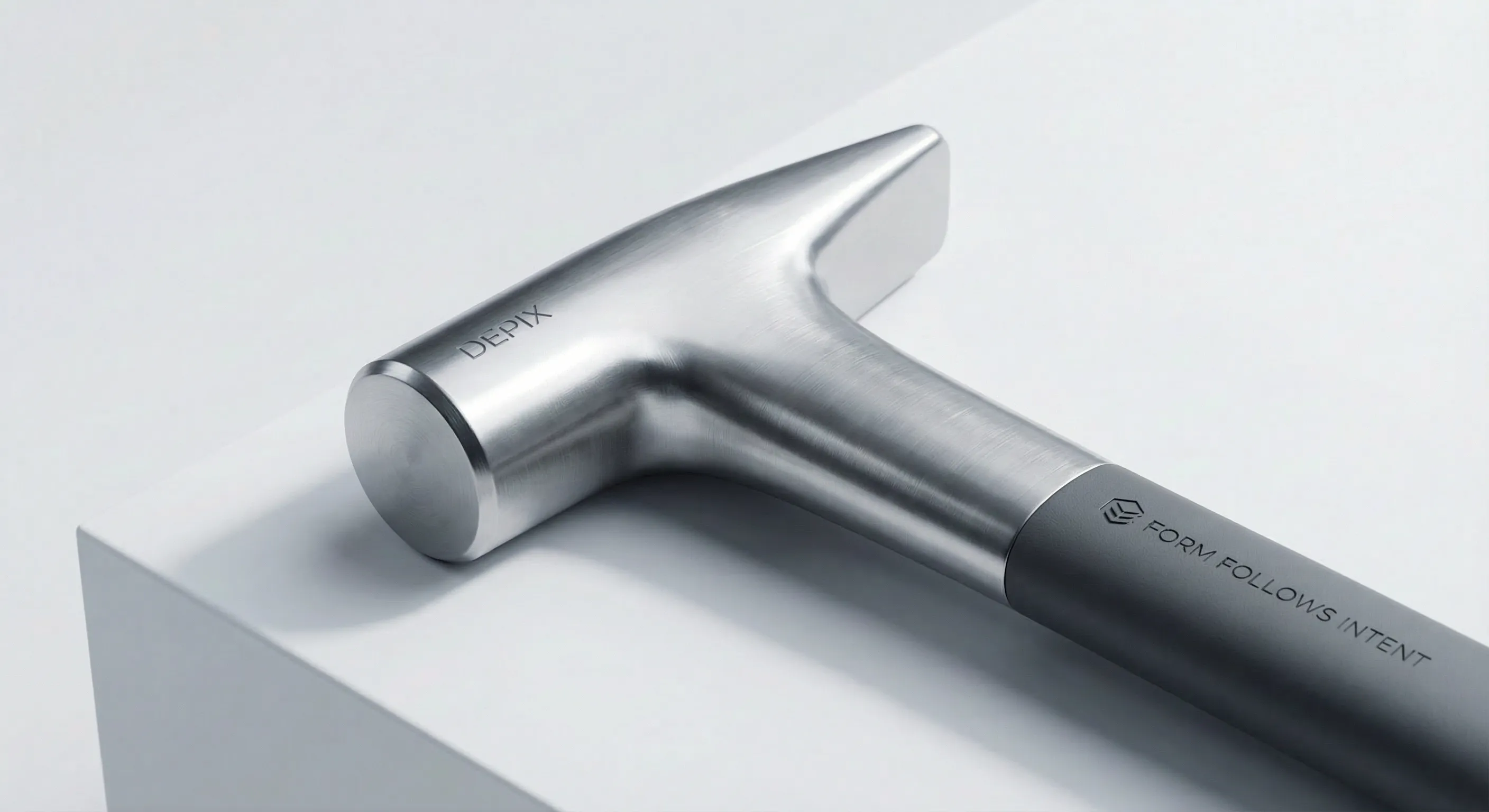
That's why I'm proposing a new principle: Form Follows Intent™.
Intent includes function, but it's bigger than function. Function is what something does. Intent is what it must achieve.
Intent combines the full reality of a product into one target:
- ●what it must do (function),
- ●what it must respect (constraints like package, cost, weight, safety, manufacturability),
- ●what it must signal (brand identity and recognizability),
- ●how it must feel (emotional target values),
- ●and where it must live (context of use, user, environment).
When intent is clear, form stops being a guess. Form becomes a consequence.
This shift matters because sketching is a rare skill — and for many designers, it's also a barrier. In my career, I've met only a small number of people who can consistently sketch at a truly top level. Many designers can sketch, but the jump from "can sketch" to "can sketch in a way that instantly sells a vision" is enormous. For a lot of people, the fear of producing a weak sketch slows down the start of a project, even when the idea in their head is strong.
Design has historically been gated by two difficult translation steps: turning a vision into a convincing sketch, and turning that visual into robust 3D. Both require long practice. Both are unevenly distributed across teams. And both can hold back great ideas simply because the medium becomes the judge.
Intent-first workflows remove that gate for the majority. Not by removing taste or creativity — but by removing friction between meaning and credible visualization. The designer's job shifts upward: from manually drawing the solution to directing the outcome.
This is not the end of craft. The craft just moves. The most valuable skill becomes the ability to specify intent precisely: to define constraints intelligently, to protect and evolve brand language, and to make confident decisions under ambiguity.
And this won't stop in design.
Just as sketching has been a bottleneck in design, manual modeling is a bottleneck in engineering. As systems become better at producing geometry under constraints, the role shifts from modeling everything by hand to specifying and verifying outcomes. The same pattern repeats: when production becomes cheap, decision-making becomes everything.
That's the core of "Form Follows Intent."
If you can express what you want with clarity — including performance, constraints, brand, emotion, and context — you can move faster, explore wider, and still land on outcomes that are more coherent, more credible, and more desirable.
Form follows intent.

What If the Charger Is the Presentation Device?

Design by Intent™: PreCAD Changes the Equation