Audi Brings Back the Button. The Real Decision Is Upstream.
Audi is about to delete one of the most confident interior decisions of the last decade. After years of "Digital Stage" cockpits built around large glass surfaces, the company has confirmed it is reversing course - a direction first detailed by GoAuto - bringing back physical switches, honest materials and restrained displays, with a technical brief that every control should recover the "classical Audi click and feel." The first wave is already here: for the 2026 model year the A5, Q5, A6 and Q6 e-tron get redesigned steering wheels with real scroll rollers in place of the flush haptic pads buyers disliked.
It is tempting to read this as nostalgia, or as an admission that the screen era was a mistake. It is neither. It is something more useful: an industry re-discovering that the interior's interaction architecture - which functions you touch, which you tap, which the car simply handles - is a concept-phase decision, not a styling one. And right now three different forces are making everyone decide it again, on purpose.
Europe is deciding it through safety. From January 2026, Euro NCAP's new protocol withholds top marks from cars that bury basic functions in a touchscreen. Indicators, hazard lights, the horn, wipers and the eCall SOS function must have real, physical controls a driver can find without looking - feedback that works even wearing gloves. Overnight, the button stopped being a cost line and became a five-star requirement.
China is deciding it through regulation, too - harder. China's MIIT has drafted rules that, from 1 July 2027, would mandate dedicated physical controls for turn signals, hazards, horn, wipers, defrost, windows, gear selection and even ADAS activation - buttons that must be at least 10 mm, fixed in place, with tactile or audible feedback. The market long treated as the most screen-maximalist on earth is now writing the strictest physical-control law.
The United States is deciding it through frustration. No mandate yet - but J.D. Power's Initial Quality Study shows infotainment as the single worst-scoring category, climbing from 42.6 to 44.4 problems per 100 vehicles year over year, with connectivity and buried menus at the core. Nearly half of all distraction complaints point straight at the touchscreen. The American question is less ideological and more practical: people will accept a big screen, but not when it replaces the ability to do a simple thing simply.
Here is the part that matters for anyone who designs anything. Audi's own explanation is the tell: it says American, European and Chinese buyers are genuinely different, so it will keep minimal big-screen cabins for China while giving the West smaller, better-integrated screens and tactile switchgear - the same brand DNA, expressed through three different interaction maps. That only works if the interaction map is treated as a first-order concept decision, made region by region before a single surface is modelled - not as a skin applied late over one global architecture.
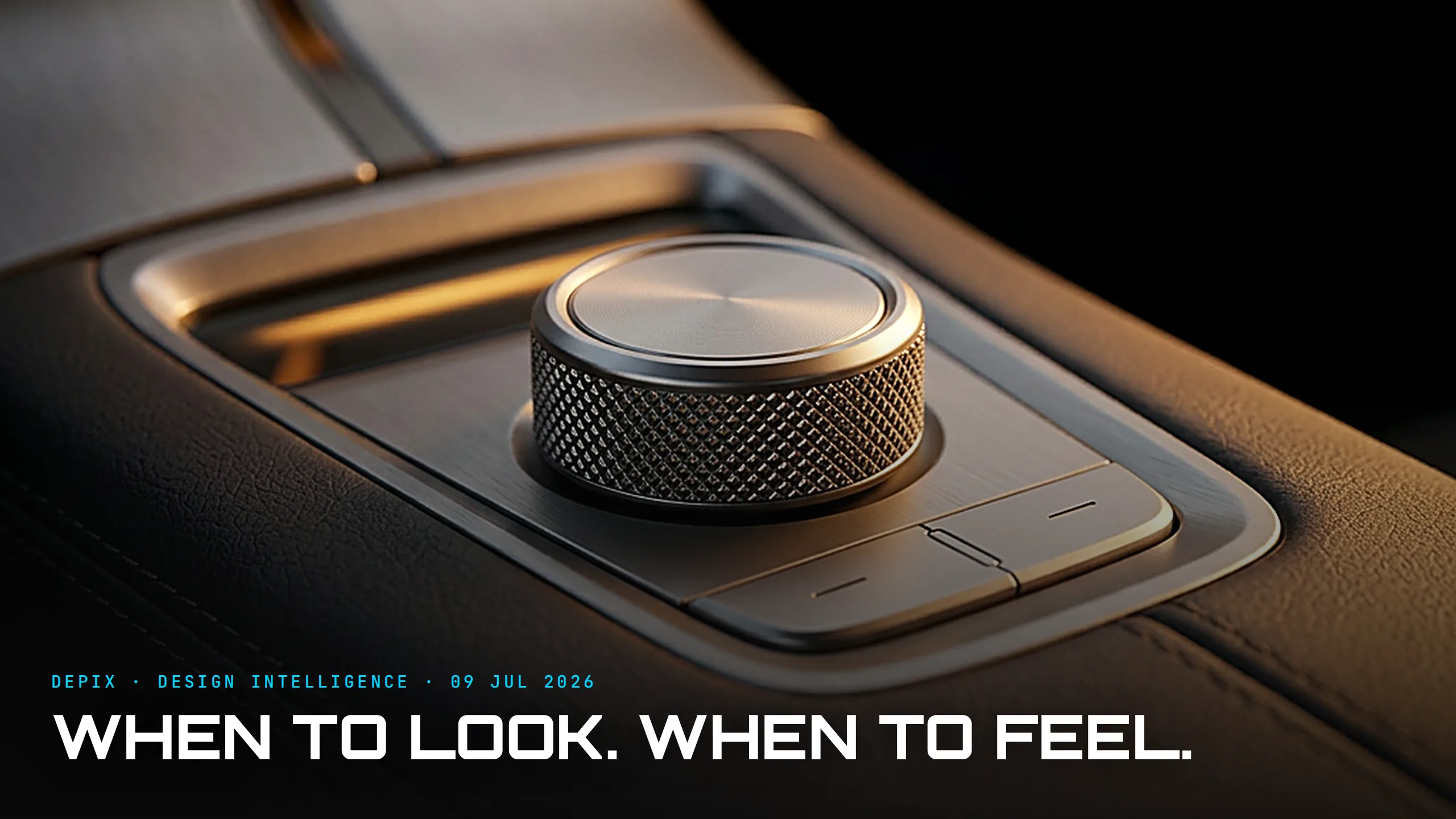
Because that is the real lesson hiding inside the "buttons are back" headline. The screen was never the design decision. The decision was always which interaction deserves to be digital, and which one must stay physical - and the brands that got burned are the ones that answered "all of it, digitally" downstream, at the styling stage, chasing a clean render. The ones now differentiating are answering it upstream: deciding, at the concept phase, when the driver should look, when the driver should feel, and when the car should simply understand and act without being asked.
Framed that way, Audi's reversal is not a retreat from digitalization. It is the next level of it - less screen theatre, more intentional control. Physical where the hand needs certainty; digital where intelligence genuinely adds; region-specific where the customer truly differs. A premium cockpit built around lower cognitive load, real materials, and a clear sense of which sense each task belongs to.
The winners of the next interior decade will not be the brands with the biggest displays, or even the ones with the most buttons. They will be the brands that decided - early, deliberately, and per market - exactly which interactions to make you look at, and which to let you feel. Getting that map right at the concept stage, before the platform and the regulations lock it in, is precisely the kind of load-bearing decision we work on at Depix.
Sources:
- ●Audi will shortly kill current cabin design - GoAuto
- ●Audi Is Reversing Its Biggest Interior Decision Of The Decade - Carscoops
- ●Audi Tells Us Why Some Physical Controls Are Back - Motor1
- ●Audi Will Ditch Its Screen-Heavy Interior Designs and Bring Back Buttons - Edmunds
- ●Cars will need buttons for a 5-star Euro NCAP rating - ETSC
- ●Euro NCAP 2026 Rules Favour Physical Buttons - Carwow
- ●Europe Is Requiring Physical Buttons For Top Safety Marks - The Autopian
- ●China to Mandate Physical Controls by 2027 - Drive Tesla
- ●China to require physical controls for vehicle functions - CarNewsChina
- ●Everyone Hates Touchscreens - J.D. Power Quality Study - CarBuzz
- ●J.D. Power Study: Infotainment Biggest Pain Point - Newsweek
- ●Europe and China Now Require Physical Buttons - Will the US Follow? - Autoblog