Grammar of Forms
The obvious way to build a couture collection around a famous artist is to put the artist's shapes on dresses. Jonathan Anderson, presenting his second Dior couture collection on the opening day of Paris Couture Week this July, did the opposite — and the difference is a lesson every design team should steal.
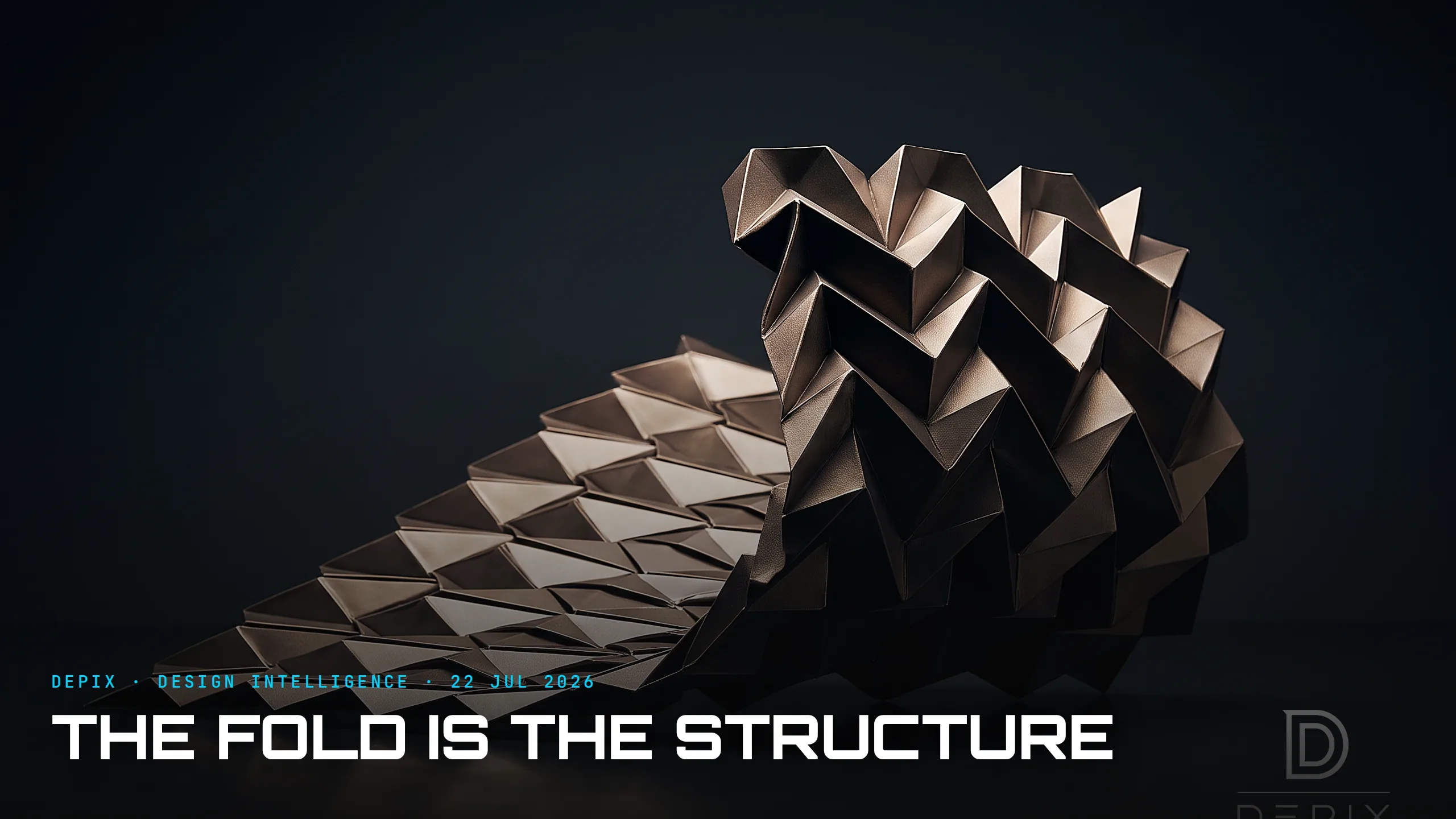
His reference was the American sculptor Lynda Benglis, whose work he paired with the collection in a Musée Rodin exhibition titled "Grammar of Forms", running 7–12 July. Benglis's whole practice is a transformation: she takes flat, two-dimensional material — latex, metal, wax, mesh — and, through knotting, pleating and moulding, turns it into three-dimensional form. Anderson did not reproduce her sculptures. He extracted the operation behind them and re-ran it in fabric: hand-plissé, draping and intricate knotting that gave flat cloth a genuinely sculptural presence.
That is the whole point, and the exhibition title says it out loud. A grammar is a set of rules that generate forms; the forms themselves are only the output. Copy the output and you get one dress that looks like a Benglis. Learn the grammar and you can make a hundred garments that share her logic while none of them is a copy. Anderson took the rules, not the results — which is why the collection reads as Dior thinking in Benglis's language rather than borrowing her pictures.
This is reference done the hard, right way, and it generalises far past couture. Every design team references something — a competitor, a heritage archive, a mood board, a rival's hit product. The decisive question is what you actually take. Take the surface — the silhouette, the colour, the finished gesture — and you are locked into imitation: your work dates the moment the source does, it invites the legal and reputational risk of the near-copy, and it teaches you nothing you can reuse. Take the grammar — the underlying rules that made the reference work — and you own a generative system you can run at any scale, in any material, for years.
The catch is that grammar is much harder to extract than surface. A surface you can trace in an afternoon. A grammar you have to understand: you have to work out why the reference works before you can speak it yourself. That is precisely why it belongs to the concept phase. The choice between copying the surface and learning the grammar is made at the very start, and it determines everything downstream — whether you end the project with one derivative object or a language you can keep building in.
You can see the failure mode everywhere the shortcut is taken. A car studio that quotes a beloved old model's chrome grille has copied a surface; a studio that understands why that car's proportions felt right has learned a grammar it can apply to a shape the original never imagined. A brand that lifts a rival's signature colour has taken a surface; one that grasps why that colour reads as premium has taken a rule. The copy ages into pastiche. The grammar keeps generating.
Couture happens to be the clearest place to watch this, because the atelier performs the same alchemy every season: flat fabric given sculptural form, activated the moment it is worn. Benglis turns flat latex into a frozen gesture; the couturier turns flat silk into a moving one. Anderson's collection simply made the shared grammar visible — hanging the garments beside the sculptures at the Rodin so you could read the rules running through both.
There is a quieter lesson here too, about what a new creative director's first real statement should be. Anderson could have announced himself at Dior with spectacle. Instead he announced a method: here is how I read a reference, here is the grammar I intend to build in. That is a more durable opening move than any single showpiece, because a method compounds and a showpiece doesn't.
For anyone who works upstream of a product — a car, a building, an interface, a garment — the takeaway is uncomfortable and useful. When you put a reference on the wall, you have already made a decision, whether you noticed it or not: are you going to copy what it looks like, or learn what it knows? The first is faster and the results fade. The second is the actual work of the concept phase, and it is the only one that leaves you with something you can use again. Take the grammar, not the surface.
Sources:
- ●Wallpaper* — Jonathan Anderson's Dior couture
- ●Wikipedia — Lynda Benglis
- ●FashionUnited — Dior stages 'Grammar of Forms' exhibition (Musée Rodin, 7-12 July)
- ●Whitewall — Dior Haute Couture FW26: Anderson x Benglis
- ●Grazia — Anderson shapes fashion into sculpture
- ●Haute Living — inside Anderson's Dior Haute Couture FW26
- ●Fashion Headline — Anderson and the Grammar of Form
- ●The Impression — Christian Dior Fall 2026 review
- ●Galerie — Anderson's Dior couture meets Lynda Benglis
- ●Wikipedia — Musée Rodin
- ●Wikipedia — Jonathan Anderson (fashion designer))
- ●Wikipedia — Haute couture
- ●Musée Rodin