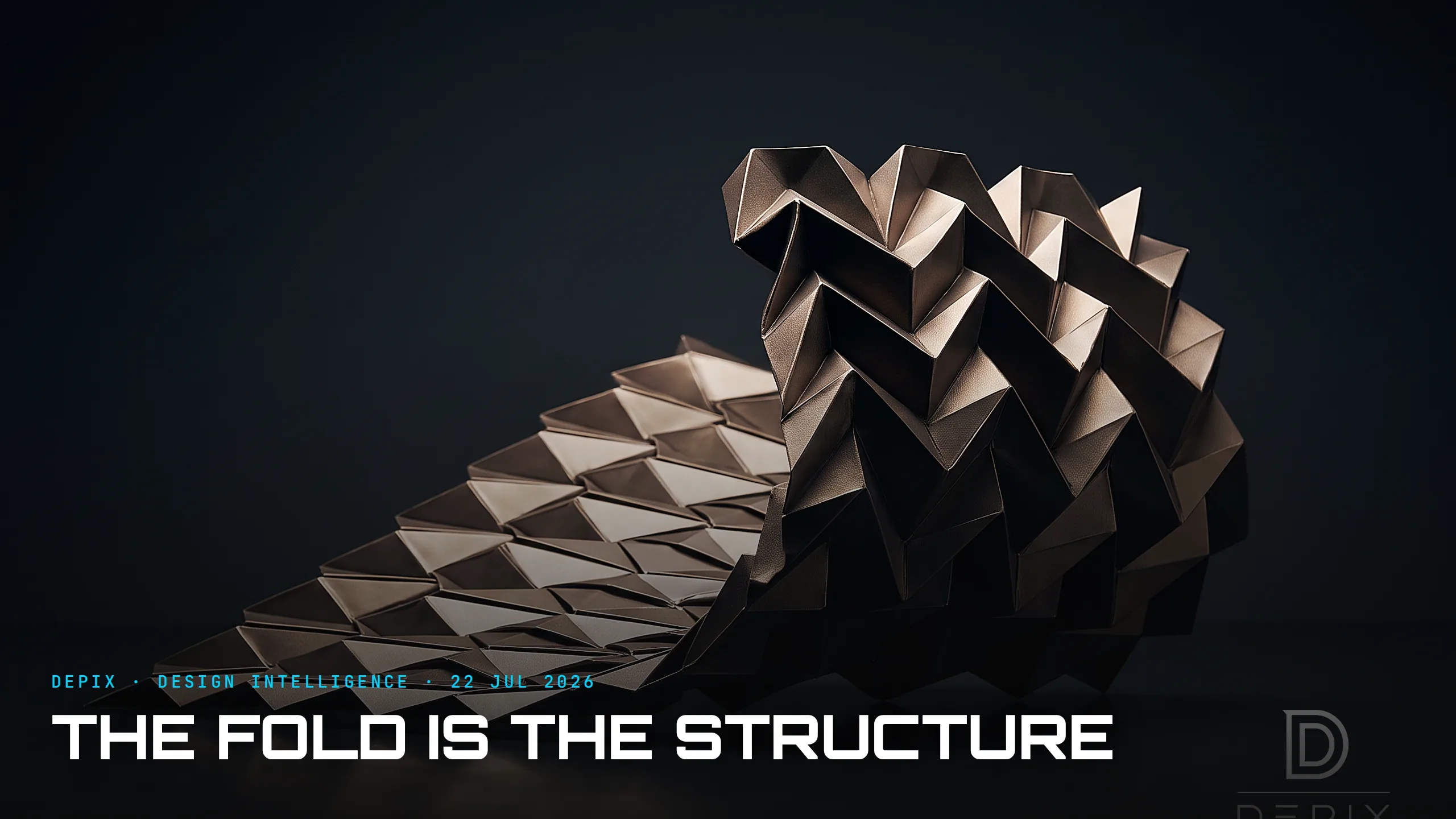
The Fold Is the Structure
July's gadget roundups included a small, quietly clever object: a travel mouse that folds nearly flat, using an origami-inspired triangular structure to stay rigid in the hand yet collapse to almost nothing in a bag. It looks like a novelty. It is actually a consumer-scale echo of one of the most serious ideas in modern engineering — and one of the clearest illustrations of why the concept phase decides everything.
The idea is origami engineering: using folding, rather than added material, to do the structural work. Its reach is enormous. The James Webb Space Telescope — a sunshield the size of a tennis court and a mirror too wide for any rocket — flew to space folded like paper and unfurled in orbit. Deployable spacecraft arrays use the Miura fold, a pattern devised by astrophysicist Koryo Miura that collapses a flat membrane in both directions at once — enough to stow a 25-metre array in a package under three metres across. The physicist Robert Lang, who left a laser-optics career to formalise the mathematics of folding, has applied it to airbag packing, self-deploying medical stents and space-telescope optics.
What unites these is a single, radical inversion of a designer's default instinct. We are trained to think strength comes from material: add a rib, thicken a wall, choose a denser alloy. Origami says the opposite — that rigidity can come from geometry. Fold a flat sheet one way and it becomes stiff; fold it another way and it collapses. The material barely changes; the pattern changes everything. BYU's researchers made the point unforgettable with a chair cut from a single flat sheet: a tessellated pattern lets a rigid material like acrylic bend into shape and then hold a person's weight — strength conjured from a cut pattern, not added mass.
The reach is not exotic, either. A folded airbag — packed to vanish into a steering wheel, then deploy in a fraction of a second without snagging — is an origami problem. A self-deploying arterial stent travels through a vessel folded small and blooms open to hold the wall. In each case the object must survive as one thing, compact and inert, then become another, large and working, on command, with no human hand to help it. The fold is what carries it across.
Here is why this reaches far beyond space hardware. In an origami structure, the crease pattern is the product. Once you commit to a fold pattern, everything downstream is already determined: how small it packs, how stiff it becomes, how it moves, whether it deploys at all. You cannot add a crease to a finished sheet, and you cannot patch a bad one. The entire behaviour of the object is encoded in a geometry chosen at the very beginning — the concept phase, in its most literal possible form. The discipline of designing those patterns exists precisely because the fold cannot be improvised later.
And it is unforgiving. A pattern that self-intersects, binds, or locks halfway does not announce the fault on the drawing board — it announces it when you try to deploy. For Webb, that moment came after launch, a million and a half kilometres from Earth, across hundreds of single-point deployment steps with no possibility of a repair mission. The whole edifice of origami engineering — the software, the simulation, the compliant hinges that let rigid panels bend without breaking — exists to make one thing certain: that the geometry is right before anyone commits to it. There is no second draft in orbit.
That is the design-intelligence lesson, stated as plainly as design ever states it. The most consequential decision an origami structure makes is invisible in the finished object and impossible to change once made. It is decided in the pattern, at the start, and everything the object will ever do is already contained there. A folding mouse and a space telescope are the same problem at different scales: get the geometry right first, because there is no fixing it after.
This is the concept phase with the safety net removed. Most products let you sand down a weak early decision through late iteration — expensively, but possible. Origami does not. It is the discipline that makes literal what every design discipline is quietly bound by: the decision that governs everything is the one you make before there is anything to look at. The value was never in admiring the deployed structure. It is in knowing, with certainty, that it will deploy — before you fold.
Sources:
- ●Yanko Design — The 8 Best Tech Gadgets of July 2026 (OrigamiSwift folding mouse)
- ●NASA — Webb and Origami
- ●Wikipedia — James Webb Space Telescope
- ●Wikipedia — Miura fold
- ●Wikipedia — Koryo Miura
- ●COMSOL — Solving a Space Problem with Origami Principles
- ●Wikipedia — Robert J. Lang
- ●Robert J. Lang — Origami
- ●Wikipedia — Rigid origami
- ●BYU News — origami-inspired Flex Chair
- ●Wikipedia — Mathematics of paper folding
- ●BYU — About Compliant Mechanisms


