The Reference Trap: The Most Useful Tool in the Studio Is Also the Most Dangerous
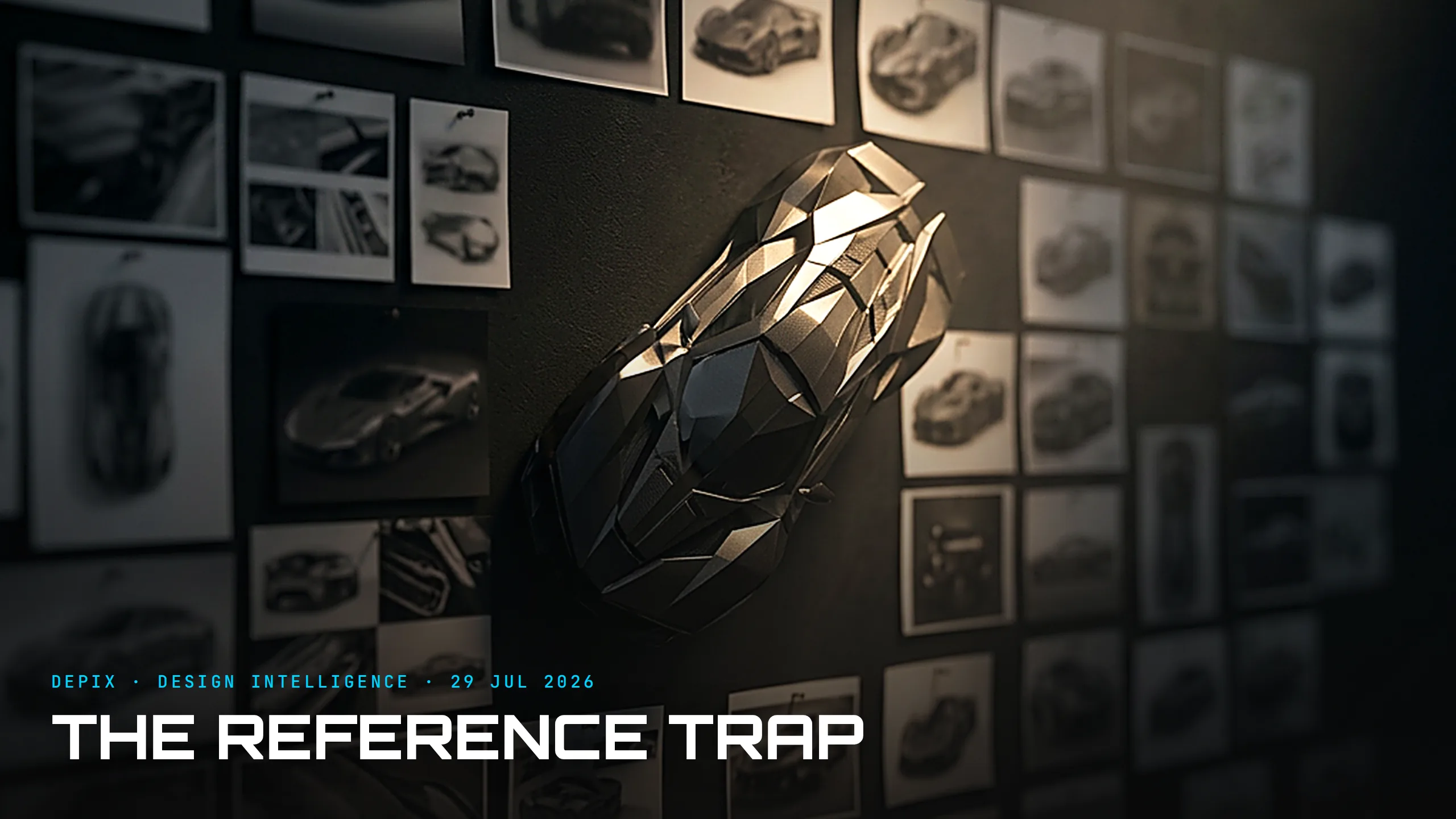
Every serious design project now begins the same way: with a wall of references. A moodboard, a folder of screenshots, a shared board of images that say, faster than any brief could, "something like this." It is one of the most useful tools ever adopted by design teams — and, for exactly the same reason, one of the most dangerous. The reference image both aligns a team in seconds and quietly decides the answer before anyone has thought to ask the question.
Start with why it's indispensable, because that part is real. A moodboard snaps abstractions to real, existing images, turning a vague ambition into something a whole team can see and agree on. It supports visual research through framing, aligning and directing the work. Skip it, and you get the opposite of speed: endless revisions as stakeholders realise they never agreed on the basic look and feel. References are how design communicates intent without words, and a team without shared references is a team arguing in the dark. That is not in dispute.
The danger is the mechanism underneath the benefit. A reference works by anchoring — and anchoring is a cognitive bias, not just a technique. The same pin that aligns the team also limits the range of thought and traps people in a set way of seeing the problem. The reference that captured your ambition, left on the wall too long, silently becomes the ceiling on it. You stop asking "what should this be?" and start asking "how close can we get to that?" — and those are completely different questions with completely different answers.
Then it compounds across the whole industry. Everyone references the same admired winners, so the field quietly averages toward them. This is the homogenisation everyone can feel and few can name: when everything starts to look the same because every studio is anchored to the same small set of references. And generative AI has poured accelerant on it. These tools are, by design, pattern-matching machines that identify what has been done and produce variations of it, regressing toward the most statistically common form — the reason so much output shares one recognisable default aesthetic. Worse, research on design fixation in generative AI shows designers exposed to AI outputs tend to perpetuate the same patterns, creating a vicious cycle. A reference-driven pipeline, run at machine speed, doesn't just risk sameness — it manufactures it at scale.
So how do you keep the power and escape the trap? The discipline is a concept-phase one, and it comes down to what you let the reference decide. Use references to define the problem — the emotional target, the functional constraints, the quality bar, and just as importantly the anti-references (the things it must not be). Do not use them to pre-select the answer. A reference that says "it should feel this calm" is a brief; a reference that says "it should look like this car" is a cage. The best studios collect references to understand why something works — the underlying principle — and then deliberately close the board and design forward from that principle, rather than reaching back to copy the surface that expressed it.
There is a moment, in every project, when the reference stops helping and starts limiting — when it has done its job of aligning everyone and now only holds the work back. Knowing that moment, and having the discipline to take the images down, is one of the most underrated skills in design. The reference got you to the right question. It cannot give you an original answer, because by definition it is made of answers that already exist.
This is the balance we think about constantly at Depix. References are the raw material of design intelligence — they carry taste, intent and precedent better than words ever will — but their gravity is real, and a tool that makes referencing effortless makes the trap effortless too. The skill was never finding the right reference. It is knowing what to take from it, what to refuse, and exactly when to stop looking at it and start designing. Used to frame the question, a reference is the most powerful tool in the studio. Used to answer it, it is the most dangerous.
Sources:
- ●Andrew Cornell Robinson — Visualizing ideas through mood boards
- ●Icons8 — How mood boards are used in digital product creation
- ●Milanote — How to make a moodboard
- ●Interaction Design Foundation — What is anchoring?
- ●Miro — Mood board vs brand board vs style guide
- ●Medium (Sabharwal) — When everything starts to look the same
- ●Vandelay Design — Why AI-generated designs look the same
- ●Kompozy — The AI design aesthetic (2026)
- ●Editorialge — Why AI art looks the same everywhere
- ●Medium (Amorim) — UX and the aesthetics of AI: homogenization
- ●FashionINSTA — AI fashion homogenization
- ●Wheels Up Collective — The homogeneity problem with AI-built sites

The Car That Won't Be Built: What a Concept Car Is Actually For
Design Debt: Why 'We'll Fix It Later' Is Borrowing at a Brutal Rate