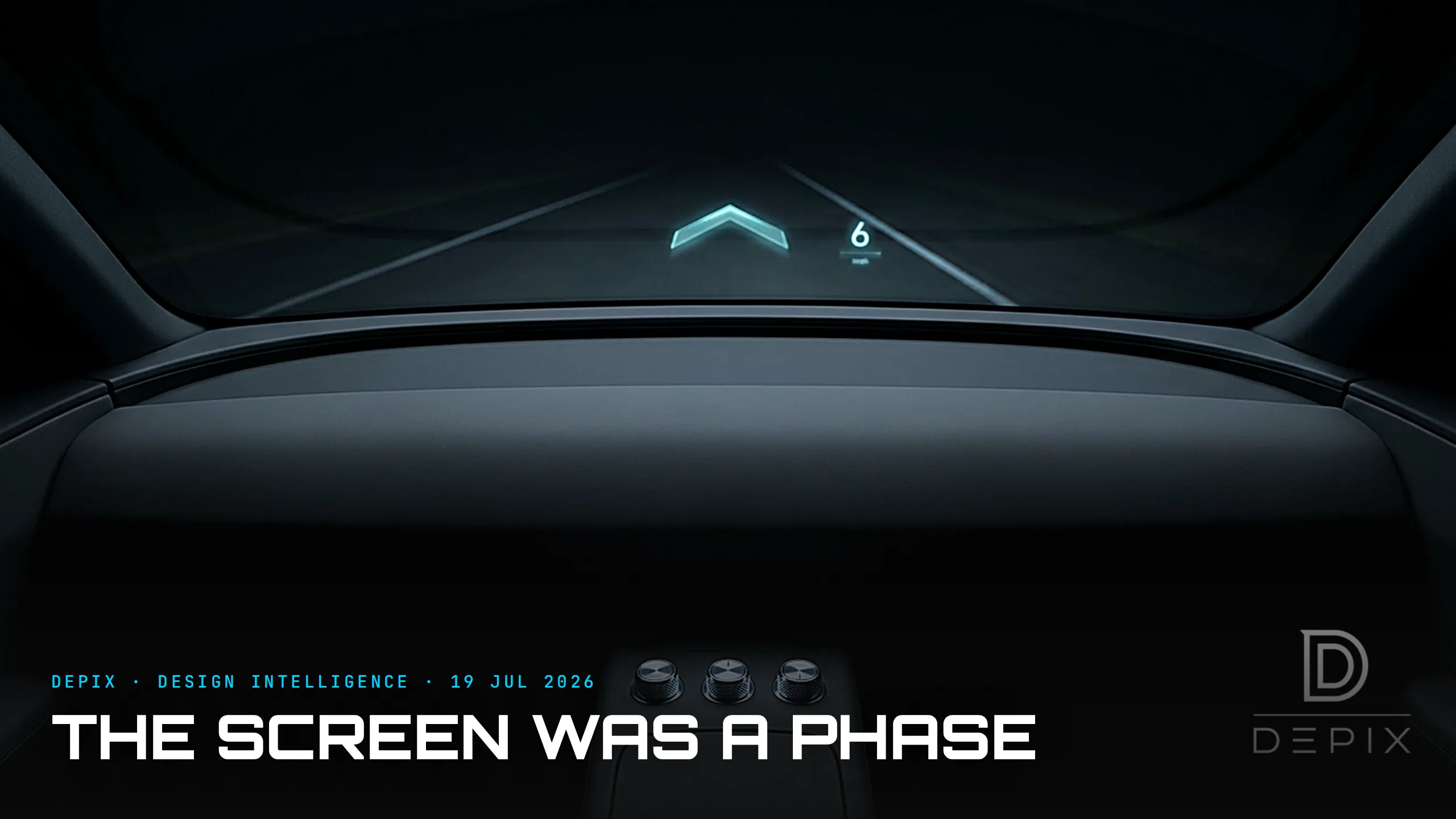
The Screen Was a Phase: Why the Car's Dashboard Is Disappearing in Two Directions
For fifteen years, the story of the car interior has been the rise of the screen. Buttons and dials were swept away, absorbed one by one into an ever-larger central touchscreen, until the dashboard became a single black slab. The industry sold this as arrival — the interior finally made modern, a smartphone on wheels. It was nothing of the sort. The giant touchscreen was a detour, and you can already see the road bending away from it in two opposite directions at once.
The first direction is downward and backward: controls returning to physical buttons. This isn't nostalgia, it's regulation. From January 2026, Euro NCAP's new rules make it much harder for a touchscreen-only car to earn a five-star safety rating — to score top marks, five critical functions (indicators, hazards, horn, wipers and the emergency call) must have physical controls. The body's own safety director calls the overuse of touchscreens "an industry-wide problem," forcing drivers to take their eyes off the road. The market had already begun to turn: Volkswagen restored physical buttons for climate and volume after customer backlash, and safety regulators are now following. A button you can find by touch, without looking, turns out to be better designed than a menu you have to hunt for at 70mph.
The second direction is upward and outward: information leaving the dashboard entirely and moving onto the windshield. Augmented-reality head-up displays take data from the car's cameras, radar and GPS and project it onto the glass so it looks like part of the road — navigation arrows that lie on the tarmac, hazards flagged before you consciously see them, the speed limit floating at the edge of your vision. This is not a concept. BMW is building AR head-up displays into its Neue Klasse EVs, Audi and Porsche have brought AR to their head-up systems, suppliers like Valeo now sell AR-HUD as a catalogue item, and Jaguar Land Rover is trialling the next wave. The logic is simple: the best place for driving information is where you are already looking — the road — not a slab below it.
Put those two movements together and the giant touchscreen is being hollowed out from both ends. The things you must do quickly go back to physical controls you can feel. The things you must see go up onto the windshield where your eyes already are. What's left for the central screen shrinks to the things that genuinely suit it — the map you occasionally study, settings you change when parked, media. The screen doesn't vanish; it stops being the whole dashboard and goes back to being one tool among several.
Here is why this matters at the concept phase, and it is the real lesson. The single-screen car was, in large part, a decision made for the wrong reasons: a touchscreen is cheap, endlessly reconfigurable, and lets you ship a half-finished interior and patch it later in software. It optimised for the manufacturer's flexibility, not the driver's attention. A good interior does the opposite — it decides, before anything is drawn, which information belongs in your eyeline, which actions belong under your fingertips, and which content belongs on a screen, and then commits physical architecture to that map. You cannot retrofit "eyes on the road" onto a car that put everything behind a menu. Where information lives is the foundational decision of the whole cabin, and it dictates the dashboard's shape, the wheel, the sightlines and the switchgear.
So the giant screen was never the destination. It was the phase a whole industry passed through while it worked out that a car is not a phone — that the person using it is moving at speed and cannot afford to look away. The interiors that feel genuinely modern in ten years won't be the ones with the biggest slab of glass. They'll be the ones that made you forget the screen was ever there.
Sources:
- ●Physical buttons beat touchscreens in Euro NCAP's 2026 rules — Carwow
- ●Cars will need buttons for a 5-star Euro NCAP rating — ETSC
- ●Europe's 2026 rules will force carmakers to bring back buttons — Euro Weekly News
- ●Physical buttons could make a comeback thanks to a new safety rule — Autoblog
- ●Europe is requiring physical buttons for top safety marks — The Autopian
- ●AR head-up display: the windshield is the world's most advanced screen — inAirSpace
- ●Augmented reality head-up display (AR HUD) — Valeo
- ●Qualcomm augmented reality heading to BMW Neue Klasse — Supercar Blondie
- ●Audi brings augmented reality to the head-up display — Design News
- ●AR/VR head-up display developments, JLR trial — Repairer Driven News
- ●Augmented reality in automotive — AIDAR Solutions

Should It Look Recycled? The Design Politics of Visible Waste
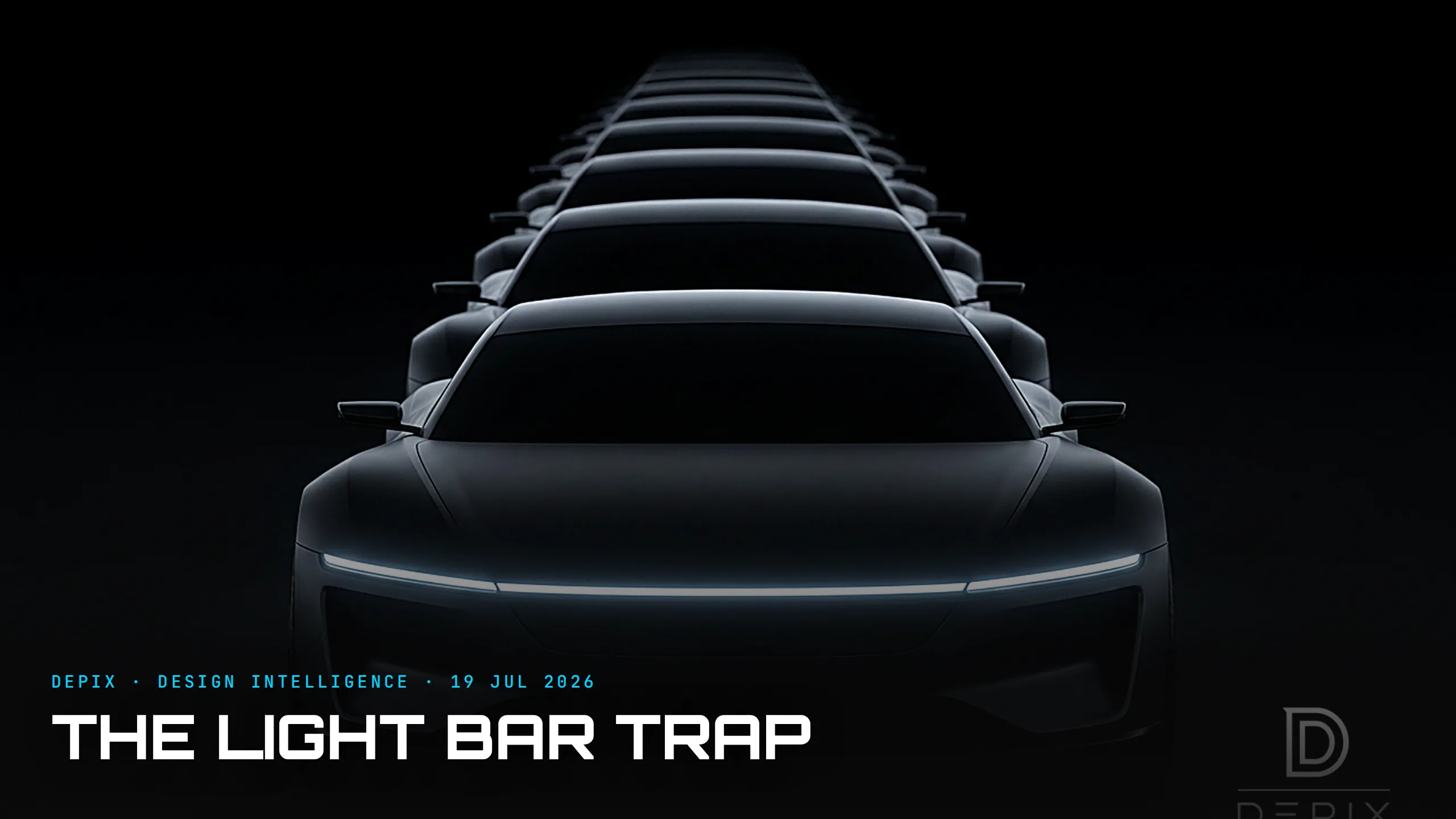
The Light Bar Trap: How the EV Era's Signature Move Made Every Car Look the Same