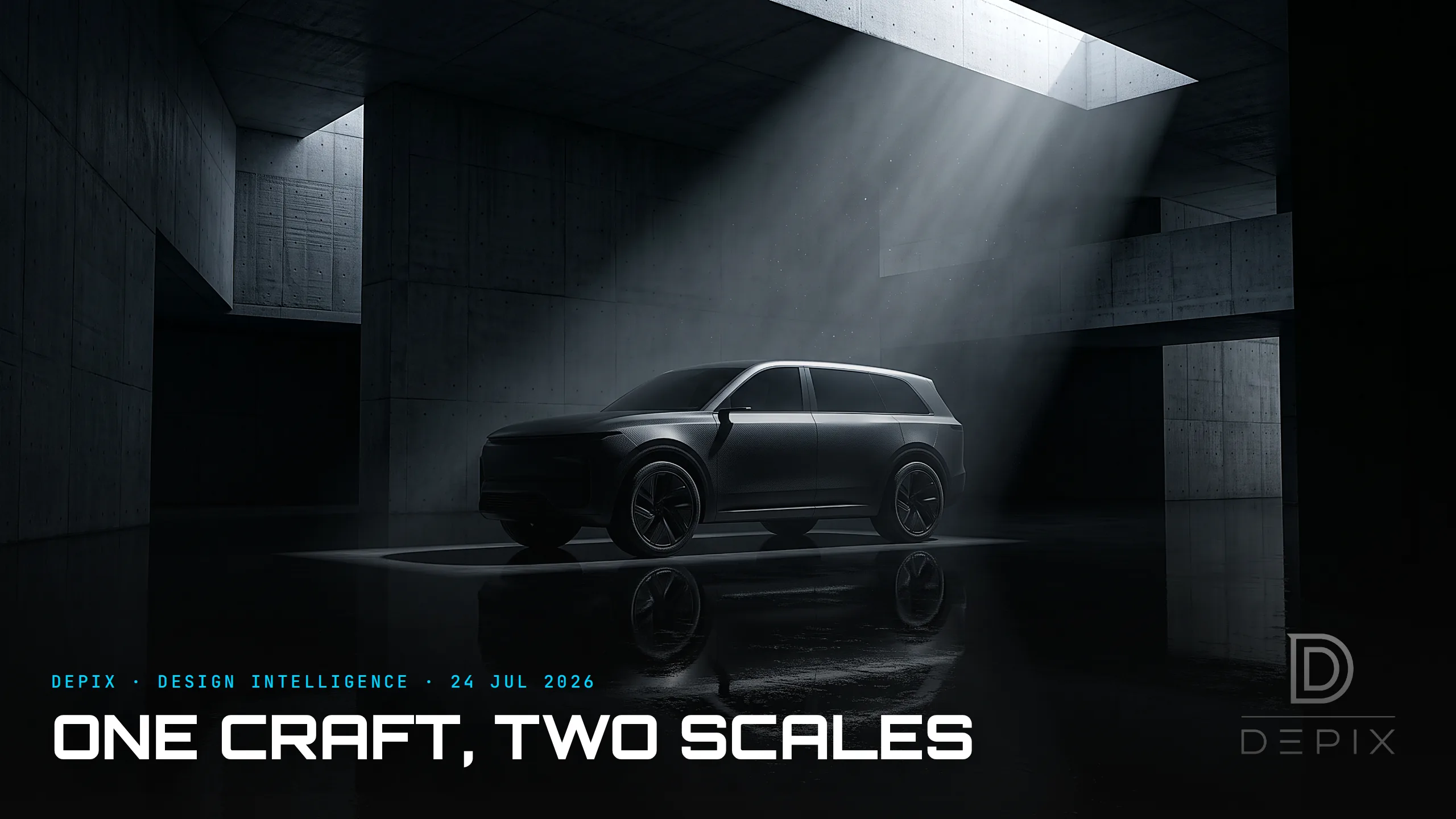
Same Discipline, Different Scale: What Cars and Buildings Steal From Each Other
We file car design and architecture in different drawers — one is product design, the other is the built environment; one moves, the other stands still. But look at how each is actually made and the distinction dissolves. They are the same discipline practiced at two scales, and the designers who understand that have quietly moved between them for a century.
Start with the shared grammar. The most-quoted rule in car design — "form follows function" — was coined by an architect, Louis Sullivan, describing tall buildings. Both fields obsess over the same first move: proportion, often reaching for the same golden-ratio relationships to decide how a volume sits before any detail is drawn. A car's glasshouse is a facade; its A-pillars and roofline are structure expressed as style; the relationship of solid metal to open glazing is exactly the solid-to-void problem an architect solves on an elevation. Read a car in section and you are reading a building.
The history makes the kinship explicit, and for most of it the influence ran from buildings to cars. Le Corbusier believed architects had much to learn from the automobile production line, and his 1936 Voiture Minimum sketches still look modern. Giò Ponti's 1953 Linea Diamante, with its huge glasshouse and plunging bonnet, predicted the cars of the 1970s. Buckminster Fuller's 1933 Dymaxion reorganised the body around the passenger like a fuselage. The traffic never stopped: Monocle and others keep asking architects to imagine cars because the crossover is so natural, and Ferrari's design is led by Flavio Manzoni, a trained architect. Car Design News has a name for the shared territory: the "Nth Space."
Here is the contrarian part: the influence has now started flowing both ways, and it is accelerating. Electrification is turning cars into architecture. Strip out the engine and the battery-sandwich floor raises the car's height and rewrites its proportions, and the cabin becomes a room to be laid out rather than a cockpit to be packaged — a spatial, architectural problem. The most admired new EVs read as buildings or aircraft as much as cars: minimal, sectional, structural. Meanwhile architecture is moving the other way, borrowing the car world's obsession with aerodynamics, kinetics and mass-produced, lightweight componentised structure. The two scales are converging on one language.
Why does this matter beyond a nice observation? Because it points at where design leverage actually lives. Both disciplines make their single most consequential decision at the same moment and in the same way: the massing — the proportion, the stance, the relationship of the volumes — is fixed at the concept phase, before a single surface is styled, and everything downstream negotiates with it. An architect who gets the massing wrong cannot detail their way out of it; neither can a car designer. The skills that transfer are precisely the concept-phase skills: how to read a proportion, how to compose solid and void, how to make structure do expressive work, how to decide what a volume should feel like before deciding what it looks like.
Which is the real lesson, and it generalises past cars and buildings. Your own discipline's blind spots are usually another discipline's basic literacy. The car designer who has never studied a facade is missing a century of thinking about solid-to-void; the architect who has never packaged a car is missing hard lessons about volume, weight and the section. The most original work almost always comes from someone who imported a way of thinking from the scale next door — and the place to import it is the concept phase, while the massing is still fluid and the biggest decisions are still cheap to change.
This is why, at Depix, we think in terms of intent and proportion rather than category. A car, a building, a product, an object — they are the same act of deciding what a volume should be and mean, performed at different sizes. Get that first decision right and the discipline barely matters. Cars are architecture. They always were; we just kept the two in different drawers.
Sources:
- ●Rethinking The Future — How architectural principles influence car design
- ●Stellantis Heritage — Vehicles conceived by great architects
- ●Roarington — Architects and cars: rationality and imagination
- ●Monocle — Eight architects' vision for automobiles
- ●Car Design News — Auto and architecture crossover in the 'Nth Space'
- ●JTAPE — How famous architects would design a car
- ●Architecture Adrenaline — What cars architects favour
- ●Cambridge Core — Systematic analysis of changing vehicle proportions
- ●Accio — Futuristic cars defining the 2026 design trends
- ●Verified Market Reports — Automotive design market trends
- ●Jasper Colin — Tech revolutions quietly redefining cars in 2026

Taste Is the Bottleneck: What Generative AI Actually Changes in the Concept Phase

The Analog Holdout: Why the 'Obsolete' Manual Refuses to Die