For 170 Years, the Hardest Part of Designing an Elevator Was Never the Elevator
The elevator is one of the most consequential machines ever built — it made the vertical city possible and unlocked the skyscraper — and yet almost none of its landmark design moments were about lifting a box up a shaft. The mechanics of hoisting were largely solved early. The hard problems, the ones that took real design intelligence, were all about the human being riding inside. For 170 years the elevator's defining challenge has not been mechanical. It has been psychological.
Start with the moment the industry itself treats as its origin. In 1854, Elisha Otis stood on an open platform high above a crowd at New York's Crystal Palace, ordered an assistant to sever the hoisting rope with an axe, dropped a few inches, and stopped — then announced, "All safe, gentlemen, all safe." The spring-loaded safety brake that caught him was a genuine engineering advance, but its real product was not the brake; it was trust. People already had hoists. What they didn't have was the nerve to ride one high. Otis didn't design a lifting machine that day — he designed a demonstration, a piece of theatre aimed squarely at fear. Skyscrapers exist because someone solved a feeling.
Once people would ride, the next problem was equally human: they hated waiting. The instinctive fix is engineering — faster motors, more cars — but that is slow and ruinously expensive. The famous, far cheaper solution was pure perception design. A well-worn story from the queuing-theory literature has an office building flooded with complaints about slow elevators; the fix wasn't faster elevators but mirrors installed in the lobbies. MIT's Richard Larson put it plainly: the mirrors let people check their hair and their tie, the wait felt shorter, and the complaints vanished — even though the actual wait never changed. The problem was never the duration. It was the experience of the duration, and that is a design problem, not an engineering one.
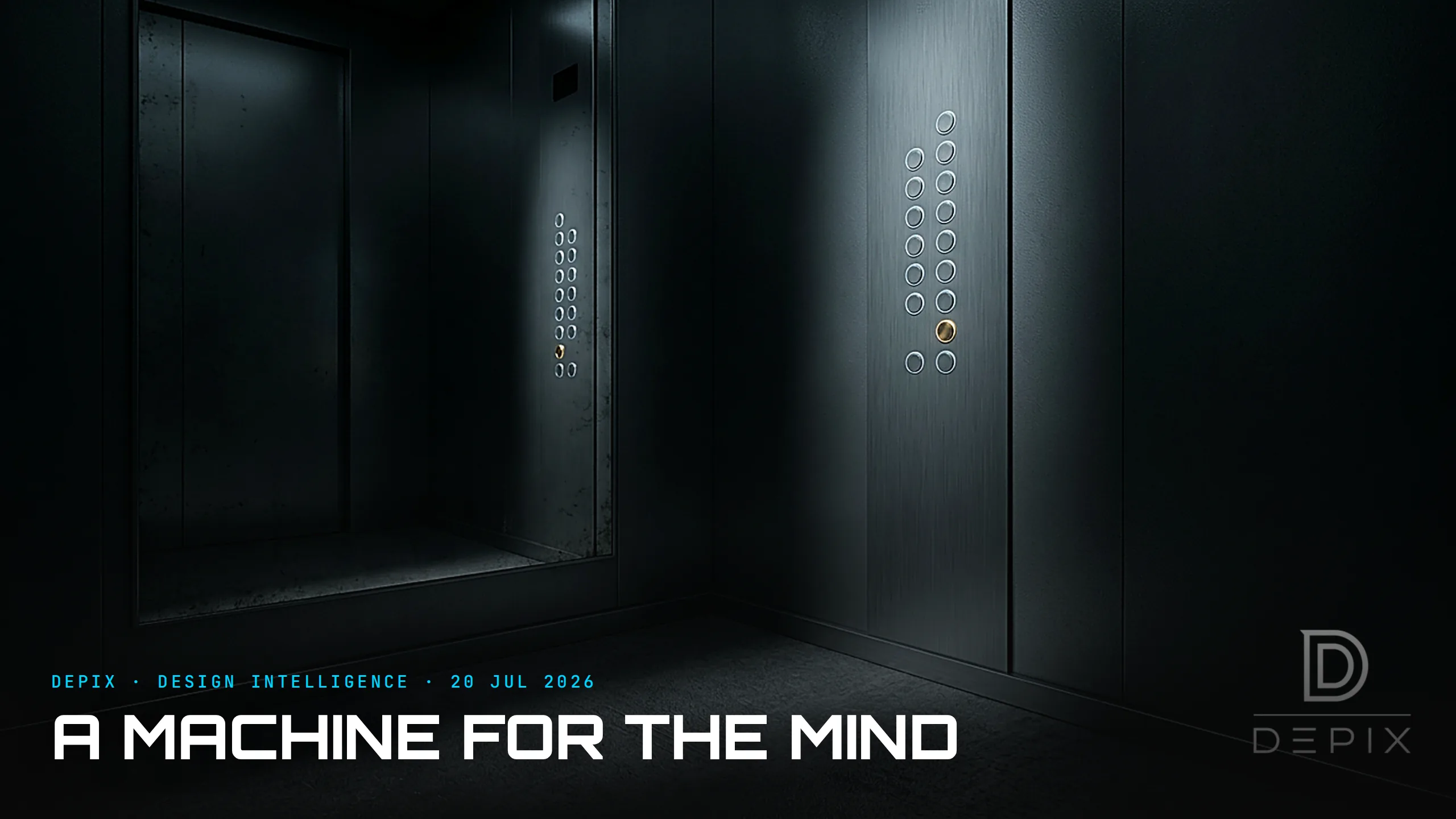
Then there is the most quietly radical piece of psychology in the whole machine: the "close door" button. On most elevators, for the general public, it does nothing at all. Since the Americans with Disabilities Act of 1990 set a minimum door-open time, the button has been effectively disconnected for ordinary riders — live only for firefighters with a key. It survives because it works on the mind. It is a placebo button, and it delivers what psychologists call the illusion of control — the sense of agency that, as Harvard's Ellen Langer has shown, genuinely lowers stress even when the action changes nothing. Engineers could have left it off. The designers understood that a rider who can do something feels calmer than one who can only stand and wait.
None of this is a historical curiosity, because the frontier is still psychological. The big modern advance in vertical transport is destination dispatch — you enter your floor in the lobby and are assigned a car with others going the same way — and the newest AI dispatch systems predict demand and pre-position cars, cutting average waits by 20–40%. Faster, yes; but the entire pitch is about flow and the feel of the journey — fewer stops, less crowding, less standing and guessing. A century and a half on, the elevator is still being designed around the passenger's perception, not just the motor.
Here is the concept-phase lesson, and it is a big one. Almost every product has two problems hiding inside it: the mechanical one and the human one. The mechanical problem is usually the one that gets budgeted, staffed and celebrated — and it is usually the easier of the two. The human problem — the fear, the boredom, the need to feel in control — is the one that actually decides whether people will use the thing, and it has to be designed for deliberately, from the very first brief, or it is left to accident. Skip it and you can ship a technically flawless machine that people quietly dread; solve it and a slow, ordinary box becomes something nobody thinks twice about stepping into. The elevator is the purest proof that solving the machine is not the same as solving the experience. Otis's competitors could all lift a box. He was the one who understood that the real design problem was the person standing inside it.
Sources:
- ●Origin Trace — The Invention of the Elevator: How Otis Unlocked the Vertical City
- ●Fenado — Elisha Otis's 1854 Safety Brake Demonstration
- ●National Inventors Hall of Fame — Elisha Graves Otis, Elevator Brake
- ●CNN Style — The design of waiting lines (mirrors and perceived waiting)
- ●Signal v. Noise — Defining the problem of elevator waiting times
- ●PMC — Examining waiting times and stress in human-elevator interaction
- ●ScienceAlert — The 'close door' buttons in elevators don't actually do anything
- ●HowStuffWorks — Are elevator 'close door' buttons a placebo?
- ●CNN Style — Why the world is full of buttons that don't work
- ●Psychology Today — Your World Is Full of Placebo Buttons (illusion of control)
- ●Elevator Scene — Destination Dispatch and elevator control innovation
- ●Elevator.tr — AI Elevator Dispatch: machine-learning traffic optimisation

The Traffic Light's Genius Isn't That It's Clever — It's That It's the Same Everywhere
For 50 Years, Hearing Aids Were Designed to Disappear. An Earbud Fixed What Shrinking Never Could.