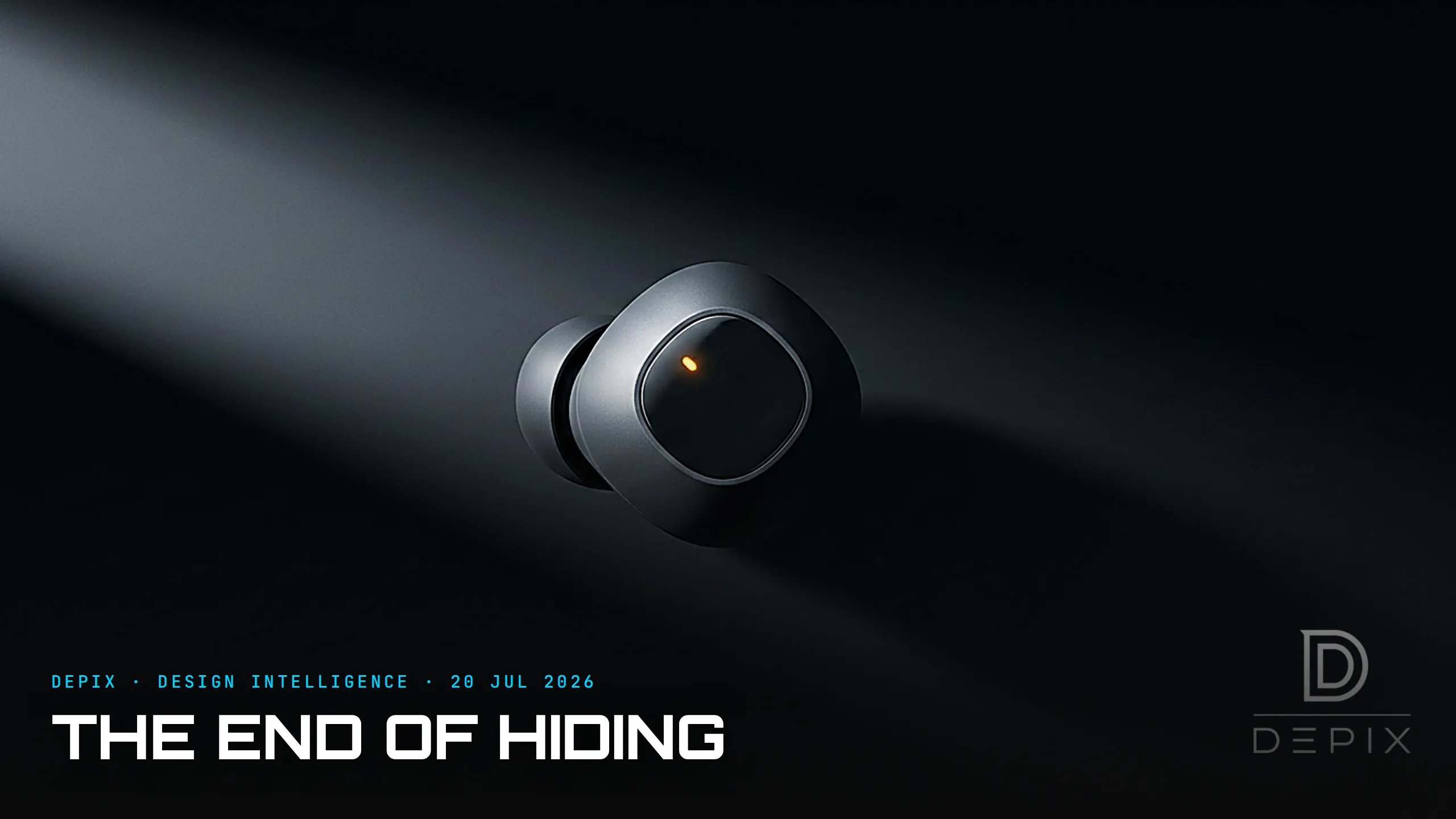
For 50 Years, Hearing Aids Were Designed to Disappear. An Earbud Fixed What Shrinking Never Could.
For most of a century, the entire design brief of the hearing aid could be summed up in one word: disappear. Make it smaller. Make it flesh-toned. Tuck it deeper into the canal, hide it behind the ear, then inside the ear, then make it "invisible." The industry poured extraordinary engineering into miniaturisation, and by any technical measure it succeeded. And yet the problem it was trying to solve only got worse.
Here is the number that should stop any designer cold: on average, people wait seven to ten years — around nine — after first noticing hearing loss before they act on it. Not because treatment doesn't work, but because stigma is one of the single most common reasons people delay. The World Health Organization lists stigma alongside isolation and cognitive decline as a core harm of unaddressed hearing loss. Fifty years of relentless shrinking did not fix this. If anything it entrenched it — because the act of hiding something announces that it is shameful. Invisibility was never the cure for the stigma; it was the stigma, expressed in industrial design.
This is the trap: the industry mistook the size of the object for the meaning of the object. The brief — "make it invisible" — was answering the wrong question. The real question was never "how do we hide this?" It was "what does wearing this say about me?" And you cannot engineer the answer to that from inside a hearing-aid company, because meaning is set by the culture, not by the caliper.
Which is why the thing that finally broke the stigma didn't come from the hearing industry at all. It came from a completely unrelated product: the wireless earbud. Before AirPods, a small device in someone's ear was read instantly as a hearing aid — as age, as disability. After a few years of everyone wearing white stems on the train, a device in the ear reads as technology. The visual vocabulary flipped, and the hearing aid could suddenly ride it. The stigma the industry spent decades trying to shrink its way out of was, in the end, architecturally eliminated by a consumer gadget that changed what an in-ear object means.
There is a quiet irony worth sitting with. The AirPod is frequently blamed for causing hearing damage — and the very same object is now the leading on-ramp to treating it. The device never had to be medical to do medical work; it had to be desirable. Desirability, not discretion, turned out to be the therapeutic feature, and no amount of miniaturisation could have manufactured it, because desirability is a cultural verdict, not a spec.
Regulators and the market caught up fast. The FDA's 2022 Over-the-Counter Hearing Aid rule, effective that October, let people buy hearing aids directly, no prescription or audiologist fitting required — reframing them from medical apparatus to consumer product. Then in September 2024 the FDA authorised the first-ever over-the-counter hearing-aid software: a feature built into Apple's AirPods Pro. The same earbud millions already wore for music could now quietly serve as a self-fitted hearing aid, set up from an iPhone — a shift NPR framed as a genuine turning point for access. And a new generation of dedicated devices now deliberately designs to look like earbuds — neutral matte finishes, in-canal forms that read as consumer electronics, not medical hardware.
Notice what actually changed. Not the size — modern hearing aids aren't dramatically smaller than the "invisible" ones of a decade ago. What changed was the meaning, and the winning design move was the exact opposite of the old one. For fifty years the goal was to make the device disappear; the breakthrough was to make it visible on purpose — indistinguishable from a thing people are happy, even eager, to be seen wearing.
The concept-phase lesson reaches far past hearing. Every product carries a meaning as well as a function, and that meaning is set at the very beginning, in the founding brief, long before a single component is engineered. Get the brief right and the object works with the culture; get it wrong — optimise "invisible" when the real problem is "shame" — and you can spend half a century polishing a brilliant answer to a question nobody was asking. Design intelligence is knowing which problem you are actually solving. The hearing aid didn't need to get smaller. It needed to stop reading as a hearing aid — and start reading as technology.
Sources:
- ●FDA — FDA Authorizes First Over-the-Counter Hearing Aid Software (AirPods Pro)
- ●Federal Register — Establishing Over-the-Counter Hearing Aids (final rule, 2022)
- ●ASHA — FDA Releases Final Rule for OTC Hearing Aids
- ●NPR — FDA approves some Apple AirPods to be used as hearing aids
- ●World Health Organization — Deafness and hearing loss (fact sheet)
- ●ASHA — Untreated Hearing Loss in Adults (treatment-delay data)
- ●audioXpress — Perception, Stigma, and Ergonomics in Hearing
- ●HearingTracker — Hearables and Hearing Wearables Technology Guide
- ●Southeast ADA Center — Apple AirPods Pro Hearing Aid Feature: how it works
- ●ELEHEAR — Hearing aids that look like wireless earbuds (2026)

For 170 Years, the Hardest Part of Designing an Elevator Was Never the Elevator

The Subway Map's Whole Job Is to Lie to You Correctly