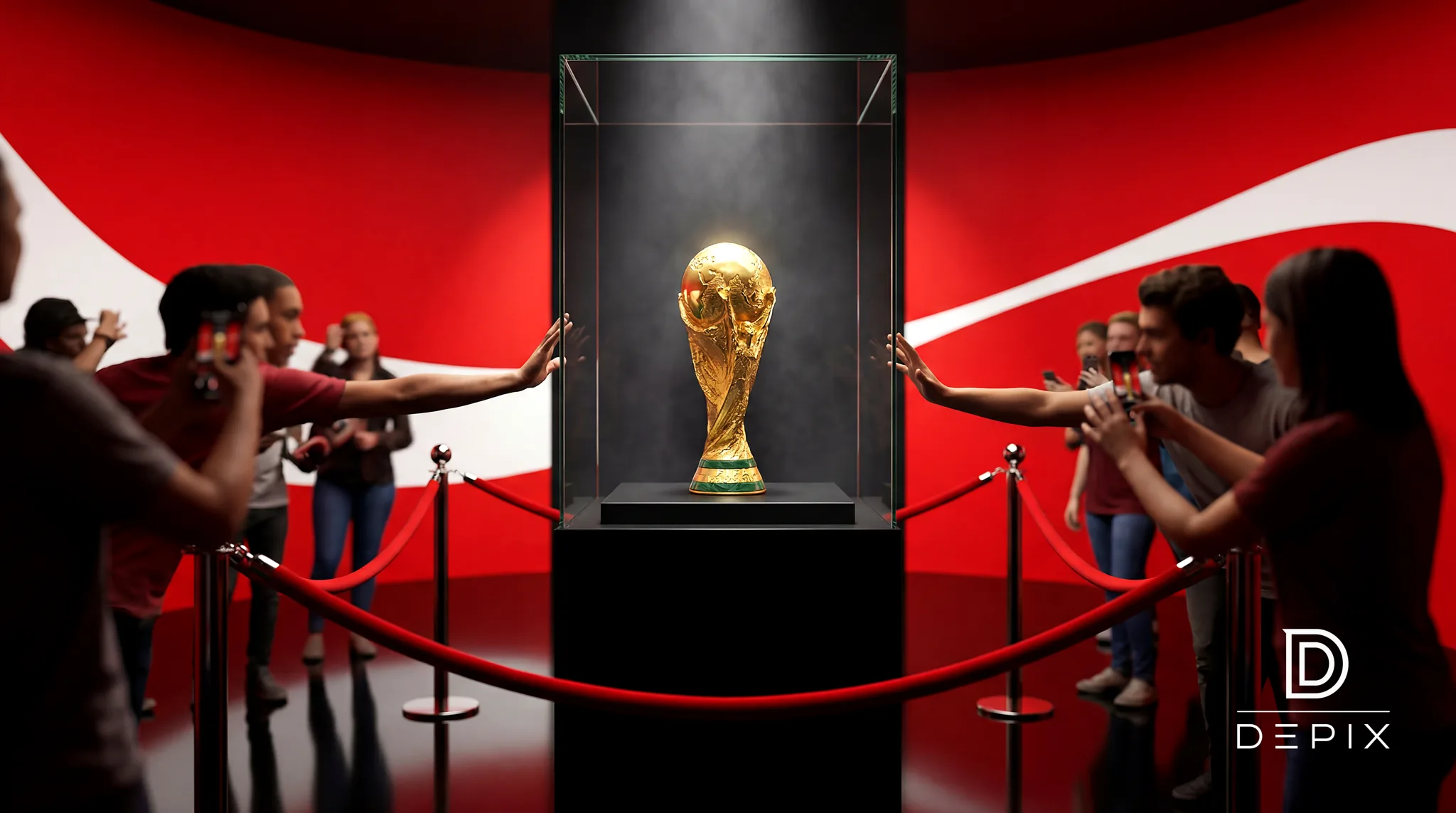
The World Cup trophy is untouchable. Coca-Cola made that a product.
There are objects you are allowed to want but not allowed to hold. The FIFA World Cup Trophy is the purest example in sport. It stands 36.8 cm tall, weighs 6.175 kg of 18-carat gold, and was sculpted by Italian designer Silvio Gazzaniga — two straining human figures lifting up the Earth. And under FIFA's own protocol, only three categories of person may touch the original with bare hands: players and managers who have actually won the tournament, heads of state, and FIFA officials. Everyone else — every fan, every sponsor executive, every child pressed against the glass — is permitted proximity and nothing more.
That prohibition is not a security footnote. It is the product.
Since 3 January 2026, when it left Riyadh, the FIFA World Cup Trophy Tour by Coca-Cola has been converting that untouchability into a distributed retail experience. The route is the largest in the tour's history: 30 FIFA member associations, 75 stops, more than 150 tour days, taking in all three 2026 host nations plus future hosts such as Morocco, Portugal, Spain, Saudi Arabia and Brazil. The North American leg alone runs 38 cities. At each stop the offer is the same — an immersive, red-liveried brand environment, football challenges, "exclusive content with FIFA Legends," and, at the centre, a gold object behind glass that you may photograph but never grasp.
Read it as a designer and the cleverness is uncomfortable. Coca-Cola is not selling the trophy. It cannot; the trophy is not for sale and never leaves FIFA's custody. It is selling the distance to it. The queue, the rope line, the reverent lighting, the "I was there" photograph — the entire experience is engineered around an artefact whose defining feature is that you are forbidden from the one interaction every human instinct demands. Scarcity here isn't a marketing overlay applied late. It is baked into the object's governance, and the tour is a machine built to monetise exactly that gap.
This is a concept-phase decision masquerading as heritage. Somewhere upstream, someone decided what this trophy is for on tour. Not a prize — the prize function happens once, in one stadium, in July. On the road it is a relic, and the design brief is aura management: how close do you let people get, how do you light untouchability so it reads as sacred rather than stingy, how do you make "you cannot touch this" feel like a gift instead of a rejection. Every rope, sightline and vitrine angle is answering that brief. Get it right and 150 days of not-touching becomes the most photographed object of the tournament. Get it wrong and it reads as a velvet-roped upsell for a fizzy drink.
The failure mode is real. The moment the staging tips from reverence into commerce — one sponsor logo too many, one paywalled photo op — the aura collapses and the whole thing looks like what it partly is: a beverage company renting the emotional charge of a national obsession. The line between "pilgrimage" and "pop-up" is drawn entirely at the concept stage, in decisions about proximity, framing and restraint that are almost impossible to renegotiate once the tour trucks are built and the 75 stops are contracted.
That is the design-intelligence lesson, and it has nothing to do with football. The value of a scarce object is not discovered at the event — it is authored far upstream, in the call about what the object is, how near people get, and what the absence of touch is supposed to make them feel. Those calls are cheap to sketch and brutally expensive to unwind after fabrication. This is precisely where DEPIX's concept-phase design intelligence earns its place: staging the aura-versus-access tension at photoreal fidelity, in real context, before the vitrines are cut and the routes are locked — so you can see whether your untouchable object reads as sacred or merely roped-off, while it still costs a render to change your mind.
Coca-Cola understood something most brands miss: sometimes the most valuable thing you can design is the reason people can't have it.
Sources
- ●FIFA World Cup Trophy — Wikipedia
- ●FIFA World Cup Trophy Tour by Coca-Cola 2026 — The Coca-Cola Company
- ●Trophy Tour to visit 38 cities across North America — FIFA
- ●Riyadh the first of 75 stops — FIFA
- ●Trophy Tour Highlights Coca-Cola's Enduring FIFA Partnership — Forbes
- ●Silvio Gazzaniga, FIFA World Cup Trophy creator — FIFA

A beer brand built the World Cup's other trophy.

Germany didn't win the 1954 World Cup. Its boots did.

