
A beer brand built the World Cup's other trophy.
There is only one FIFA World Cup trophy. Six kilos of gold, untouchable, the object every nation is chasing. And then, at this tournament, there is a second one — smaller, satin aluminium, handed out 104 times to a player most fans voted for on their phones. It does not belong to FIFA. It belongs to a beer.
Michelob ULTRA is the official beer of the 2026 World Cup, the lead brand of an AB InBev sponsorship the group has already extended through 2030. But instead of spending that partnership the way beer usually spends it — perimeter boards, stadium taps, a logo behind the manager's press conference — Michelob commissioned an object. The Superior Player of the Match trophy is awarded after every one of the tournament's 104 fixtures, from the opening match in Mexico City on 11 June to the final at the New York New Jersey Stadium on 19 July, chosen by a fan vote in the app. That is 104 designed objects, each one lifted on camera by the player the broadcast is already pointing at.
This is a colder, smarter reading of a lesson AB InBev learned the hard way. Its sibling brand Budweiser bet a fortune on stadium beer rights in Qatar in 2022 and had the sales banned 48 hours before kickoff. A rights slot can be revoked. A perimeter board can be redrawn, blanked, or taped over — as FIFA's own clean-stadium rules do to venue naming across 2026. But you cannot ban the object the winning player is holding while a billion people watch. Michelob did not rent space in the broadcast. It designed itself into the frame.
Look at what the object actually encodes. The trophy was led by Victor Solomon — the artist behind the NBA's Larry O'Brien trophy — and every decision in it is a brand decision disguised as a sculpture. The open top is sloped at a 26-degree angle, a nod to the tournament year. The base is three stacked layers, one for each host nation. And the centrepiece is a red insert built from 104 faceted crystal pieces — one for every match, and, not incidentally, the exact shape of Michelob ULTRA's signature ribbon. The logo is not printed on the trophy. The logo is the trophy. There is nothing to strip off, because the branding is the geometry.
That is the whole move, and it is a concept-phase move. The commercial outcome — guaranteed, un-bannable presence in all 104 broadcasts — was not won in the media plan or the activation budget. It was won upstream, in the single decision about what the object should be: not an ad, but an artefact the tournament's own storytelling is obliged to show. Everything downstream (the fan vote, the Messi-and-Pulisic campaign, the Kevin Hart stunt paying a fan to carry the trophy to the final) is amplification. The equity was decided in the form.
Beer marketing usually gets this backwards. It buys reach and hopes the reach carries a brand that was finished long ago. Michelob inverted it: settle what the thing is first — a covetable object shaped like your logo — and let reach come free, because the sport hands out your product on your behalf 104 times.
This is exactly the leverage point DEPIX cares about. The difference between renting attention and owning it is a decision made when a design is still an idea — cheap to sketch, cheap to change, ruinous to unwind once it is machined in aluminium and crystal and printed across a global campaign. A ribbon becomes 104 crystal shards, or it doesn't, at the concept stage. DEPIX's design intelligence exists to make that stage legible: to stage the object at photoreal fidelity, test whether the brand really lives in the form, and settle it while it still costs nothing but a prompt.
The winner's trophy will be lifted once, by one nation. Michelob's will be lifted 104 times, by design. Only one of those outcomes was a marketing budget. The other was a decision about a shape.
Sources
- ●Michelob ULTRA Unveils the FIFA World Cup 2026 MVP Trophy (PR Newswire)
- ●Michelob ULTRA Superior Player of the Match — every winner (FIFA)
- ●Custom trophies created for every 2026 World Cup match (Fox News)
- ●Kevin Hart, Michelob ULTRA offer $90K World Cup fan role (Forbes)
- ●AB InBev extends FIFA World Cup partnership through 2030 (inside.beer)
- ●How brands are capitalizing on the 2026 FIFA World Cup (Forbes)

Canada dressed its World Cup team like a hockey squad.
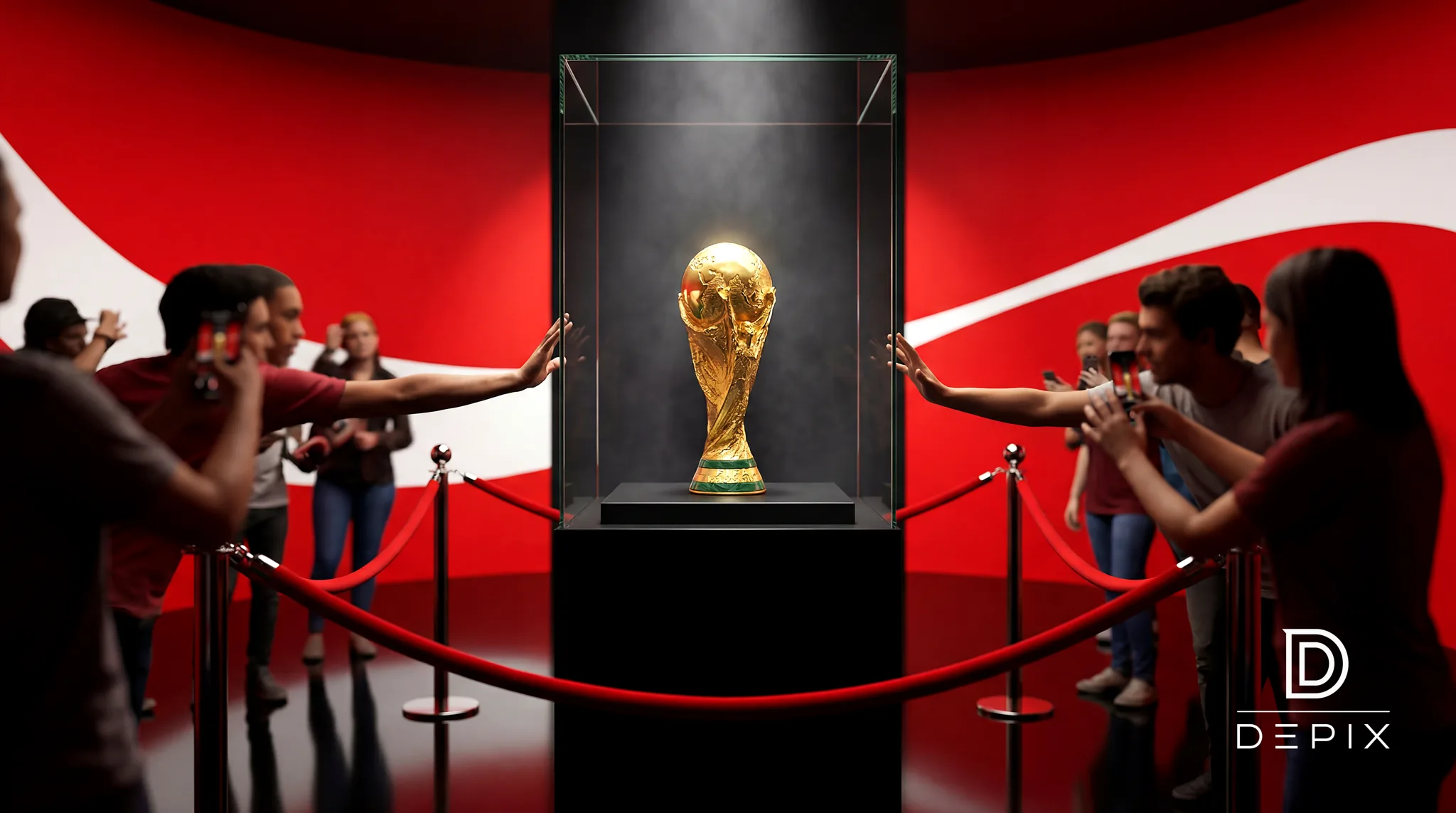
The World Cup trophy is untouchable. Coca-Cola made that a product.
