
Germany didn't win the 1954 World Cup. Its boots did.
date: 2026-07-04
Germany didn't win the 1954 World Cup. Its boots did.
Seventy-two years ago today, on 4 July 1954, West Germany walked onto a rain-soaked pitch at Bern's Wankdorf Stadium to face Hungary's "Golden Team," the most feared side football had ever produced. Hungary had not lost in four years. Weeks earlier, in the group stage, they had dismantled the Germans 8–3. Inside eight minutes of the final they led 2–0. Ninety minutes later West Germany had won 3–2, and a country flattened by war had a myth: das Wunder von Bern, the Miracle of Bern.
The miracle had a designer, and his name was on the boots.
Adi Dassler had spent decades obsessing over a detail most people never think about: the stud. His final-day boots were light leather, reportedly around half the weight of the English-made boots Hungary wore, and they carried screw-in studs that could be swapped for the conditions. As the Bern rain turned the pitch to mud, Dassler lengthened his players' studs. Germany gripped; Hungary slipped. The most talented team on earth lost its footing, literally, to a product decision made before kickoff.
That is the uncomfortable part. The comeback is remembered as heart, character, will. But the edge that let heart matter was engineered upstream — cheap, adjustable, decided long before anyone knew it would rain.
And the boots on both benches of modern football trace back to the same small Bavarian town. Adi Dassler and his brother Rudolf built shoes together as Gebrüder Dassler Schuhfabrik from 1924. They shod Jesse Owens to four golds at the 1936 Berlin Olympics. Then they stopped speaking. Nobody outside the family knows exactly why — wartime resentment, a misheard insult in a bomb shelter, wounded pride. By 1948 the partnership was dead. Rudolf crossed the Aurach river and registered Puma; a year later, in August 1949, Adi registered adidas. Herzogenaurach became "the town of bent necks," because locals would glance down at your shoes before deciding whether to greet you.
One feud, one river, two of the biggest brands in sport — and a rivalry that still frames every World Cup. At the 2026 tournament across North America, adidas alone is FIFA's official match-ball partner, with the four-panel Trionda, and it outfits 14 of the 48 national teams; Nike dresses 12 and Puma 11. Thirty-seven of the forty-eight kits belong to three brands, and two of those brands were born from brothers who never reconciled.
Here is the design-intelligence lesson under the folklore. The 1954 final was not won by a bigger budget or a louder campaign. It was won by a decision about the object — adaptable studs versus fixed ones — taken while it was still just a sketch, then validated against the one condition that mattered: real mud, real rain, real opponents. Adi Dassler was not gambling on the day. He had already decided what the boot needed to be, before the whistle made it expensive to be wrong.
That is the whole game. The decisive move in almost any product is made early, when it is cheap to change and easy to get wrong quietly. The teams that win are the ones who can see the object clearly — in its real context, under the conditions that will actually test it — while there is still time to choose differently.
DEPIX exists for that moment. Design intelligence is the discipline of making the concept-phase call at full, photoreal fidelity, in real competitive context, before tooling and budget and a billion-unit run turn the decision permanent. Hungary had the better players. West Germany had made the better decision, seventy-two years ago today, and never had to touch it again.
Sources
- ●Dassler brothers feud — Wikipedia
- ●Adidas vs. Puma: A Family Rift That Shaped Sportswear — HISTORY
- ●1954 FIFA World Cup final — Wikipedia
- ●Adolf Dassler: The Creative and Innovative Leader Behind adidas — adidas Group
- ●PUMA Timeline — PUMA
- ●PUMA FIFA World Cup 2026: 11 national team kits — Sporting Goods Intelligence
- ●The Most Important Soccer Game Ever Played — The Ringer
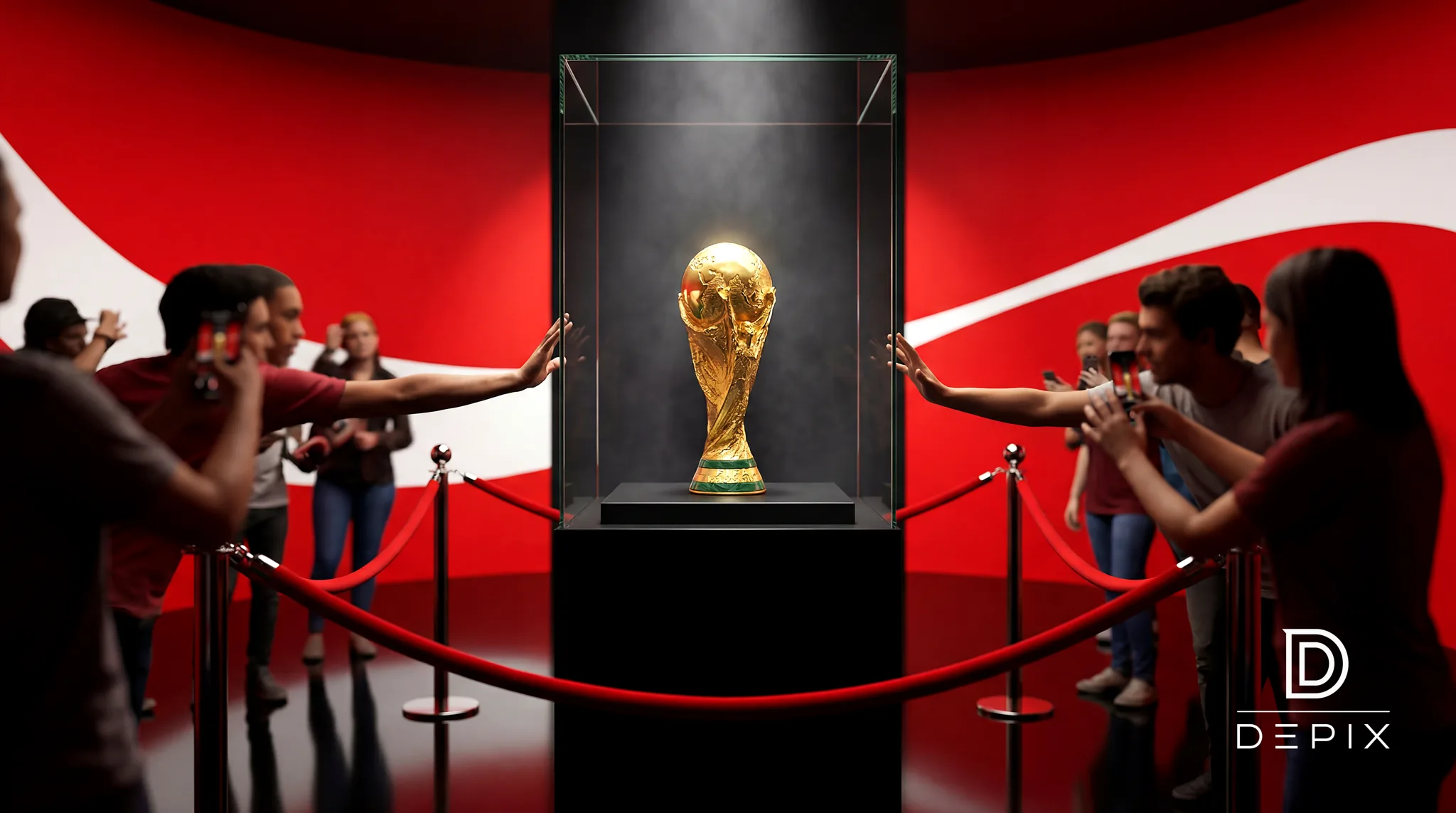
The World Cup trophy is untouchable. Coca-Cola made that a product.

Adidas hid a store inside a free World Cup festival
