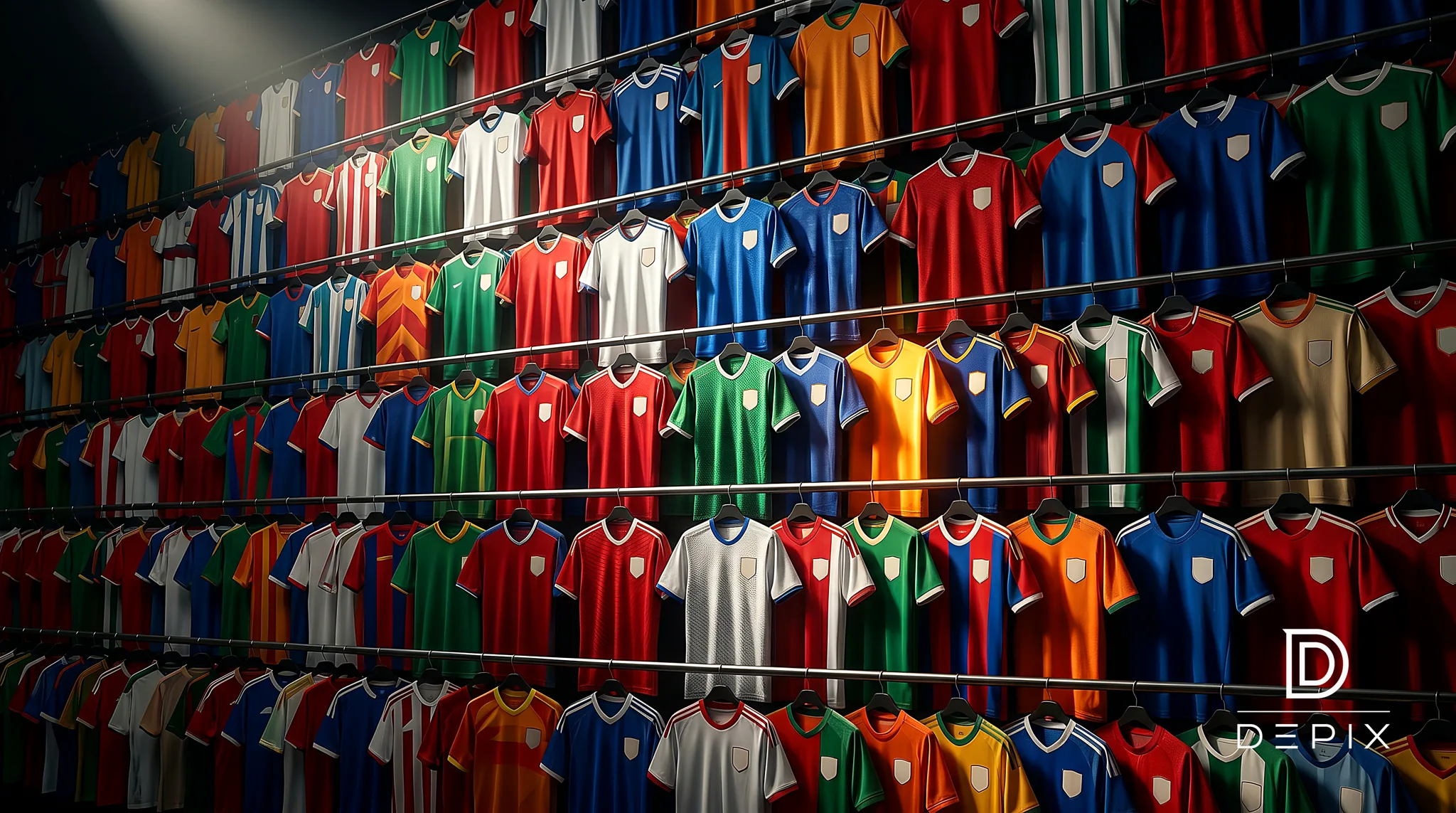
16 more teams, one giant World Cup design stress test.
date: 2026-07-04
16 more teams, one giant World Cup design stress test
Everyone is talking about the football. The more interesting story sits in the warehouses. The 2026 World Cup didn't just add teams — it multiplied every design decision behind the tournament, and most of that machinery is invisible from the stands.
The scale-up is real and it is steep. The field grew from 32 teams to 48 — sixteen more nations, a 50% jump. The match count went from 64 in Qatar 2022 to 104, up 62.5%. The group stage alone now runs 72 games (12 groups of four, six matches each). The whole thing is spread across 16 host cities in three countries and stretched to 39 days. Every one of those numbers is a design brief that had to be locked long before a ball was kicked.
Here is the part nobody tweets about. Forty-eight teams means roughly 105 distinct national jerseys on sale, per ESPN's kit round-up — home and away shirts that all have to read as their own nation and still sit coherently on the same retail wall. It means a merchandise catalogue that has to scale across three legal, tax and customs regimes at once. It means a licensing map — who can make what, where, and under whose colours — that got 50% bigger overnight. Fanatics, the official retail partner, now has to carry the full range for all 48 nations. That is not a logistics problem bolted onto a design problem. It IS the design problem.
This is where expansion quietly punishes weak concept-phase work. When you scale a brand system from 32 units to 48, the decisions you made early stop being suggestions and become load-bearing. A colour palette that was "close enough" across 32 kits starts colliding at 48. A crest grid that flexed for a handful of federations cracks when sixteen more identities push through it. A merch template that looked clean in a mock-up ships as visual noise across a wall of nearly a hundred shirts. Scale doesn't create these faults. It exposes the ones that were always there.
The contrarian read: bigger is not automatically better branding, and this tournament may be the proof. More teams dilute the scarcity that made World Cup merchandise desirable in the first place — when nearly every shirt is "official," official stops meaning much. The design job shifts from making one hero object to holding a sprawling system together without letting it turn to mush. That is a far harder brief, and it is the one FIFA's licensees are actually being graded on this summer.
For anyone who designs at scale, the lesson generalises well beyond football. The moment your product line, your model range or your SKU catalogue jumps by 50%, the cost of a vague early decision doesn't rise — it compounds. Every added variant inherits whatever ambiguity you baked in at the concept phase, and then multiplies it. The teams that survive expansion are the ones that decided their design intent precisely, early, and made it explicit enough to hold across every downstream unit.
That is exactly the discipline DEPIX's design intelligence is built for: pinning down design intent in the concept phase — the proportions, the palette logic, the system rules — so that when the range scales from 32 to 48, or from 5 products to 50, the identity holds instead of fracturing. The World Cup is the loudest possible demonstration that scale is not a volume knob you turn at the end. It is a decision you make at the beginning, or pay for at the warehouse.
Forty-eight teams. One hundred and five jerseys. Three countries. The football lasts 39 days. The design decisions that made it hold together were locked years ago — and that, not the trophy, is the real stress test.
Sources

FIFA made three mascots, and fans only buy their own

France's best World Cup shirt never plays a match


