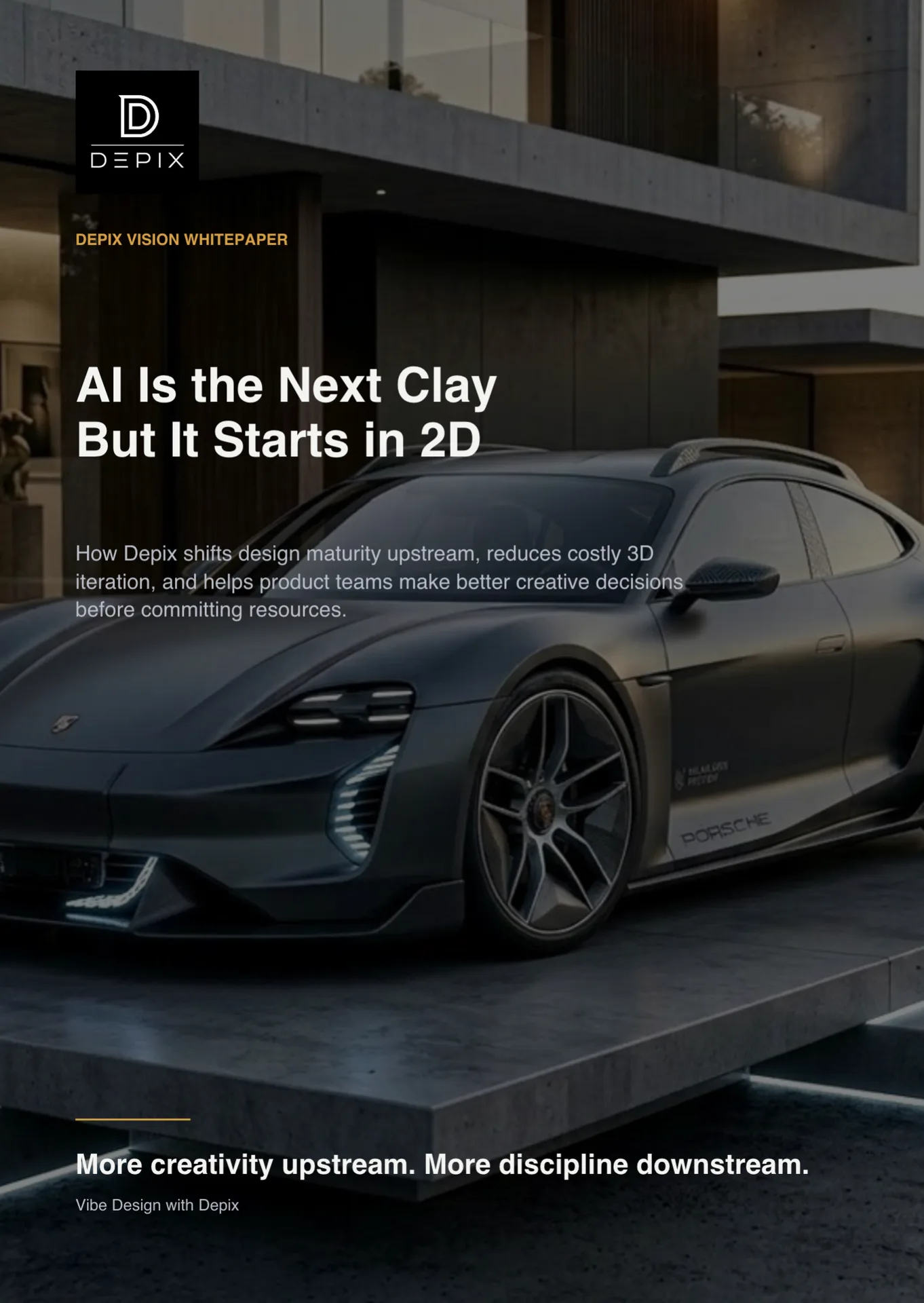
AI Is the Next Clay — But It Starts in 2D
Download PDFThe Problem
For decades, design teams have used sketches, clay, CAD, VR, and physical models to move from idea to product. Each tool has its place. But every design leader knows the same hard truth: the moment an immature idea enters 3D, cost starts to scale.
A concept that enters 3D too early is no longer just a visual direction. It becomes a commitment: modelers, CAD resources, visualization time, VR reviews, clay milling, hardware, coordination, and management attention.
None of these steps are wrong. They are necessary. But they become inefficient when too many ideas enter the expensive phase before the design direction is mature enough.
The Shift
Depix Design Studio introduces an AI-native workflow that changes this equation. It allows teams to use the 2D phase as a high-intensity exploration and decision layer. Instead of rushing early concepts into 3D, teams can explore more design directions, test more proportions, develop CMF alternatives, compare product characters, and increase design maturity much earlier in the process.
The goal is not to replace 3D. The goal is to enter 3D with fewer, stronger, better-understood ideas.
What Is Vibe Design?
Vibe Design is not random prompting. It is not decoration. It is not generating beautiful images without logic.
Vibe Design is the translation of intent into visual direction. It brings together brand ambition, product purpose, emotional target, market context, user expectation, proportion, CMF, atmosphere, product character, and design language.
The designer does not start by asking for an image. The designer starts by defining intent:
What should this product feel like? What should it communicate? What should be familiar? What should be new? What makes this idea worth developing?
Vibe Design is design maturity before geometry.
AI Is the Next Clay
Clay has always been more than material. It allows designers to understand form, proportion, tension, volume, stance, and emotion. It makes design physical and reveals problems that were invisible in drawings.
AI now introduces a new creative material into the process. But this new material starts earlier. AI-native 2D exploration allows teams to shape, compare, reject, refine, and strengthen directions before they enter the costly phase of physical and digital development.
This is not AI instead of clay. It is AI before clay. AI before unnecessary 3D loops. AI before expensive commitment.
The New Design Funnel
The strategic shift is not to skip 3D. It is to earn the right to enter 3D.
Traditional Process
Ideas → Sketches → Early selection → 3D → Review → Correction → Rework
Depix AI-Native Process
Intent → Vibe Design → 2D Explore → CMF/Form → Board → Few strong 3D
The result is a healthier design funnel. More ideas enter the early phase. More weak ideas are eliminated before they become costly. More promising ideas are refined before 3D. Fewer concepts move forward — but with more confidence.
The Depix Design Studio Model
Agents create. Agents generate directions, CMF worlds, proportions, material studies, and alternatives from intent.
Boards organize. The board turns output into structure: collect, compare, cluster, refine, and manage visual territories.
Designers decide. Judgment remains the core of design. AI creates options. Designers create meaning.
This distinction is critical. AI should not be treated as a slot machine for random output. The board should not be treated as passive storage. Together, they create a new system for design direction.
The Business Impact
Depix reduces the cost of uncertainty before uncertainty enters 3D.
Fewer 3D Dead Ends. More ideas can be explored and eliminated in 2D before expensive modeling begins.
Better Use of Specialist Resources. 3D modelers, CAD teams, visualization experts, and clay teams focus on stronger, better-defined concepts.
Earlier Alignment. Design leaders, product teams, CMF teams, and stakeholders compare directions visually before committing resources.
Higher Creative Quality. Teams are not limited to a handful of early options. They can explore broader territories and discover less obvious directions.
Stronger Review Logic. Concepts can be presented with alternatives, rationale, and context — not just isolated images.
Lean 3D Commitment. Teams select fewer, stronger candidates for 3D, clay, and expensive development loops.
The ROI is not just: We saved time. It is: We made better decisions before the process became expensive.
Key Takeaways
The design revolution happens before CAD, before clay, and before expensive commitment.
- ●The most expensive design mistakes happen when immature ideas enter 3D too early.
- ●AI-native 2D exploration allows teams to mature ideas before costly commitment.
- ●Vibe Design turns intent, emotion, brand, and context into visual direction.
- ●AI is the next clay, but it starts in 2D.
- ●Depix helps teams generate more options, organize them better, and choose with greater confidence.
- ●The real ROI is not speed alone, but decision quality before cost escalation.
- ●The future belongs to teams that enter 3D with fewer, stronger, better-understood ideas.
Depix does not replace 3D. Depix makes 3D more intentional.

China Designs Cars Three Times Faster Than the West — and It Has Nothing to Do With Factories
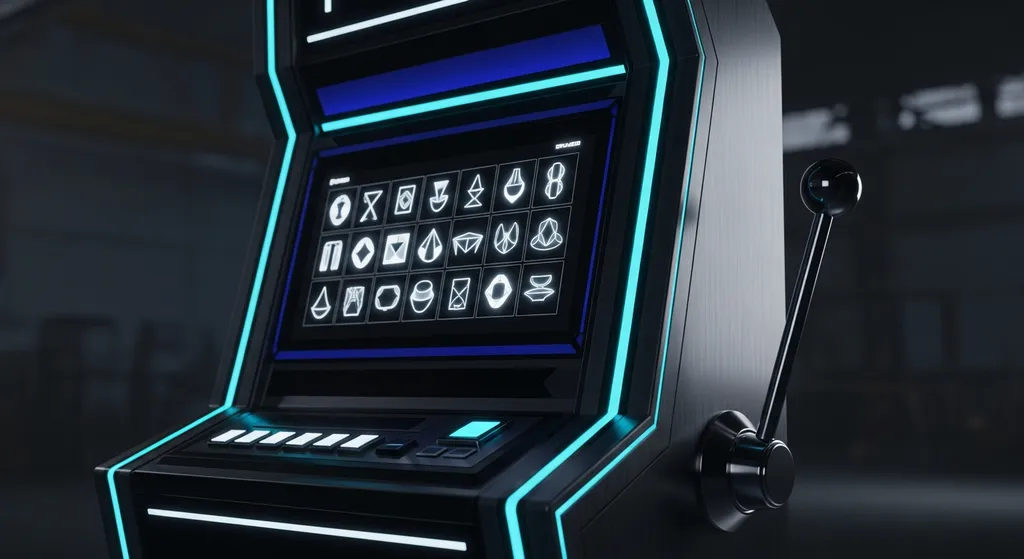
Your best designers are still sketching. Your competitors are running the slot machine.