Nothing to Hide
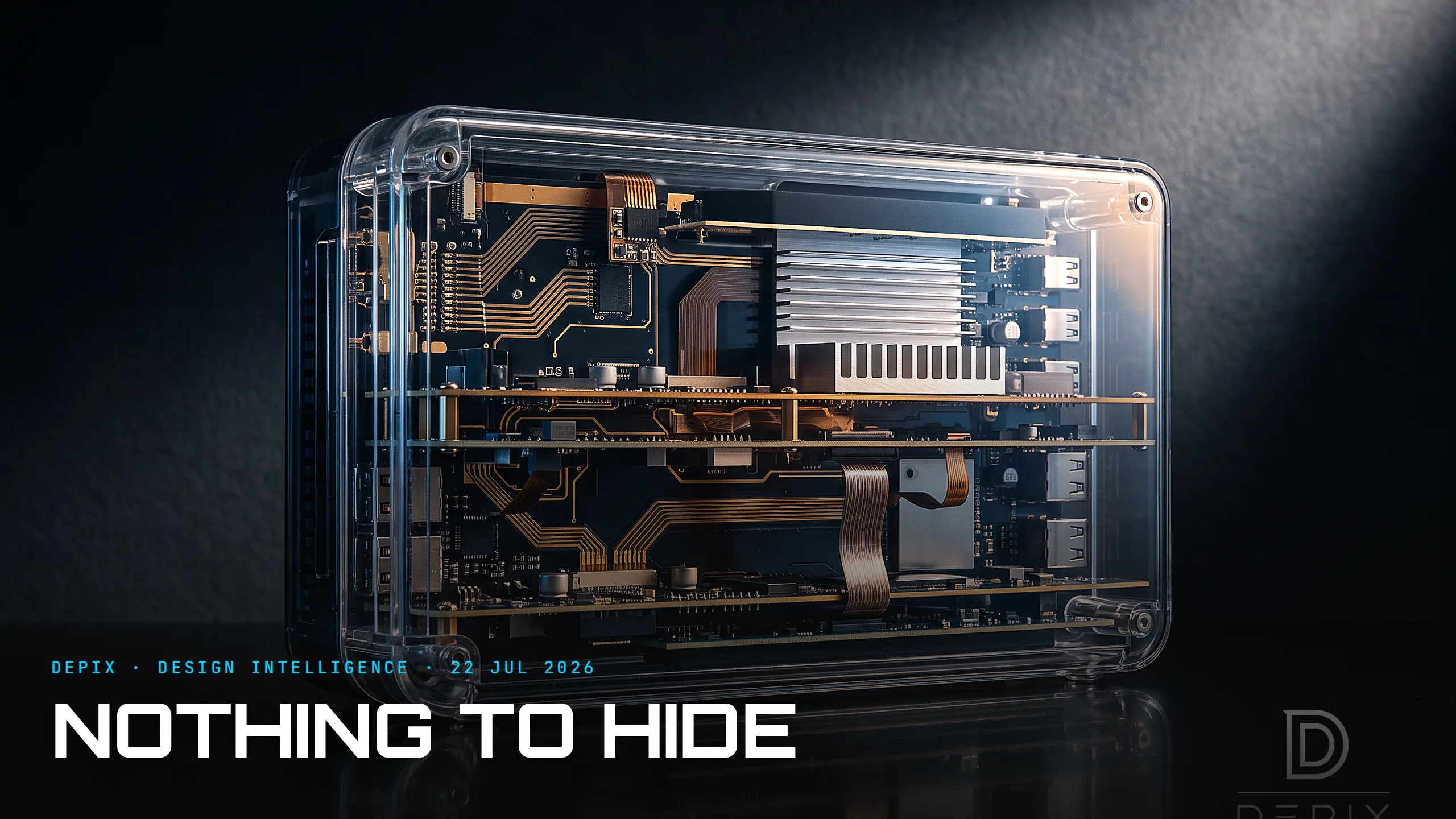
Almost every electronic device hides its guts. The industry's default assumption is that users shouldn't see the messy engineering inside, so the internals are sealed behind opaque glass or metal and forgotten. The London company Nothing — founded in 2020 by Carl Pei, a co-founder of OnePlus — built an entire brand on the opposite bet. Its phones and earbuds wear transparent casings that reveal the internal arrangement, and a widely-shared concept Nothing Book laptop — an independent design study, not an announced product — imagines the same idea for a computer, showing the cooling, circuit boards and layout through a see-through chassis.
The easy reading is that transparency is just a cool look. The design-intelligence reading is more useful: transparency is a constraint, and constraints raise standards. Once the internals are visible, they are no longer allowed to be ugly. Nothing treats screws and components as graphic features — the boards, the ribbon cables, the fasteners all become design elements that must be laid out, coloured and composed. You cannot hide a rushed interior behind a metal lid when there is no lid.
That is a concept-phase decision with enormous downstream reach. Choosing transparency means every internal part has to be designed for being seen — component placement, cable routing, the pattern of the screws — from the very first layout. You cannot retrofit "looks good inside" onto a device engineered to be sealed; by then the internals are a functional tangle optimised for cost and ease of assembly, not for the eye. The decision to have nothing to hide has to be made before there is anything inside to hide.
It is also a shrewd competitive move in a category that converged long ago on the identical sealed black slab. When every phone looks the same from the outside, Nothing simply moved the design contest inside — a place no rival was competing, because no rival was looking. Pei's team, as one account puts it, designs its phones "like logos": every element reduced to something deliberate and legible rather than hidden and anonymous.
The principle generalises well past gadgets. Making the hidden visible is a forcing function for quality, because it removes the place where corners get quietly cut. Whatever you seal off — the code you never show, the process you never expose, the assembly nobody inspects — is exactly where standards slip, precisely because no one will see. Design as if everything will be seen and you close that gap. This is not a new idea; it is Dieter Rams's insistence that good design is honest, applied with unusual literalness. Honesty is cheap to claim and expensive to build, and Nothing chose the expensive version. Open-source software runs on the same logic — code anyone can read is code you cannot afford to leave sloppy — and so does the exposed structural engineering of a Pompidou or a Lloyd's building, where the ducts and beams became the architecture precisely because they were put on show.
There is an honest caveat, and it matters. Transparency can curdle into a gimmick — a see-through shell over an undesigned interior fools no one, and after the novelty a badly-composed inside just looks like clutter you now have to look at. The transparent case is only a promise. Whether you kept it is decided by the far harder work behind the glass: actually designing the internals to be worth seeing. The shell is the easy 10%; the composed interior is the 90% that most companies were relying on the lid to excuse.
So the useful provocation, for anyone who makes anything, is simple: what would you design differently if there were no lid? If a customer could see every decision you made on the inside — every shortcut, every "no one will notice," every part left ugly because it was hidden — which of those would you be proud of, and which would you quietly go back and redo? The list of things you'd redo is a precise map of where your current design is coasting on invisibility.
Nothing's whole proposition is to build as though the answer to that question is always on display. It is a bet placed at the concept phase, because visibility cannot be added at the end — and it quietly raises the standard of everything behind the glass. The most demanding client a design can have is a customer who can see inside it.
Sources:
- ●Vessel Object — Nothing Phone 2a: When Transparency Becomes Design
- ●Wikipedia — Nothing (company))
- ●Wikipedia — Carl Pei
- ●Wikipedia — OnePlus
- ●Wikipedia — Nothing Phone (1))
- ●Nothing — official
- ●Yanko Design — Nothing Book laptop concept
- ●Techgenyz — Nothing Book concept reveals internals
- ●Wikipedia — Nothing Phone (2))
- ●Creative Bloq — Why Nothing designs its phones 'like logos'
- ●Wikipedia — Dieter Rams
- ●Wikipedia — Industrial design