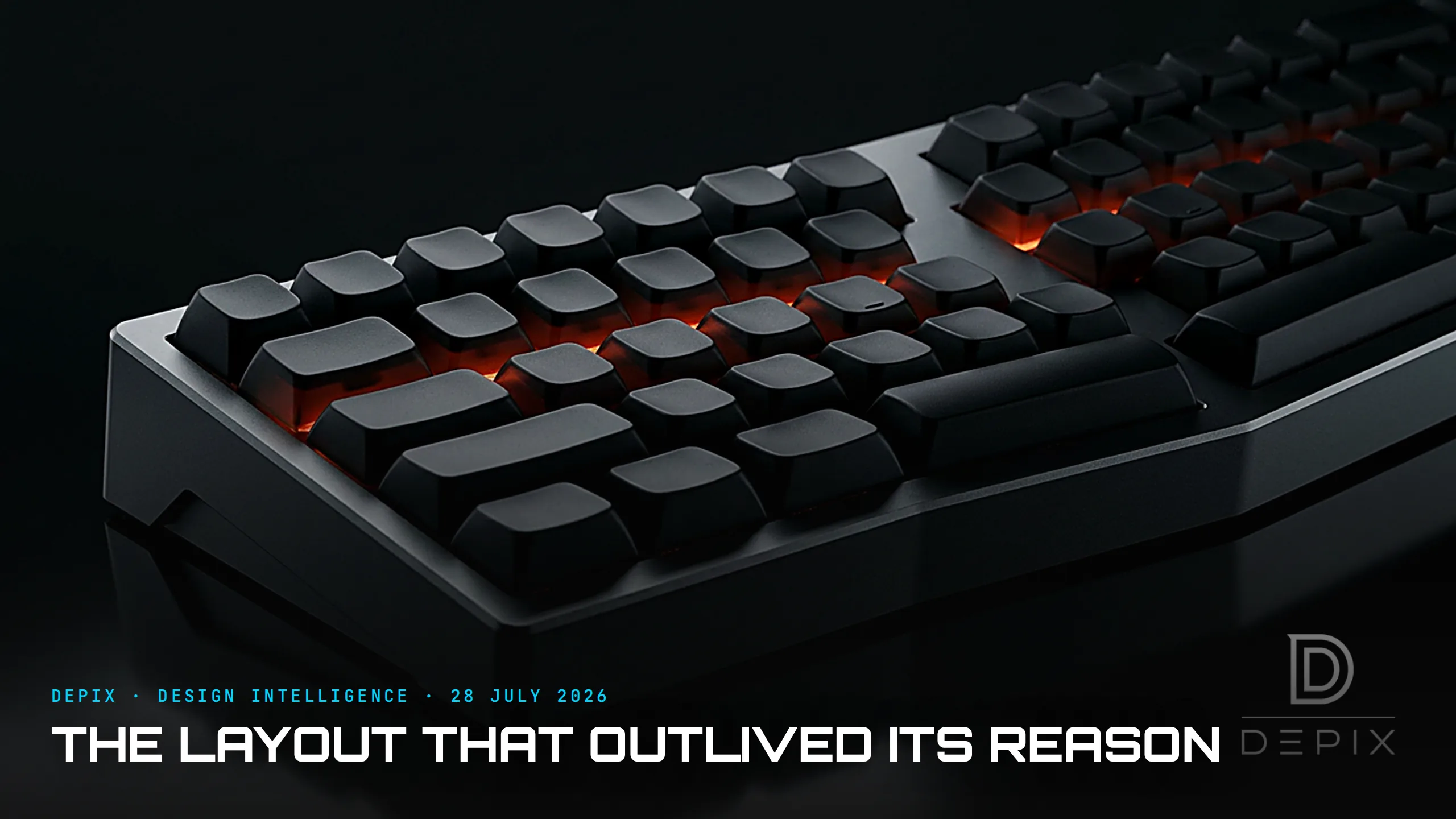
The Layout That Outlived Its Reason
Look down at your keyboard - phone, laptop, it does not matter. The top row starts Q-W-E-R-T-Y, an order so familiar it feels natural, even inevitable. It is neither. That arrangement was worked out in the early 1870s in a Milwaukee workshop by Christopher Latham Sholes, a newspaper editor, to solve a mechanical problem that has not existed for a hundred years: the typebars of early typewriters jamming when two neighbouring keys were struck in quick succession.
First, let us kill the myth. QWERTY was not designed to slow typists down - that is the story everyone repeats, and it is mostly wrong. Sholes's early keyboard was roughly alphabetical, which put common pairs like "th" and "he" physically adjacent; those type bars collided and jammed. The layout was re-tuned to separate the fast-moving pairs so the mechanism would not clash - which let people type faster without jamming, not slower. It was a genuine, intelligent engineering fix. For a machine no one has used in generations.
And that is the whole point. The problem QWERTY solved is gone. There are no type bars in your phone; a touchscreen has no moving parts to jam, no mechanical reason for any particular arrangement of letters. You could lay the keys out any way at all. And yet there they are, Q-W-E-R-T-Y, on a sheet of glass, faithfully reproducing the collision-avoidance geometry of a Victorian machine. The reason died; the shape is immortal.
Why? Because once QWERTY rode the first commercially successful typewriter, the Remington, out of the factory, the world began to organise itself around it. Typing schools taught it. A generation trained their hands on it. Every new typist learned QWERTY because that is what the machines had, and every new machine used QWERTY because that is what typists knew. This self-reinforcing loop is the textbook case of what economists call path dependence and lock-in - the outcome that persists not because it is best, but because everyone already uses it.
The proof that it is lock-in and not merit is Dvorak. In 1936, August Dvorak patented a layout engineered for efficiency: the most common letters on the home row, less finger travel, less fatigue. On paper it should have won. It did not - it never came close, and neither have later alternatives like Colemak. Even Sholes himself was not sure QWERTY was best and kept designing alternatives for the rest of his life. None of it mattered. And here is the honest twist: the evidence that Dvorak is dramatically better is thin - the famous studies were flawed, the real gains marginal. Which only strengthens the lesson: if the challenger is merely a little better, ubiquity wins every time.
This is the concept-phase truth that should make every designer sit up. The earliest decision you make - the one that feels arbitrary, provisional, "we can always change it later" - has a way of becoming permanent infrastructure that the entire world reorganises itself around. QWERTY was a reasonable answer to a 19th-century mechanical constraint. It is now committed to the procedural memory of billions of people, a neuromotor standard so deeply embedded that no marginal improvement can dislodge it. The switching cost is not technical; it is civilisational.
So the lesson is double-edged, and both edges cut. The first: choose your foundational decisions as if they are forever, because they might be - the arrangement you pick at the concept phase can outlive the reason you picked it and calcify into something no one can move. The second, more subtle: once a standard achieves ubiquity, compatibility beats optimality. A better design does not automatically win; frequently it loses, badly, to the good-enough thing that got there first and became the thing everyone shares. The value of a standard is partly its universality - and universality is created early, then compounds.
QWERTY is not a story about a bad keyboard. It is a story about how a design decision escapes its original purpose and becomes a load-bearing wall in a structure the whole species lives inside. The metal is long gone; the muscle memory remains. Before you commit an early, "temporary" choice, it is worth asking the QWERTY question: if the reason for this decision disappeared tomorrow, would anyone ever be able to change it? Sometimes the answer is no - and you are designing the future's typebars right now.
Sources:
- ●https://wi101.wisc.edu/category/clusters/sholes-and-glidden-typewriter
- ●https://www.smithsonianmag.com/history/the-qwerty-keyboard-will-never-die-where-did-the-150-year-old-design-come-from-49863249/
- ●https://www.historyofinformation.com/detail.php?id=2134
- ●https://inventivehq.com/blog/qwerty-keyboard-history
- ●https://www.missedhistory.com/article/typewriter-qwerty-sholes-remington-1874
- ●https://commonplacefacts.com/2025/09/01/qwerty-keyboard-history/
- ●https://bactra.org/notebooks/qwerty.html
- ●https://itotd.com/articles/3528/the-dvorak-keyboard-controversy/
- ●https://petitkeycaps.com/blogs/all-blogs/the-ultimate-keyboard-layout-comparison-qwerty-vs-dvorak-vs-colemak-vs-azerty-and-qwertz
- ●https://www.erichgrunewald.com/posts/how-bad-is-qwerty-really-a-review-of-the-literature-such-as-it-is/
- ●https://www.bunkhistory.org/resources/the-qwerty-keyboard-will-never-die-where-did-the-150-year-old-design-come-from
- ●https://medium.com/@kimchiwave/qwerty-and-path-dependence-e1c848508d1c