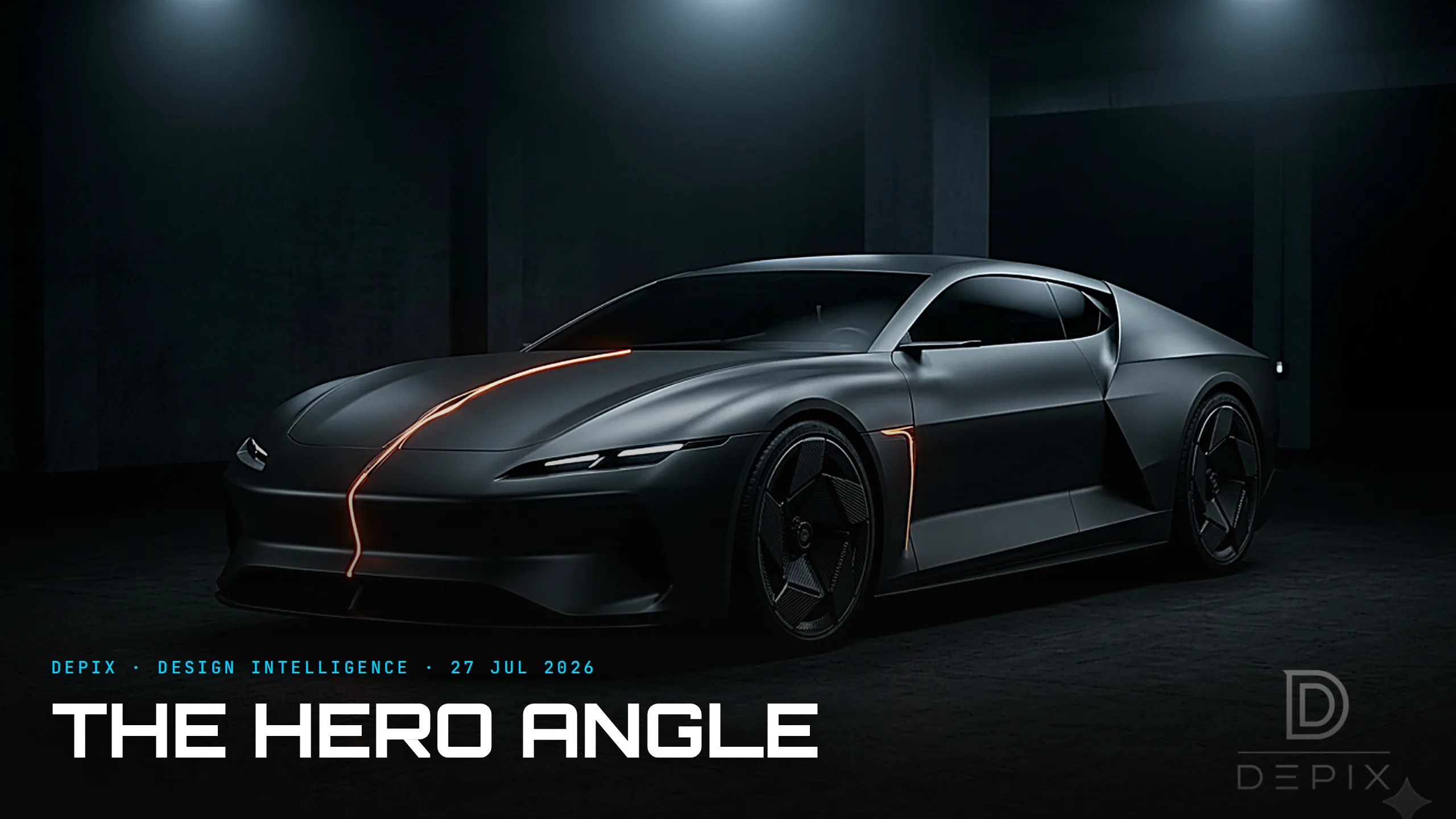
The Hero Angle
Think of the last car you saw for the first time — in a reveal, an ad, a render, a press pack. Picture the image. It is almost certainly a front three-quarter: the camera at roughly forty-five degrees to the front corner, catching the face and the flank in a single frame. This is not a coincidence. Around ninety percent of car magazine covers use the front three-quarter, and it is the standard shot for commercials, dealership banners, luxury campaigns and listings. It is so universal that we have stopped seeing it as a choice at all.
But it is a choice — and it has quietly become the angle that designs the car. The reason the three-quarter is the hero shot is honest enough: it is the most complete single view of a vehicle, showing the grille, lights, bonnet, fender and side profile at once, and it is the angle that best reveals depth, proportion and stance. It flatters. And because everyone in the studio knows the reveal, the render and the poster will all be this angle, the whole car gets tuned to sing from exactly that viewpoint. The clay model is judged from it. The lighting rig is built for it. The surfaces, the shoulder line, the set of the face, the rake of the screen — all are resolved, at the concept phase, to look their absolute best from the front three-quarter.
Here is the contrarian cost. A car optimised for one angle can be a masterpiece from that angle and a quiet disappointment from every other. The rear three-quarter, the straight profile, the head-on and the low and high views each tell a different truth, and they are the views that get less love precisely because they sell fewer magazines. Every photographer's checklist has its six or twelve essential angles, but the designer's attention is not evenly distributed across them — it pools where the hero shot lives. So the dangerous outcome is a car that photographs like a hero and lives like a compromise: gorgeous approaching you at forty-five degrees, awkward as it drives away, heavy from the side, anonymous head-on. The angle you never photograph is the angle no one defended. Designers even have a wry phrase for the failure — a car "styled for the brochure" — and every studio has shipped one: a shape that dies the moment it leaves the hero light.
And there is a deeper twist for the electric era, where so many cars already struggle to look distinct. If every brand optimises for the same hero angle, they converge on the same hero-angle tricks — the same dramatic dash-to-axle, the same shoulder, the same stance — and the three-quarter that was supposed to reveal character starts hiding it, because everyone is performing for the identical camera. The hero shot becomes a costume all of them wear.
None of this makes the three-quarter wrong. It is genuinely the most flattering and informative single frame, and shooting it well is a craft in its own right. The point is that the hero angle is a decision, not a law of nature — and like every powerful default, it does its damage precisely by being invisible. The discipline is to treat the reveal angle as one deliberate input among many at the concept phase, and then to force the design through the views nobody will photograph: to walk the clay round to the rear, to judge the head-on that every owner sees in their mirror, to defend the profile that no campaign will ever use. A car is not a photograph. It is a thing seen from every side, in motion, in daylight, for years — and proportion and stance have to hold up from all of them, not just the one on the poster.
At Depix, this is exactly the kind of invisible default we exist to expose at the concept phase: the hero shot is a promise, and the promise is only kept if the car is honest from the angles no one bothered to photograph. Design for the hero angle, by all means — but never let it be the only judge in the room, and never mistake its applause for the final verdict.
Sources:
- ●Professional car photography: the 3/4 front view — Visual Education
- ●Car photography angles (90% of covers are front 3/4) — BlendNow
- ●Best car photography angles for listings — Spyne
- ●12 must-have car photography angles — CarBackground
- ●The ultimate guide to automotive photography — Furoore
- ●The 6 essential car photography angles — Car Photo Checklist
- ●Design differentiation and the EV sameness problem — The Truth About Cars
- ●7 best angles for car photography — By Sebas
- ●The secrets behind a great car photo — Car Photo Tutorials
- ●Vellum Venom: a glossary of automotive design terms — Hagerty


