
The gap above the wheel that four people are fighting over — and the hero shot hides every cost of getting it wrong
Park any new crossover next to its brochure and look at one place: the crescent of empty air between the top of the tyre and the lip of the wheel arch. It looks like nothing. It is, in fact, one of the most quarrelled-over dimensions on the whole car — and the four people fighting over it are not looking at the same object.
Four people, one crescent of air
The designer wants that gap gone. A tight wheel-to-arch gap reads as planted, expensive, athletic; a big one reads as cheap, under-tyred, rental-spec. The enthusiast world has spent two decades turning this into a literal sport — "slammed" cars chase zero wheel gap, and the gap is such a cultural signal that car-design glossaries list "wheelarch gap" as a defined term of the trade (Mac's Motor City Garage, According to Volkswagen: A Glossary of Current Styling Terms, 13 July 2017). To win that look without breaking everything underneath, designers resort to optical sleight of hand — the flat, slightly squared edge you now see stamped into almost every modern arch is partly there to make a non-circular opening read as a perfect circle, an illusion to flatter the wheel it frames (Jalopnik, Here's Why Most Modern Cars Have That Weird Flat Edge In The Bodywork Around The Wheel, 11 January 2019).
The chassis engineer wants that gap kept. Suspension travel, full-lock steering sweep, snow chains, tyre growth at speed and the worst-case loaded-and-bouncing condition all live inside that crescent. Close it for the photograph and the wheel hits the liner on the first speed bump. The gap the designer hates is the engineer's safety margin made visible.
The efficiency engineer wants that gap closed a different way — not for looks, for range. The wheels and the turbulent air churning around them account for a startling share of a car's aerodynamic drag; industry analyses put wheel/tyre losses at up to a quarter of total aero drag, which is why EV makers obsess over flush aero wheel covers and tight body-side airflow (Performance Plus Tire, Wheel Aerodynamics for Electric Vehicles: Do They Increase Range?, 27 February 2024). The penalty is brutally real: a 2024 BMW i4 eDrive40 rated at 301 miles on 17-inch wheels drops to 233 miles on 20-inch wheels — a 68-mile, ~23% range collapse from a styling choice (ClearWatt, Do Your Wheels Matter? How Wheel Size and Style Affect EV Range, 2 October 2024). The same big-wheel, tight-gap stance the designer is paid to deliver is quietly the most expensive aero decision on the car.
The regulator wants that gap governed, and was never in the design review. UN Regulation No. 26 on external projections of passenger cars is blunt: travelling in a straight line, no part of the wheel above the axle — other than the tyre — may project beyond the body-panel edge above it; the bodywork must cover the wheel (UNECE Regulation No. 26, Uniform provisions concerning the approval of vehicles with regard to their external projections, consolidated text). For heavier vehicles the law goes further still — spray-suppression rules dating to Council Directive 91/226/EEC and implemented by Commission Regulation (EU) No 109/2011 of 27 January 2011 require mudguards to fully cover the upper tyre zone. The arch lip is not a free surface. It is a regulated envelope the designer is decorating.
Why the picture is the problem
Here is the trap. The single image every one of these decisions is signed off against — the hero render, the auto-show turntable, the configurator beauty shot — is taken in the one condition that makes the gap lie.
It is shot static, at show ride height, on the largest optional wheel, unladen, wheels straight, on a dry studio floor. In that one frozen state the gap is at its tightest and most flattering, the stance is at its most planted, and not one of the four costs is visible. You cannot see the suspension travel the chassis engineer reserved (the car never moves). You cannot see the 68 miles the efficiency engineer lost to the 20-inch wheel (there's no range readout on a turntable). You cannot see the regulator's coverage envelope being honoured or fought (the body is doing its legal job invisibly). And you cannot see what the gap becomes in the real world — splayed open over a bump, packed with slush, throwing spray, or yawning embarrassingly wide on the base trim nobody photographs.
So the tight-gap, big-wheel proposal sails the review looking like jewellery. The fenders get tooled. The wheels get homologated. And the costs surface later, exactly where the studio camera can't see them: in a range figure that disappoints, a snow-chain warning buried in the manual, a base-spec car that looks under-tyred next to its own brochure, and an owner who quietly resents the gap they were sold a fantasy of closing.
The DI move
This is a Design Intelligence problem, not a styling one. The question — how tight is the gap, on which wheel, at what ride height, and what does each closing of it cost in travel, range, and legal coverage — is a four-way trade made by four people who never see the same picture, decided from an artefact engineered to hide the trade.
The DI move is to put the call in front of the design chief as photoreal evidence in the hidden states, at decision time, while the fascia and arch are still surfaces in CAS and the wheel package is unfrozen:
- ●the same car rendered at show ride height and loaded-and-compressed, so the gap the camera flatters and the gap the suspension actually needs are seen side by side;
- ●the proposed tight-gap stance on the 20-inch wheel next to its own range penalty and its base-trim 17-inch reality, so leadership trades stance against the 23% the efficiency engineer is quietly paying;
- ●the arch lip drawn against the UN R26 coverage envelope, so the regulator's line is in the room before tooling, not after.
Photoreal evidence in the conditions the hero shot structurally cannot show, so the design chief trades stance, travel, range and legal coverage with their eyes open — at the moment the decision is still cheap to change. The photoreal output is the evidence. The decision is the product.
DEPIX builds Design Intelligence — a parallel design team in a box that renders the consequence of a design decision, in the states the beauty shot hides, while the call is still reversible. We help people make better design decisions.
Sources
- ●Mac's Motor City Garage — According to Volkswagen: A Glossary of Current Styling Terms — 13 July 2017 — https://macsmotorcitygarage.com/according-to-volkswagen-a-glossary-of-current-styling-terms/
- ●Jalopnik — Here's Why Most Modern Cars Have That Weird Flat Edge In The Bodywork Around The Wheel — 11 January 2019 — https://www.jalopnik.com/heres-why-most-modern-cars-have-that-weird-flat-edge-in-1832739443/
- ●Performance Plus Tire — Wheel Aerodynamics for Electric Vehicles: Do They Increase Range? — 27 February 2024 — https://www.performanceplustire.com/Blog/wheel-aerodynamics-for-electric-vehicles-do-they-increase-range
- ●ClearWatt — Do Your Wheels Matter? How Wheel Size and Style Affect EV Range — 2 October 2024 — https://clearwatt.co.uk/blog/ev-wheels
- ●UNECE — Regulation No. 26: Uniform provisions concerning the approval of vehicles with regard to their external projections (consolidated) — https://www.unece.org/fileadmin/DAM/trans/main/wp29/wp29regs/2013/R026r1e.pdf
- ●EUR-Lex — Commission Regulation (EU) No 109/2011 of 27 January 2011 (spray-suppression systems, implementing Reg. (EC) No 661/2009) — 27 January 2011 — https://eur-lex.europa.eu/legal-content/EN/TXT/HTML/?uri=CELEX:32011R0109

The one control the law says you must PULL, not press — and the whole industry keeps shipping it as a press
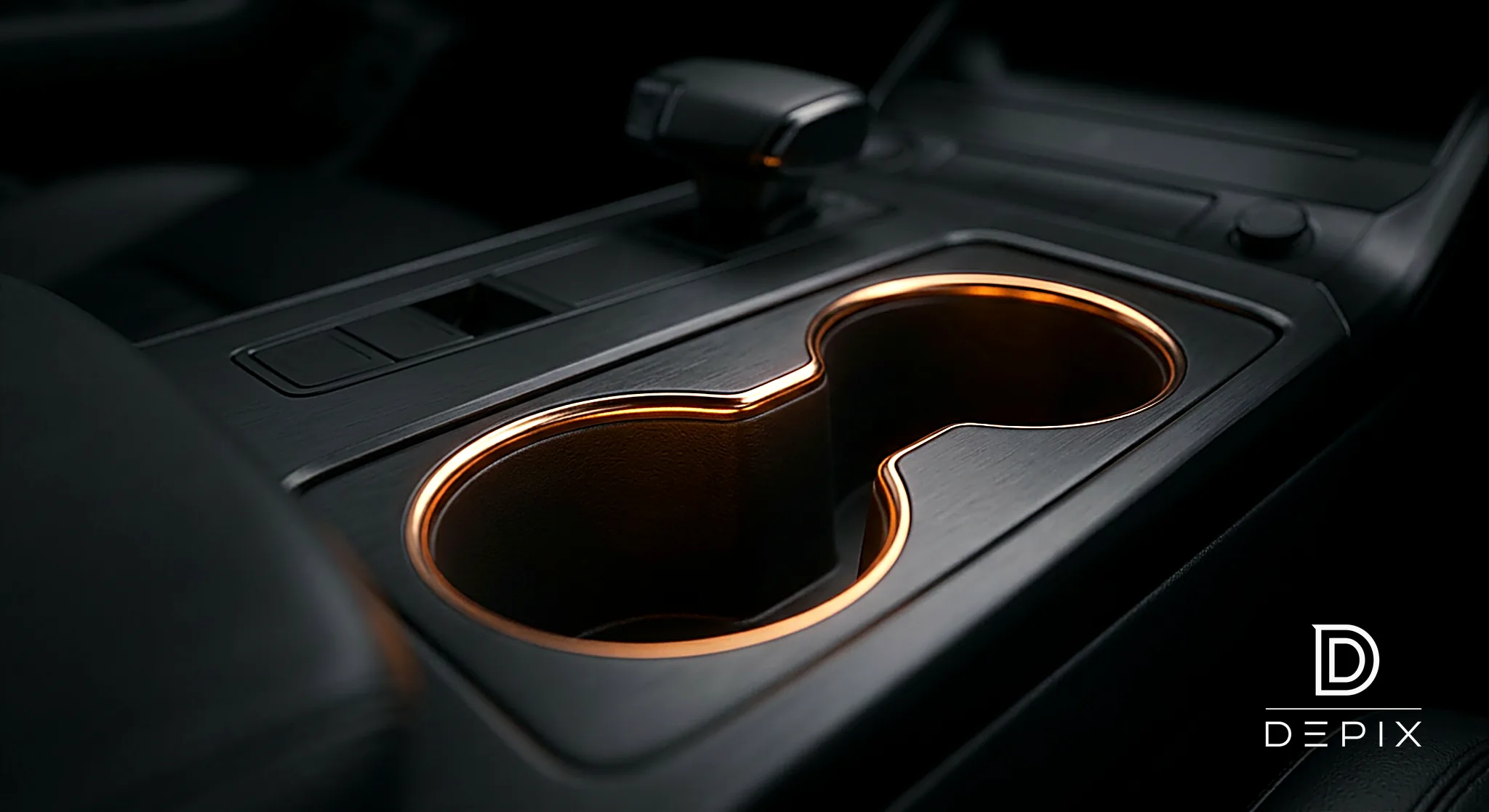
The cheapest part in the cabin is the one your customer judges the car by
Related posts

The bridge of air where the gearstick used to be — the console the studio floats for the look, that the elbow and the loose phone never agreed to

The clean pad that cooks the phone it charges — the cabin feature sold as the cableless future, that a fifty-cent wire still beats on every metric that matters

The rails on the roof that carry nothing — the one styling cue that promises a life the car will never live, and quietly taxes the range to do it