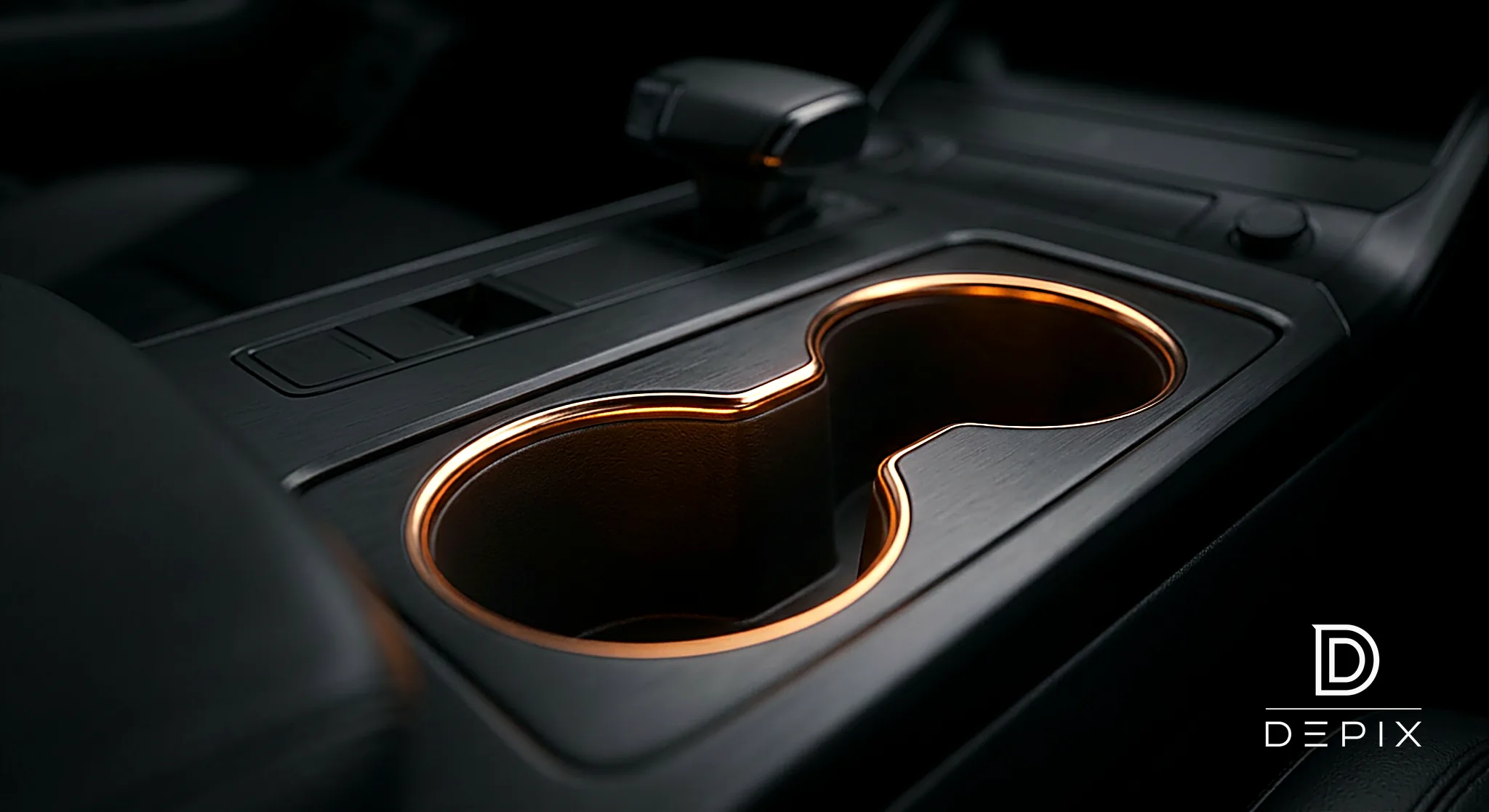
The cheapest part in the cabin is the one your customer judges the car by
There is a part in every car that no design chief will admit is a design decision, that no studio puts on its showreel, that engineers treat as an indignity — and that the person writing the cheque will rank above the engine. It is the cupholder. In 2026 it is, quietly, one of the most honest tests of whether a company actually knows who it is building for, because it is the one component where the buyer's taste and the designer's taste point in opposite directions, and the buyer wins every time.
That should be embarrassing to say out loud. The cupholder holds a drink. It is a hole. It has no styling brief, no brand DNA, no colour-and-trim review. And yet a French-born anthropologist hired to study American car buyers reported the finding that has haunted product planners ever since: that "the first thing educated car-buyers look at in a car is how many cup holders it has" — a line Malcolm Gladwell relayed and Henry Petroski quoted in the essay that remains the canonical account of how this hole conquered the dashboard (Slate, 15 Mar 2004). Educated buyers. Not the cooling vents, not the seat bolster, not the shut-line. The cupholders.
The part the studio never wanted, decided by the buyer who never left
The cupholder was not born in a design studio. It was born in a minivan. The 1983 Chrysler minivans — the Dodge Caravan and Plymouth Voyager — were the first mass-produced cars to ship with built-in cupholders, and they arrived as a packaging afterthought, not a styling statement (GoMechanic, 8 Aug 2023). From that afterthought grew an arms race. Ford is reported to have spent on the order of half a million dollars engineering the fold-out cupholders for the mid-1990s Taurus and Sable — real tooling money, on a hole — because the cupholder had stopped being a convenience and become a reason people chose one car over another.
And here is the split that still defines it. European designers, the same essay records, "did not consider cup holders essential for driving pleasure or safety, and the basic car design left no room for the gauche American accessory" (Slate, 15 Mar 2004). Two continents, two readings of the same hole: in Detroit it was a sales feature; in Stuttgart and Munich it was a vulgarity that admitted you drink while you drive. The cupholder is the rare component where the design decision is not aerodynamic or structural or even ergonomic. It is cultural. It is a statement about who the car thinks its owner is — and for forty years the studios that decided their owner was too sophisticated to want one were quietly overruled by the showroom.
The arms race that has no ceiling
Once a part becomes a buying reason, the only safe number of them is "more than the rival." So the count climbed. The Subaru Ascent shipped with nineteen cupholders. The Volkswagen Atlas and the Hyundai Palisade landed in the high teens. For years the three-row SUV class competed, in part, on a metric that would have been a punchline in any other category (DAX Street, 6 Feb 2024).
Then the absurdity tipped over. In June 2024 The Autopian found a vehicle that had broken the per-passenger record: the 2024 Mercedes eSprinter, a two-seat cargo van, fitted with eight cupholders — "4.0 cupholders per passenger" — dethroning the Ascent on a ratio nobody had thought to defend (The Autopian, 25 Jun 2024). Four holders per human, in a van designed to carry boxes. That is what happens to a feature whose only design constraint is the competitor's spec sheet: it stops being briefed and starts being inflated, because no product planner has ever been fired for adding a cupholder, and the designer who would push back is not invited to the meeting where the number is set.
The 40-ounce problem the brochure pretends doesn't exist
While the studios were counting holes, the holes stopped fitting the drinks. The defining beverage object of the 2020s — the 40-ounce insulated steel tumbler, the Stanley Quencher and its many imitators — does not fit a conventional car cupholder. It is too tall and too wide at the base, and an entire cottage industry of adapters and 3D-printed sleeves now exists to stop a forty-dollar tumbler from toppling into a forty-thousand-dollar interior (AOL / Autoblog, 2024).
Read that as a designer should: the single most-used interior touchpoint in the car was sized against a drink the market abandoned. The cupholder was dimensioned for a 1990s fast-food cup and a 2000s travel mug, and the buyer walked in carrying a vessel it cannot hold. The part that exists specifically to serve the customer's habit is now the part most visibly out of step with it — and the customer notices, every single trip, because the failure is not hidden inside a control unit. It wobbles in the centre console at eye level. A studio can ship a flawless grille graphic and a perfect shut-line, and the owner's first lived complaint will be that their cup doesn't fit.
And now the lawyers arrive at the cupholder
For forty years the cupholder's only stakeholders were the buyer and the bean-counter. In 2026 a third one showed up: the regulator. As the United States pivots, state by state, toward strict hands-free and "full attention" distracted-driving statutes — Iowa's hands-free law took full effect on 1 January 2026, with a $100 primary-offence fine for merely holding a device (Slocumb Law, 2026) — the legal logic is widening past the phone. A measure in Ohio would make it an offence to drive "without giving full time and attention to the operation of the vehicle," language broad enough to reach the driver reaching for a drink (Fox News, 2025), and commentators are openly modelling scenarios in which handling a beverage in motion draws a serious fine (Legal Clarity, 2025).
This is the contradiction the studio built and never reconciled. The same industry that competes on having nineteen cupholders — that designs the interior around the assumption you will drink while you drive — operates in a legal climate increasingly built around the premise that you should not. The cupholder is an invitation; the statute is a warning; and they sit forty centimetres apart in the same cabin. The feature the marketing brochure celebrates is the behaviour the safety brief is meant to discourage, and no one in the building owns the seam between them — because the cupholder is "just a hole," and the hole was never anyone's decision to defend.
The part of the decision nobody made
Here is the thing the configurator will never show you. Somewhere in the design of every car, a question was answered without ever being asked: who is this cabin for, and what do they actually do in it? The cupholder answers that question more honestly than any mood-board, because it is the one feature the buyer audits with their own hands in the first thirty seconds in the seat — and it is the one feature the studio is least interested in getting right.
That mismatch is not a small thing. It is the whole problem in miniature. The grille is fought over for months; the cupholder is filled in by whoever owns the centre-console package, sized to a default, validated against a cup nobody carries anymore, and shipped. Then the customer sits down, reaches for the one object they brought with them, and forms an opinion of the entire fifty-thousand-euro machine based on whether a hole fits. The most consequential first impression in the cabin was made by the person who cared about it least.
This is exactly the gap DEPIX exists to close. The decisions that get the studio's attention — the face, the stance, the signature line — are not the decisions the buyer judges the car by in the showroom. Design Intelligence puts the real lived cabin in front of the people who own it as photoreal evidence: the centre console with the drink the market actually carries sitting in it, the reach from the driver's hand, the part the owner touches forty times a trip rendered with the same seriousness as the part the press photographs once. Not so the cupholder can win a beauty contest — it never will — but so that the cheapest part in the cabin stops being the one nobody in the room was responsible for, on the day it is still cheap to move. The job was never to make the cabin look expensive in a press shot. The job is to know what the buyer's hands will find when the cameras are gone — and to have decided it on purpose.
Sources
- ●Slate — "How U.S. Car Design Came to Include Cup Holders," 15 Mar 2004
- ●GoMechanic — "The History Behind Cupholders In Modern Cars," 8 Aug 2023
- ●The Autopian — "I've Found A New Vehicle With An Insane Number Of Cupholders," 25 Jun 2024
- ●DAX Street — "5 Cars With Most Cupholders And 5 With Barely Any," 6 Feb 2024
- ●AOL / Autoblog — "These Car Cup Holder Adapters Keep Your 40-oz Stanley Tumbler From Toppling," 2024
- ●Slocumb Law — "Distracted Driving Statistics & 2026 Hands-Free Laws," 2026
- ●Fox News — "Ohio city's distracted driving law could restrict eating, drinking behind the wheel," 2025
- ●Legal Clarity — "Is Eating and Driving Illegal? What the Law Says," 2025

The gap above the wheel that four people are fighting over — and the hero shot hides every cost of getting it wrong

The wiper is the one part the self-driving car can't figure out
Related posts

The bridge of air where the gearstick used to be — the console the studio floats for the look, that the elbow and the loose phone never agreed to

The clean pad that cooks the phone it charges — the cabin feature sold as the cableless future, that a fifty-cent wire still beats on every metric that matters

The rails on the roof that carry nothing — the one styling cue that promises a life the car will never live, and quietly taxes the range to do it