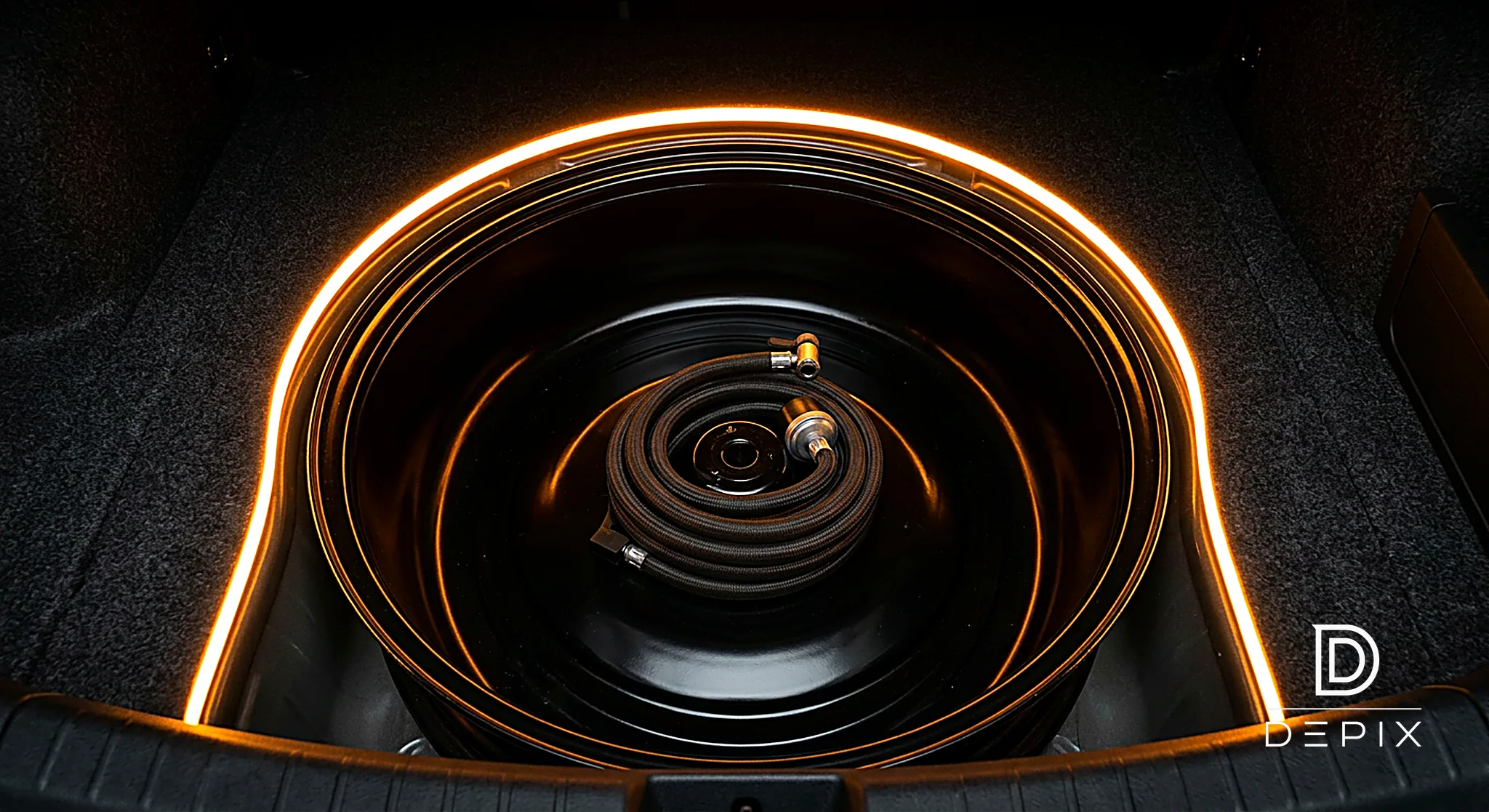
The fifth wheel the spreadsheet deleted — the one part no designer ever wanted, that a quarter of new-car buyers don't know is already gone
For a hundred years every car carried a fifth wheel it hoped never to use. The spare lived under the boot floor, a dead weight in a styled cubby, the most boring twenty kilograms on the vehicle. No designer ever loved it; it ate cargo volume, raised the load floor, and added mass to a number every engineer is paid to lower. So it is being deleted — quietly, at scale, and largely without telling the buyer. About 30 percent of new cars now ship with no spare at all, up from roughly 5 percent in 2006; there are more than 30 million spare-less cars already on the road, and for the 2026 model year, by one tally, 39 brands omit a spare across more than 200 models, Ford, Mercedes-Benz and BMW among them (Consumer Reports; Cars.com). This is one of the largest silent design decisions of the era, and it was made on a spreadsheet, not a drawing board.
The case for deleting it is real, and it is mostly about a number. The spare did not vanish for styling. It vanished for fuel economy. A spare, jack and tools weigh 30 pounds or more, and shedding that mass buys a small but measurable improvement on the regulatory fuel-economy test — an improvement automakers value because it saves them money under CAFE standards, as Cars.com and CarPro both traced ("How Fuel Economy Rules Helped Kill the Spare Tire"). On an EV the logic compounds twice over. The battery is heavy already, so engineers resist adding anything; and the skateboard platform puts the pack exactly where the under-floor spare used to live. As InsideEVs put it, "the biggest reason we're seeing more EVs lean away from spare tires is simply packaging" — the cubby is now full of cells. In its place: nothing, a can of sealant and a compressor, or run-flat tyres. Each is lighter, cheaper, and more space-efficient than a fifth wheel. On paper the spare is pure cost.
Why this is a contested decision and not a settled one. The trouble is that the replacement does not do the same job. A sealant kit, the most common substitute, is useless in exactly the situations a spare exists for: it "won't work for blowouts, sidewall damage, or large punctures" — which are among the most common ways a tyre actually fails (Consumer Reports; Jalopnik's expert round-up reached the same verdict). A tyre's sidewall flexes too much to hold a sealant patch, so the rocky back-road blowout, the kerbed sidewall, the shredded tread on the motorway — none of them are fixable by the kit in the boot. And the buyer mostly does not know. The sharpest figure in the whole debate comes from a 2024 AAA study: more than 30 percent of drivers without a spare had to call for roadside assistance with a tyre problem, and 40 percent of those did not realise they had no spare until the moment they needed one. That is the design failure in one sentence — a part deleted so quietly that the owner discovers the deletion on the hard shoulder, in the dark, out of cell range.
The decision the studio is actually making. Deleting the spare is not "remove a part." It is choosing, on the customer's behalf, that a tow truck and a phone signal are an acceptable substitute for self-rescue — and choosing it without saying so. For a city commuter who never leaves coverage, that trade is genuinely fine; the weight and volume are better spent on range or cargo, and roadside assistance closes the gap. For the rural driver, the towing customer, the long-distance traveller far from a signal, the sealant can is, as one guide put it, "a thin safety net." Both buyers exist, and the configurator treats them identically: it shows a clean, low load floor and a flush cargo area, and says nothing about the wheel that used to be under it. The same car is a smart deletion for one owner and a stranding for another, and nothing in the showroom distinguishes them.
What good design intelligence does here. The spare is the perfect example of a decision that looks free in every artefact a studio uses and is anything but in the one state that matters. A render of the boot with the spare gone is unambiguously better: more space, lower floor, less mass. It cannot show the sidewall blowout 80 kilometres from a town, the AAA call-out, the 40 percent of owners learning the part is missing at the worst possible moment. Design intelligence is the parallel team that holds both states at once — the cleaner, lighter boot the spreadsheet wants and the roadside reality the spreadsheet never sees — and forces the trade into the open before the load floor is tooled: spare, or kit, or run-flat, chosen on evidence about who actually drives the car, and disclosed to them rather than discovered by them. The brands deleting the spare have made a defensible bet for most buyers. The question is whether they made it knowingly, for the right buyer — or just took the thirty pounds because the test rewarded it.
The spare was never the point. Whether a stranger broken down at midnight can rescue themselves was — and that is the state no render of an empty cubby will ever show.
Sources
- ●Some Newer Cars Are Missing a Spare Tire — Consumer Reports
- ●We Finally Know Why Spare Tires Are Slowly Going Extinct — Cars.com
- ●The Amazing Disappearing Spare Tire — AAA Automotive
- ●How Fuel Economy Rules Helped Kill the Spare Tire — CarPro
- ●Why Don't EVs Come With Spare Tires? — InsideEVs
- ●How Well Does The Tire Sealant Kit That Replaced Your Spare Tire Actually Work? — Jalopnik

The rails on the roof that carry nothing — the one styling cue that promises a life the car will never live, and quietly taxes the range to do it

The screen bolted to a seat that was obsolete before it shipped — the one cabin feature a designer keeps installing that the back-seat passenger already replaced with their own
Related posts

We made the headlights brighter, bluer, and taller — then made the only cure illegal.

We finally flattened the floor — then deleted the safest seat in the car.

The bridge of air where the gearstick used to be — the console the studio floats for the look, that the elbow and the loose phone never agreed to