The Door That Always Opens
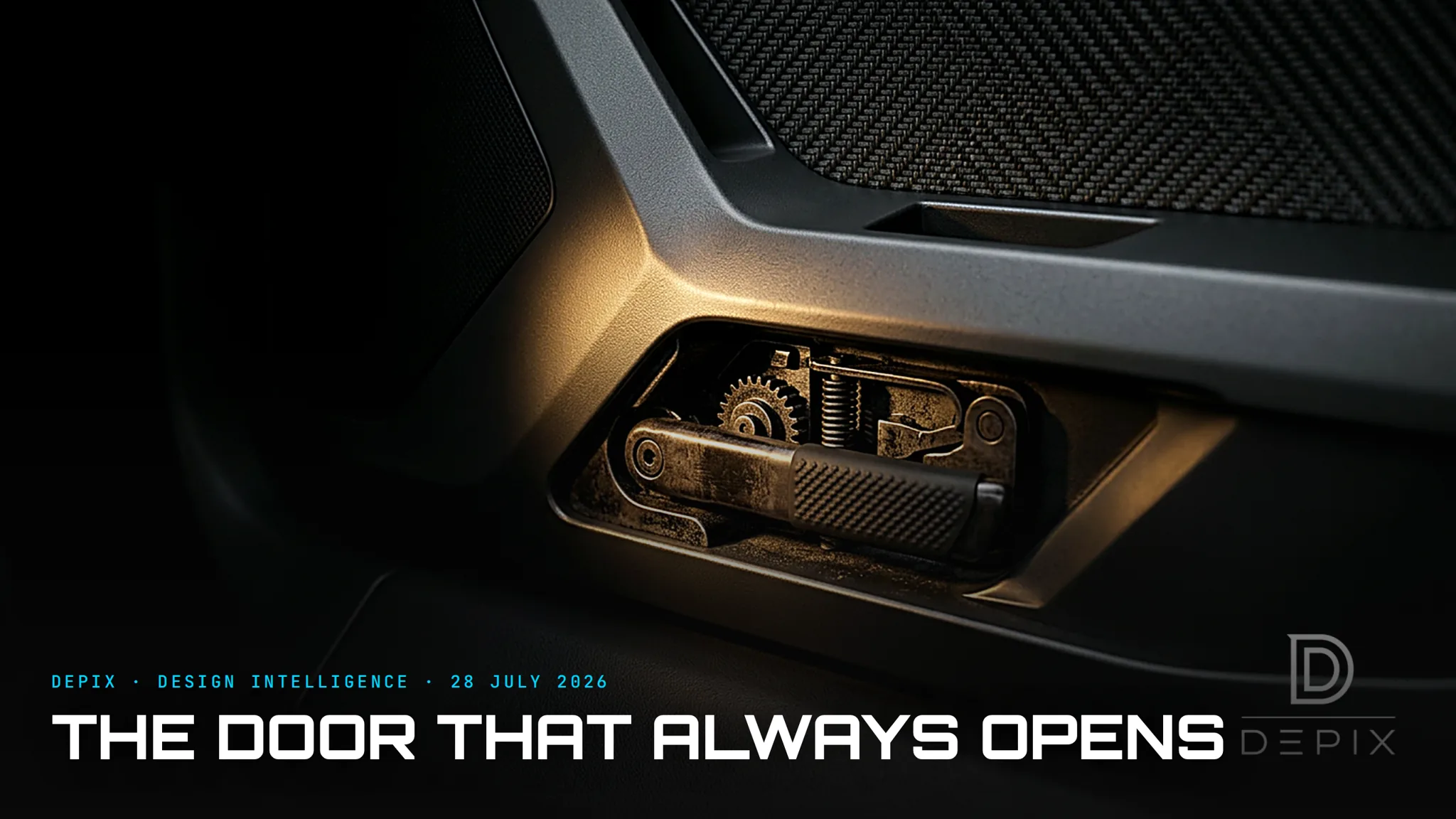
I will not sign off on a car whose only way out is electricity. That is my line, and I set it at the concept phase, before a single surface is styled, because this is not a trim decision that can be walked back later. Every door on every vehicle I touch gets a mechanical, tactile, blind-findable emergency release. You should be able to find it in the dark, with smoke in your eyes, with the twelve-volt system dead and your hands shaking. If it needs a manual, a torch, or a YouTube tutorial, it has already failed. A door is the one part of a car you may need to operate when everything else has stopped working, so it is the one part that must never depend on everything else working.
I hold this position because the evidence is now brutal and public. A Bloomberg review of federal crash data found at least fifteen people have died in Tesla crashes since 2012 after doors would not open following an impact, several in cars that caught fire. Regulators are no longer treating this as an edge case. In the United States, NHTSA denied a narrow defect petition but opened full rulemaking on emergency egress, and the agency had already been investigating Model Y complaints from parents whose children were trapped in the back when the electronic locks lost voltage. TechCrunch reported the same trajectory: flush, electronic handles are now the thing the safety establishment is circling.
China moved first and hardest. In January 2026 it approved GB 48001-2026, a mandatory standard that effectively bans purely electronic flush handles and requires a mechanical emergency release on both the inside and outside of every passenger door. Electrek covered the finalisation, NPR framed it as a rebuke of a design Tesla popularised, and TechSpot put it plainly: the futuristic handle is now the dangerous one. When the world's largest car market writes your safety argument into law, the debate is over.
Here is the part designers hate to hear. The manual releases that do exist are frequently useless in the moment that counts. Bloomberg found rear releases hidden under floor mats, behind speaker grilles, and beneath plastic trim, and Consumer Reports had to publish a guide teaching people where to grope for them. InsideEVs ran a similar survival explainer. If your escape hatch requires an owner to have read a feature article in advance, you have not built a safety feature, you have built a puzzle.
This is where I invoke poka-yoke, the mistake-proofing principle from the Toyota Production System. The ASQ definition is precise: a device or method that makes an error impossible, or makes it immediately obvious. Applied to egress, this means the release must be operable by a panicking adult who has never seen the car before, and ideally by a frightened child in the dark. The correct action must be the obvious action. A recessed grip that your hand falls into and pulls is poka-yoke. A capacitive pad that depends on a live battery is its exact opposite, a device that fails silently and invisibly at the worst possible instant.
I know the objections, because I have made them myself. Flush and electronic handles are cleaner. They shave aerodynamic drag, they simplify the surfacing, they cut a few parts and a few dollars, they photograph beautifully. NHTSA and Chinese regulators reviewing the same hardware have concluded those gains do not survive contact with a real crash. I agree with them. A tenth of a percent of range is not worth a coroner's report.
The reason this is a concept-phase decision and not a late fix is structural. The mechanical release path dictates the door module, the wiring loom, the interior trim break lines, the B-pillar packaging, and where your hand naturally lands. Try to add a proper blind-findable lever after the interior is signed off and you get exactly the compromised, mat-hidden afterthoughts that are now killing people. Set it as a non-negotiable at the concept, and every downstream surface bends around it cleanly. That is the whole thesis in one bracket: the earliest choices are the load-bearing ones. Move the decision late and it becomes a negotiation; make it first and it becomes a constraint everyone else designs around.
So this is not styling and it is not open for value-engineering. A car is a room that can catch fire, and a room you cannot leave without electricity is not a car, it is a trap with a warranty. Give me the lever I can find with my eyes shut.
Sources:
- ●At Least 15 People Have Died in Tesla Crashes Due to Faulty Electric Doors - Autoblog
- ●NHTSA denies Tesla door-release defect petition, opens new door rules - Electrek
- ●NHTSA opens probe into Tesla Model Y door handle failures - CBT News
- ●Tesla's door handles may spur new US safety rules - TechCrunch
- ●China Bans Flush Door Handles on Cars: GB 48001-2026 Explained - ChinaStandards
- ●China finalizes proposed ban on Tesla-style hidden door handles for safety - Electrek
- ●China bans hidden car door handles, a design popularized by Tesla - NPR
- ●Flush door handles were futuristic, now China says they're too dangerous - TechSpot
- ●How to Escape Your Car If the Electronic Door Release Fails - Consumer Reports
- ●So You Just Got Trapped In Your EV With Electronic Door Latches: What To Do - InsideEVs
- ●Poka-yoke - Wikipedia
- ●What is Poka-Yoke? Mistake & Error Proofing - ASQ
- ●NHTSA investigates Tesla emergency mechanical door handles; China bans flush EV handles - Repairer Driven News