The Ritual Pod
There was a ritual, and almost nobody chose it deliberately. You pushed a knurled knob into the dashboard, waited for the faint tick, and pulled out a glowing orange coil. For most of a century this was standard equipment in nearly every car built, so common that we stopped seeing it as a design decision at all. The electric cigar lighter was patented in the early 1880s, but it only reached cars once they carried batteries, arriving as fitted equipment in American cars around the mid 1920s and hardening into an industry standard by the 1950s, as History Garage recounts. The plug geometry was eventually codified so tightly that, as Jalopnik once argued, the humble socket became the original universal car hack, the one power port every accessory maker could rely on.
Then the thing it was built for went away. Smoking rates in the developed world collapsed, from something like 42 percent of American adults in 1964 to a small fraction today, a public health turn that Greater Greater Washington frames as one of the great behavioural victories of the century. Legislation followed the culture. Britain made it an offence to smoke in a car carrying a child from October 2015, a rule the UK government still publishes and Car Magazine covered at the time. The ashtray quietly vanished from the options list. The lighter, curiously, did not. Manufacturers kept the socket, dropped the heating element, and rebranded the hole as a twelve volt power outlet, a lineage the Wikipedia entry on the auxiliary power outlet traces cleanly. As Motor1 and Hackaday both note, most drivers under thirty have never lit anything with the port they charge a phone from, and the RS technical guides now describe it purely as a legacy power source living on borrowed time.
Here is the part designers should sit with. When the object died, the cavity survived. A warm, lit, hand sized recess at the centre of the cabin, positioned exactly where the eye and the hand fall at rest, is spatial real estate that no touchscreen can replace. It is the one place in the cabin your hand finds without looking, and that muscle memory is worth designing around. We have already begun refilling it clumsily. The wireless charging pad arrived, pioneered in the console of the 2013 Toyota Avalon as Kelley Blue Book reported and now a near standard fitting governed by the Qi protocol that Aptiv explains. Fragrance came back too, most visibly through the Mercedes-Benz Air Balance system, described by Mercedes-Benz of Bellevue, which pulses a calibrated scent into the cabin at controlled intervals. We have the ingredients. We have not yet combined them into a ritual.
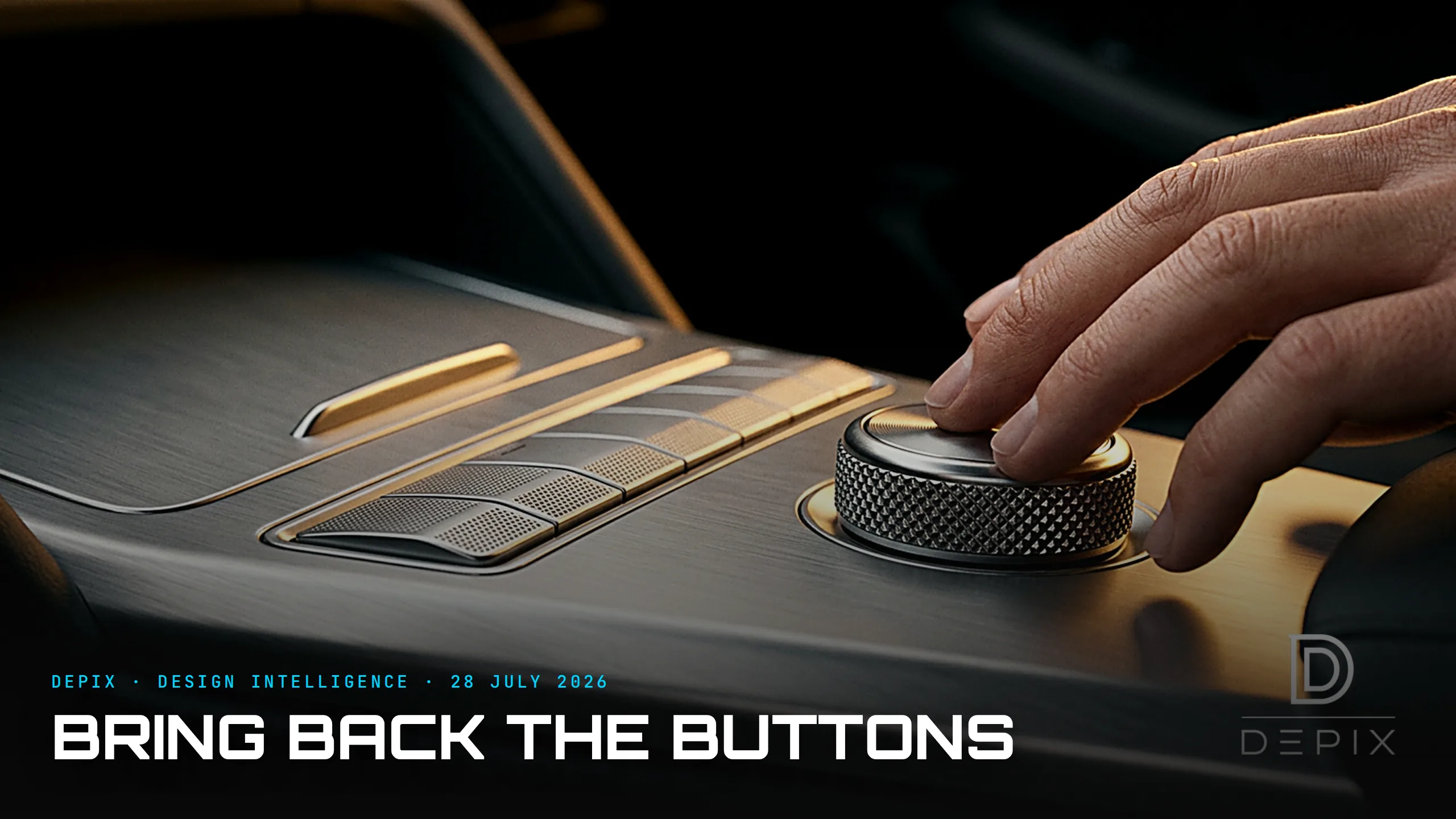
So reimagine the cavity for 2030 as a wellness pod. Picture a sealed, softly lit recess where the ashtray sat. Drop a phone in and it charges without a cable. Close the lid and the pod becomes a small climate of its own, warming a flask of tea on a winter commute or chilling a water bottle in July. At a long red light, or the moment you park, it releases a metered breath of a scent you have tuned, bergamot to wake up, cedar to wind down, coordinated with the cabin lighting the way the ENERGIZING packages already gesture toward. The old smoke break was never really about nicotine. It was a sanctioned pause, a reason to stop, exhale, and be still for ninety seconds. The pod gives that pause back, stripped of the harm.
This is the concept-phase lesson, and it is the whole point. What a cavity is for is not decided by the trim team or the styling studio. It is decided years earlier, in the concept phase, when someone draws a box and labels its purpose. Get that label wrong and no amount of beautiful surfacing rescues it. The engineers who kept the lighter socket alive for two decades after smoking died were not being lazy, they were being honest about a truth they could not name. The hole was load-bearing. It held a ritual, and rituals outlive the objects that carry them. The real design brief was never the lighter, or the ashtray, or the pad, or the atomiser. It was the pause. Name the ritual at the concept phase and the object designs itself. Name only the object, and you will spend a century missing the point.
Sources:
- ●The Birth & Death Of The Automobile Lighter — History Garage
- ●A Tribute To The Cigarette Lighter Plug, The Original Car Hack — Jalopnik
- ●Driving is the new smoking — Greater Greater Washington
- ●Smoking in vehicles — GOV.UK
- ●Britain bans smoking in cars carrying children from 1 October 2015 — Car Magazine
- ●Automobile auxiliary power outlet — Wikipedia
- ●Car Cigarette Lighter: How Does It Work? — Motor1
- ●How Much Longer Will Cars Have Cigarette Lighter Ports? — Hackaday
- ●Why Cars Still Have Cigarette Lighter Sockets — RS
- ●2013 Toyota Avalon first with in-console Qi wireless charging — Kelley Blue Book
- ●What Is the Qi Standard in Automotive? — Aptiv
- ●What is the Mercedes-Benz Air Balance System? — Mercedes-Benz of Bellevue