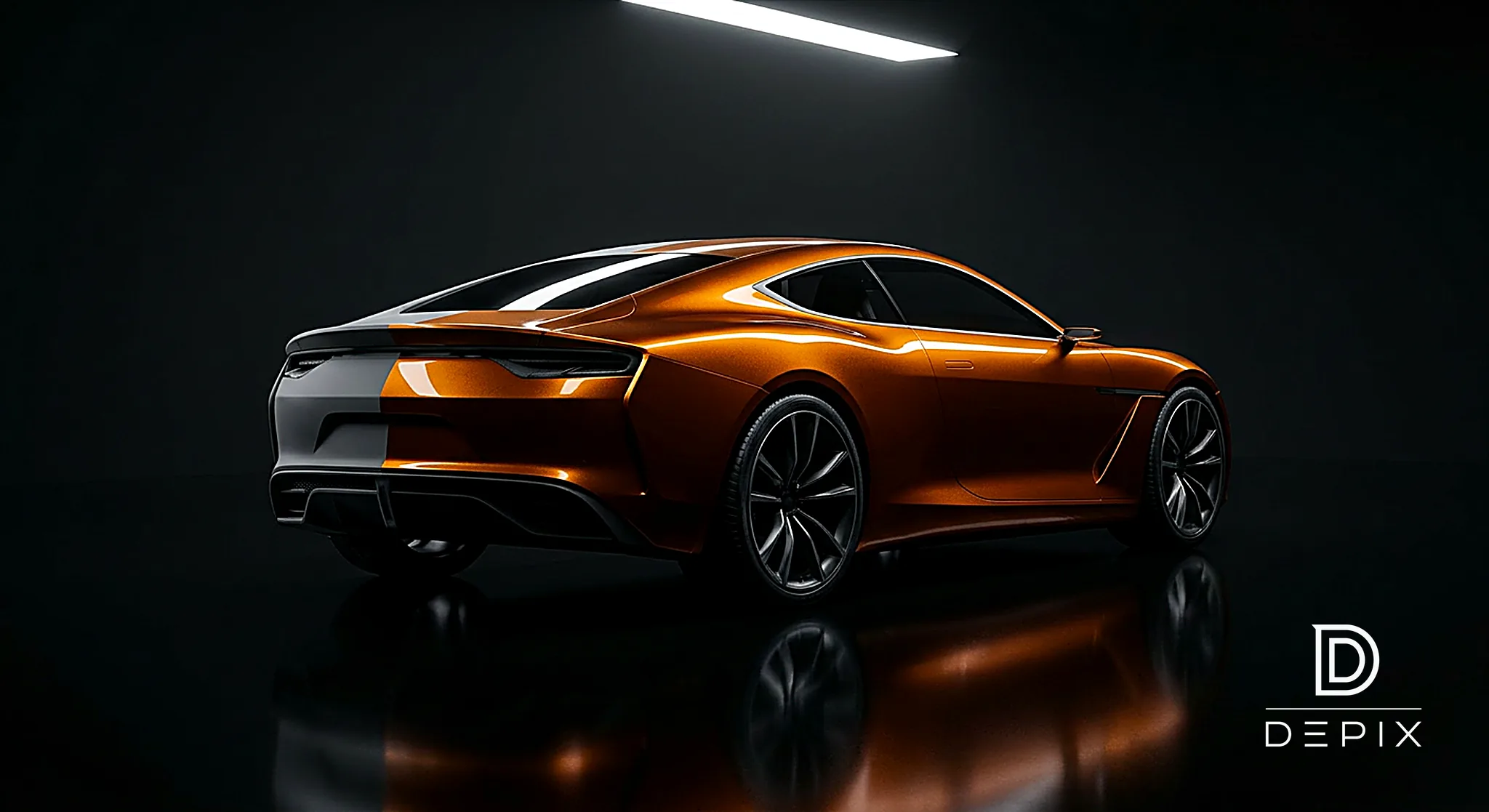
The most emotional decision in the building is now the one nobody dares to make
For a hundred years, colour was the loudest thing a car could say about itself — Guards Red, British Racing Green, a Plymouth in 1970 that came in Vitamin C Orange and In-Violet and Lime Light. Today four out of five new cars roll off the line in white, black, grey or silver, and the studio's single most emotional surface — the one decision a stranger reads from across the street — has been quietly handed to a spreadsheet about resale risk. The reveal render is always painted the hero hue: a deep, saturated, impossible colour that maybe one buyer in twenty will tick. The car the studio actually sells is grey. And the cruellest part, sitting in the data the whole time, is that the colour everyone avoids to protect their money is the colour that holds its money best.
The contested surface here is the body colour — the paint, the single largest, most visible, most emotional design decision on the entire car, and the only one a person standing fifty feet away can read instantly. For most of automotive history it was a point of pride and a brand cue: a marque was a colour before it was a shape. It is now the most quietly surrendered decision in the building. Global paint data for 2025 says it plainly — and the gap between the colour the studio renders and the colour the world buys has become one of the widest, least-examined chasms in car design.
Four out of five cars are now greyscale — and that is new
The numbers are not subtle. Axalta's 73rd annual Global Automotive Color Popularity Report, released 16 December 2025, found white leading at 29%, black at 23% and grey at 22% — the achromatic neutrals (white, black, grey, silver) together accounting for 74% of every vehicle built worldwide; silver added 7%, and blue, the strongest chromatic colour on earth, managed just 6% (Axalta, 16 Dec 2025). BASF's Color Report 2025, released 15 January 2026, put a finer point on the retreat from colour: grey rose another two percentage points, red collapsed to just 3% of the global market, and solid colours — the plain, confident, single-pigment hues — shrank to only 18% of everything sold (BASF, 15 Jan 2026).
This is not how it always was, and that is the point. As recently as the late 1990s the split between greyscale and everything-else was closer to 50/50, the decade was loaded with jewel tones and vibrant metallics, and more than 20% of vehicles sold in North America were green (CarBuzz, Nigel Evans, 11 Apr 2026). Greyscale's share has climbed from roughly 60% in 2004 to about 80% of the American market today. A buyer in 1996 walked into a showroom and chose from a wall of colour. A buyer in 2026 chooses, overwhelmingly, between four shades of nothing. The most expressive surface on the product has been draining of expression for a quarter of a century, one model cycle at a time, with no single person ever deciding to kill colour.
Nobody killed colour — a spreadsheet did
There was no edict. Colour was strangled by a stack of rational, defensible, individually-correct business decisions, and the same reporting lays them out. The turning point was the 2008 financial crisis: as GM and Chrysler went bankrupt and survival meant simplifying production, cutting the paint palette was one of the easiest costs to take out (Eastwood / industry histories, via CarBuzz, 11 Apr 2026). The paint shop is one of the most complex and expensive parts of any assembly plant; every colour change means re-sequencing vehicles and purging the spray guns, so a factory that builds fewer colours in bigger batches simply costs less to run. A brand-new colour can take five years or more to develop and validate. Exotic metallics and translucent finishes are harder and costlier to match in collision repair, which feeds back into insurance and residuals. And so automakers narrowed the standard palette to a safe neutral core and moved the interesting colours behind a paywall — Mazda charges around $595 extra for a specialty metallic on a CX-5 versus the base white (CarBuzz, 11 Apr 2026). Every one of those moves is defensible on its own. Stacked together, they amount to an industry that has made colour expensive to offer, expensive to buy, and frictionless to avoid — and then concluded, looking at the resulting sales mix, that customers "want" grey.
Buyers finish the job the factory started. With car prices and interest rates high, a vehicle is increasingly treated as a financial asset, and a neutral colour is read — by the buyer and the future used-car buyer — as the lower-risk holding. People fear they will tire of a bold colour, or that it will date, or that it will be hard to sell on. So they default to grey "to protect resale." This is the received wisdom of the entire market, the quiet logic behind 74% of the world's cars. It is also, according to the data, wrong.
The paradox the whole market is built on backwards
Here is the part that should stop a product chief mid-sentence. In June 2025 iSeeCars analysed depreciation across 1.2 million three-year-old used cars, and the safe-colour logic inverted. The colours everyone chooses to protect their money — white, black, and gold — depreciated most, losing over $15,000 in value across three years. The colours buyers avoid as "risky" — yellow, orange and green — held value best, shedding only roughly $9,951 to $13,667 over the same period (iSeeCars via Yahoo, 5 Jun 2025). The colour-based spread between the best- and worst-holding shades on otherwise identical cars ran as much as 10%, around $5,000. The mechanism is plain supply and demand: when 80% of the market is greyscale, a grey car competes against an ocean of identical grey cars and its price gets flattened; a clean yellow one is scarce, and scarcity holds price.
So the central justification for the achromatic car park — "neutral protects my resale" — is contradicted by a study of over a million actual transactions. The market has talked itself into a colour strategy on a premise the evidence refuses to support. Four out of five buyers are choosing the financially weaker option because they believe it is the financially safer one. That is not a taste trend. That is a decision the entire industry is making in the wrong direction, at the scale of nearly every car sold, on a belief nobody pressure-tested.
The four rooms, the one colour, and the buyer who never sees the wall
Four parties touch the body colour and none of them is deciding the same thing. The exterior designer and the CMF (colour-materials-finish) team see the brand's emotional signature — the hero hue the launch car wears, the colour that should make the shape mean something, the one a stranger reads as joy or menace or restraint. The product and finance team see the palette as a cost-and-mix problem — fewer colours, bigger batches, premiums on the interesting ones, residual-value risk on the exotic ones. The marketing team renders and bills the most saturated, most flattering colour in the range, because that is the image that sells the shape. And the buyer — the person who actually picks — stands in a configurator months later and, terrified of a resale penalty that the data says is mostly imaginary, clicks grey. Four rooms, four different objects, and the one decision they supposedly converge on is the single most emotional thing on the car. The colour that defines the brand is set by the room that fears the future used-car listing.
The render is the one lie the studio tells itself
This is the recurring trap, and colour is its purest form. Every reveal, every press shot, every configurator hero image is painted in the boldest colour the programme offers — the deep metallic green, the molten orange, the saturated blue that exists precisely because it photographs like a dream. The studio falls in love with the car in that colour, signs off the shape in that colour, and bills the campaign around it. Then the line builds white, black and grey, because that is the mix the dealers order and the buyers tick. The car that earns the studio its applause and the car that fills the car park are, chromatically, two different products — and the difference is invisible at every point where the decision is actually made, because the decision is made in front of the one colour almost nobody will buy. The CMF craft pours itself into a hero hue that ends up a rounding error in the sales mix, while the colour that will define the brand on the road — the grey — is the one nobody ever put on the wall and argued for.
Where the decision goes wrong — and what we do about it
The mistake is letting the most emotional surface on the car be set by default: rendered in a colour for applause, sold in a colour for fear, and never once examined as the deliberate brand decision it is. The reveal says "saturated, confident, alive." The car park says "grey, again." And the resale logic that drives the gap is contradicted by a study of 1.2 million cars that the room making the call has never been shown.
This is the gap DEPIX Design Intelligence exists to close. Not to pick the brand's colour — to put the call (which hue carries the brand, what the realistic mix actually looks like on the road, and whether "safe grey" is the asset the buyer thinks it is) in front of the design chief as photoreal evidence in the states the hero render structurally hides: the new shape rendered not only in the impossible launch green, but across the colours people will actually buy — the white, the black, the grey — so leadership signs off the car it will truly sell, not the one it wishes it sold; the realistic colour mix shown as a real street scene, so "is our shape strong enough to survive being grey?" is answered with a picture, not a hope; and the bold, scarce, value-holding option shown beside the safe, ubiquitous, value-flattening one, with the depreciation evidence attached, so the brand can decide — eyes open — whether to keep surrendering its signature to a resale fear the data does not support. Side by side, at decision time, while the palette is still a set of chips and the configurator is still unwritten — not after another five-year colour-development cycle, another fleet of grey, and another generation of buyers talked into the weaker bet.
The point of design intelligence is to use the intelligence of AI to make the better decision before the palette is locked, the hero hue is wasted, and the brand dissolves into the achromatic ocean with every rival. Render the impossible launch colour — of course. Then render the four colours the car will actually wear, put the resale truth next to the resale myth, and decide which colour the brand is willing to be — not just the one it is willing to photograph. The photoreal output is the evidence. The decision is the product.
Sources
- ●Axalta Coating Systems — "Axalta Releases 2025 Global Automotive Color Popularity Report" (73rd annual report; global: white 29%, black 23%, grey 22%, silver 7%, blue 6%; achromatic neutrals white+black+grey+silver = 74% of all vehicles; Europe grey 26% / white 25% / black 22%; North America white 31%, blue 10%, red 7%; Dr. Lei Qiao, VP Technology, Mobility Coatings: "Overall, the 2025 landscape reflects a market anchored in simplicity yet increasingly open to refined color expression and contemporary finishes"), 16 Dec 2025 — https://newsroom.axalta.com/posts/pressreleases/axalta-releases-2025-global-automotive-color
- ●BASF Coatings — "BASF Color Report: Green and gray redefine the 2025 automotive color landscape" (grey up two percentage points; red down to just 3% of the global market; solid colours shrink to 18% of the market; green the strongest-growing chromatic colour, into the global Top 3; Florina Trost, Design EMEA, BASF Coatings, quoted on the breadth of shades in the Automotive Color Trends collection), 15 Jan 2026 — https://www.basf.com/global/en/media/news-releases/2026/01/p-26-Coat01
- ●CarBuzz — "The Real Reason Car Colors Got Boring" (Nigel Evans; greyscale ~80% of the current market, up from ~60% in 2004; late-1990s split closer to 50/50 with jewel tones and >20% green in North America; 2008 financial crisis as the turning point when GM/Chrysler simplified production and cut paint options; paint shop as the most complex/expensive part of assembly, re-sequencing and gun-purging costs of colour changes; a new colour taking five-plus years to develop; exotic finishes harder/costlier to repair; Mazda CX-5 ~$595 premium for specialty metallic over base), 11 Apr 2026 — https://carbuzz.com/real-reason-car-colors-got-boring/
- ●iSeeCars (reported via Yahoo Autos) — car-colour depreciation study of over 1.2 million three-year-old used vehicles (white, black and gold lost over $15,000 in value over three years — the worst performers and the overwhelming majority of new-car paint colours; yellow, orange and green held value best, losing roughly $9,951–$13,667 over the same period; colour-based depreciation spread as much as ~10% / ~$5,000 between best- and worst-holding shades on identical vehicles; rarer distinctive colours hold value better on supply-and-demand grounds), 5 Jun 2025 — https://autos.yahoo.com/paint-colors-decrease-cars-resale-202500663.html
- ●The Monday Economist — "Why Aren't Cars as Colorful as They Used to Be?" (reference feature on the long decline of automotive colour and the cost/risk forces driving the shift to neutral palettes) — https://www.mondayeconomist.com/p/car-colors

The Jewel in the Wheel Was Always a Lie. Now It's on a Regulator's Clock.

The front end that sells the truck is the one the pedestrian in front of it doesn't survive
Related posts

The bridge of air where the gearstick used to be — the console the studio floats for the look, that the elbow and the loose phone never agreed to

The clean pad that cooks the phone it charges — the cabin feature sold as the cableless future, that a fifty-cent wire still beats on every metric that matters

The rails on the roof that carry nothing — the one styling cue that promises a life the car will never live, and quietly taxes the range to do it